Photo: Wikipedia
Demographics of Oktibbeha County
Affluence Level in Oktibbeha County
A below-average socioeconomic profile. Incomes, home values, and educational attainment trail the U.S., with higher poverty and unemployment.
People of Oktibbeha County
Today, Oktibbeha County, Mississippi, is home to roughly 51,500 residents, a population shaped by the dual forces of a historic Black Belt agricultural economy and the modern presence of Mississippi State University in Starkville. The county’s character is defined by a majority-white population (55.2%) alongside a substantial Black community (36.1%), with a small but growing Asian and Indian presence driven largely by the university and its research sectors. With 45.8% of adults holding a college degree—far above the state average—the county blends Deep South tradition with a distinctly educated, youthful, and increasingly diverse professional class.
Settlement & growth (pre-1960)
Long before European settlement, the area now known as Oktibbeha County was the domain of the Choctaw people, who established villages along the Noxubee River and its tributaries. The name "Oktibbeha" itself is derived from a Choctaw word meaning "icy water" or "blood in the water," reflecting the region's creeks and springs. The Choctaw were forcibly removed via the Treaty of Dancing Rabbit Creek in 1830, opening the land to white settlement.
American settlers—primarily Scots-Irish and English yeoman farmers from the Upper South—poured into the area in the 1830s and 1840s, drawn by fertile, rolling hills ideal for cotton cultivation. They established the county seat at Starkville (originally called Boardtown) and smaller hamlets like Longview, Maben, and Sturgis. By 1850, the county's economy was firmly built on enslaved African American labor, with Black people making up a majority of the population—a pattern that persisted through Reconstruction and into the 20th century.
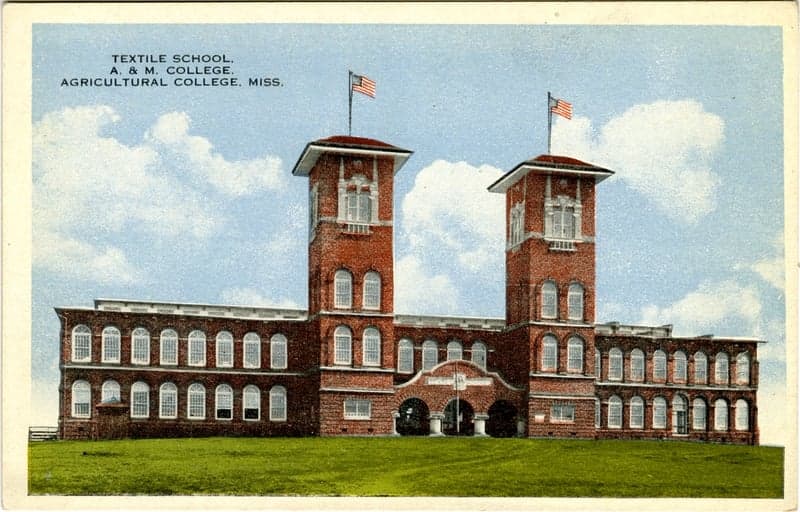
After the Civil War, freedmen and their descendants remained in the county as sharecroppers and tenant farmers, forming the backbone of the rural Black community. The founding of Mississippi A&M College (now Mississippi State University) in Starkville in 1878 brought a new, predominantly white professional class to the county, but the broader population remained overwhelmingly agricultural and racially divided. The Great Migration (1910–1970) saw tens of thousands of Black Mississippians leave the state for Northern industrial cities, but Oktibbeha County's Black population remained relatively stable due to the anchor of the university and local farming. By 1960, the county was roughly 60% Black and 40% white, with a total population of about 24,000.
Modern era (post-1965)
The 1965 Hart-Cellar Act had a modest direct impact on Oktibbeha County compared to coastal metros, but its indirect effects—combined with the growth of Mississippi State University—reshaped the county's demographics. The university's expansion in engineering, agriculture, and veterinary medicine began attracting international graduate students and faculty. The first wave of East/Southeast Asian immigrants (primarily Chinese and Vietnamese) arrived in the 1970s and 1980s, settling almost exclusively in Starkville near the campus. Today, East/Southeast Asian residents make up 1.8% of the county's population, with a visible concentration in the university-area neighborhoods and the Old West Main historic district.
Indian subcontinent immigration began later, accelerating in the 1990s and 2000s as Mississippi State recruited heavily in engineering and computer science. Indian residents now account for 1.1% of the county's population, and they are overwhelmingly concentrated in Starkville, particularly in newer subdivisions like The Cottages at South Montgomery and near the university's research park. Unlike many Southern counties, Oktibbeha's Indian community is not an enclave of small-business owners but rather a highly educated professional cohort tied to the university and its spin-off tech firms.
Domestic migration has been equally transformative. Since the 1980s, the county has seen a steady influx of white professionals from other parts of Mississippi and the broader South, drawn by university jobs, the growing healthcare sector (Oktibbeha County Hospital), and the relatively low cost of living. This has shifted the racial balance: the white share of the population rose from roughly 40% in 1960 to 55.2% today, while the Black share declined from 60% to 36.1%. Suburbanization has played a key role, with new subdivisions spreading south and east of Starkville into areas like South Farm and Adaton, while the historic Black neighborhoods in Starkville's north side (such as Northside and Green Oaks) have seen population stagnation.
The Hispanic population remains small at 2.4%, but it has grown steadily since 2000, driven by construction and landscaping work. Hispanic residents are dispersed across the county, with small clusters in Starkville and the rural community of Bradley. The foreign-born share of the population is just 3.4%, reflecting the county's limited role as an immigrant destination compared to Mississippi's Gulf Coast or the Memphis suburbs.
The future
Oktibbeha County is becoming slightly more diverse, but the pace is slow. The white population is projected to remain the majority for the foreseeable future, while the Black population share is likely to continue a gradual decline as older rural residents pass away and younger Black professionals leave for larger metros. The Asian and Indian populations will grow modestly, driven by Mississippi State's continued recruitment of international students and faculty, but they will remain small enclaves in Starkville rather than spreading countywide. The Hispanic population is the fastest-growing segment, though from a very low base, and is expected to double to around 5% by 2040, with new arrivals settling in Starkville and the Maben area.
Culturally, the county is becoming more polarized between the university-centered, college-educated population in Starkville and the older, more rural communities in Sturgis, Longview, and Maben. The university's influence is pulling the county toward a more secular, diverse, and politically moderate identity, while the rural areas remain deeply conservative and tied to traditional Southern culture. This tension is likely to intensify as Starkville continues to grow and the surrounding unincorporated areas shrink.
For someone moving in now, Oktibbeha County offers a rare combination: a deeply rooted Black Belt history, a vibrant university town, and a low cost of living. The county is becoming more educated and more diverse, but it remains a place where the old racial and cultural divisions of the Deep South are still visible—and where the future will be shaped by the ongoing contest between the university's cosmopolitan pull and the county's rural, conservative foundation.

* Values derived from national, state, county, city and local statistics and may differ in a specific area. Last updated: 2026-06-17T23:16:45.000Z
Narrative content on this page is AI-generated and may contain mistakes. Verify any details that matter before acting on them.
ReloMaps may earn a commission from affiliate links at no extra cost to you.

