
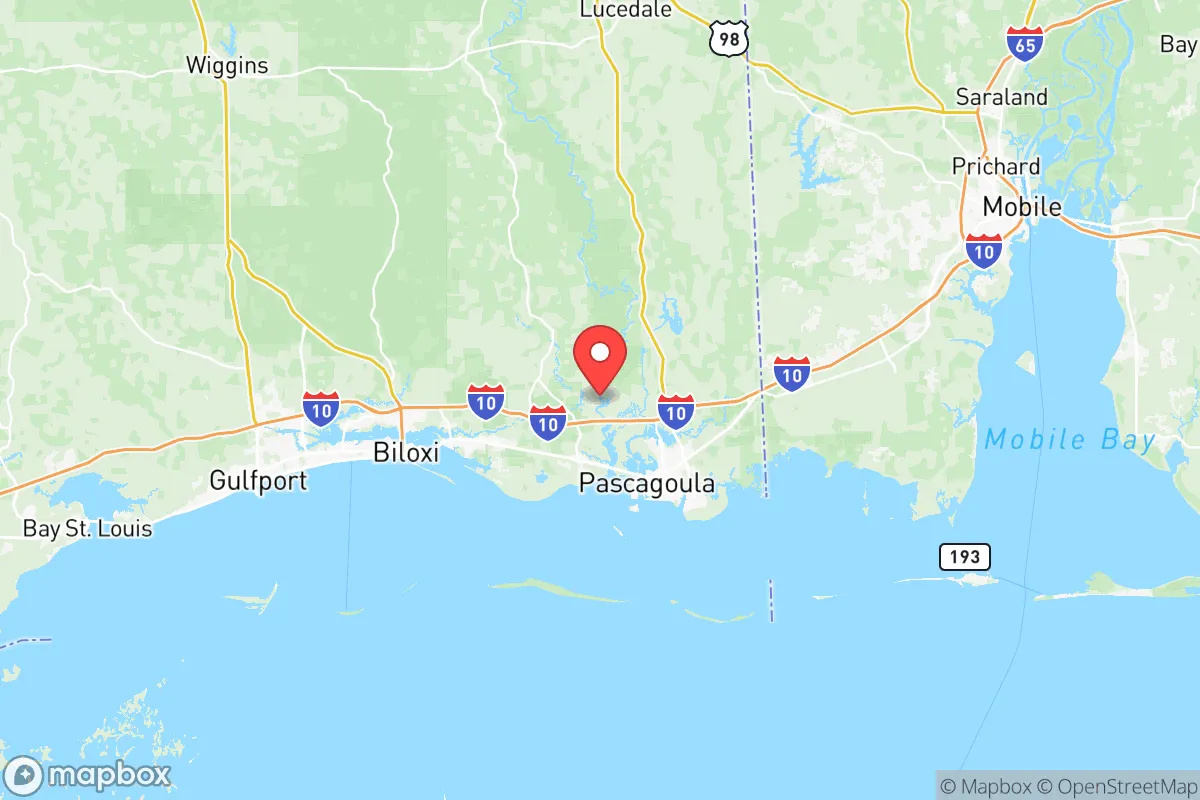
Photo: Wikipedia
Political ClimatePolitical Climate in Jackson County
Showing district-level results — no local-only data available.
Local Political AnalysisPolitical Analysis of Jackson County
Jackson County, Mississippi, is a solidly conservative area with a Cook PVI of R+21, making it significantly more Republican than the state as a whole, which sits at R+11. This isn't a new development; the county has been a reliable red stronghold for decades, but the margin has widened in recent cycles as the rural and suburban precincts have pulled further right. The real story, though, is the growing divide within the county itself, where a few pockets are starting to shift in a way that has folks like me watching the local elections a little closer.
How it compares
The ten-point gap between Jackson County (R+21) and Mississippi (R+11) is substantial. It means that while the state can sometimes be competitive in certain races—especially for statewide offices—Jackson County is rarely in play. The county's politics are driven by its strong military and industrial base, with places like Pascagoula and Moss Point historically voting Republican thanks to the shipyard and refinery workers who prioritize national security and energy independence. However, there's a noticeable split. The more rural, inland areas like Vancleave and Hurley are deep red, often voting 75% or more for GOP candidates. On the other hand, Ocean Springs has become a bit of a wildcard. It's still conservative overall, but its younger, more educated population has introduced some swing precincts that can tip toward the center, especially on local issues. You'll see a few more "Blue Dog" Democrat signs in yards there than you will in the rest of the county. The coastal towns, especially Gautier, are a mixed bag—solidly red on national issues but more pragmatic on local ones, like infrastructure and hurricane recovery.
What this means for residents
For the most part, living here means you're not dealing with the kind of government overreach you see in more progressive parts of the country. The county commission and local school boards are overwhelmingly conservative, which means property taxes stay relatively low, and there's a general hands-off approach to personal freedoms—especially when it comes to gun rights and how you run your small business. That said, the creeping influence of progressive ideology is a real concern. You see it in the push for "equity" initiatives in the larger school districts and in the occasional zoning fight where outside groups try to impose denser, more "sustainable" development patterns that ignore how folks actually want to live here. The biggest red flag for me is the potential for the state or federal government to override local control on things like energy policy, which could directly threaten the shipbuilding and refining jobs that keep this county running. If that happens, you'll see a real backlash.
The cultural distinction in Jackson County is that it's a place where your word and your work ethic matter more than your party registration. Most folks here are practical conservatives. They don't like being told what to do by Jackson or Washington, and they value the quiet, self-reliant lifestyle that the Gulf Coast offers. The biggest shift I've seen in my time here is the slow erosion of that independent spirit in the more suburban areas, where some are starting to accept the idea that government needs to solve every little problem. That's the real battle for the future of this county—keeping it a place where personal responsibility and freedom still mean something, rather than sliding into the kind of managed, bureaucratic existence you see in other parts of the country. For now, though, Jackson County remains a place where a conservative can still breathe easy.

State Political ClimatePolitical Climate in Mississippi
State Political AnalysisPolitical Environment in the State
Mississippi is one of the most reliably conservative states in the country, with a Cook Partisan Voting Index of R+11, meaning it votes about 11 points more Republican than the national average. The state hasn’t voted for a Democratic presidential candidate since 1976, and every statewide elected official is a Republican. Over the last 10–20 years, the shift has been steady but not dramatic—rural areas have hardened their GOP allegiance, while the Jackson metro area has become a Democratic stronghold, creating a sharper urban-rural divide than ever before.
Urban vs. rural divide
The political map of Mississippi is a study in contrasts. The Jackson metro area (Hinds, Madison, and Rankin counties) is the state’s most Democratic-leaning region, driven by a large African American population and a growing progressive activist base in the capital city itself. Hinds County went +38 for Biden in 2020. Just 15 miles north, Madison County is one of the wealthiest and most Republican counties in the state, voting +27 for Trump. The Gulf Coast, anchored by Biloxi and Gulfport, leans Republican but with a libertarian streak—military veterans and casino workers tend to favor low taxes and gun rights over social crusading. The Delta region, including Greenville and Clarksdale, is heavily Democratic due to its majority-Black population, but turnout is low and the region’s political influence is shrinking as population declines. The northeastern hill country around Tupelo and Oxford is reliably Republican, though Oxford’s university population (Ole Miss) injects a small but visible liberal presence. The Pine Belt, anchored by Hattiesburg, is a mix—the city itself leans Democratic, but surrounding Forrest and Lamar counties are solidly red. The rural counties along the Alabama border, like Lauderdale County (Meridian), are deeply conservative and have only gotten more so as the national Democratic brand has soured.
Policy environment
Mississippi’s policy environment is among the most conservative in the nation. The state has no income tax on Social Security benefits and a flat 4% income tax rate on most other income, with a phase-down to 3.99% by 2026. Property taxes are among the lowest in the country—the median effective rate is about 0.81%—and there is no estate or inheritance tax. The state is a “right-to-work” state, meaning union membership is optional, and it has some of the weakest labor protections in the country. Education policy is a mixed bag: the state has a school choice program (the Mississippi Education Scholarship Account) that covers special needs students, but there is no broad voucher system. Public schools are chronically underfunded, and the state ranks near the bottom nationally in NAEP scores. Healthcare is a major concern—Mississippi did not expand Medicaid under the ACA, leaving roughly 200,000 low-income adults in a coverage gap. The state has some of the strictest abortion laws in the country, with a near-total ban in effect since the Dobbs decision. Election laws are moderately restrictive: voter ID is required, early voting is limited (no-excuse absentee voting was expanded in 2024 but still requires a notary or witness), and same-day registration is not allowed. The state has not seen the kind of election integrity controversies that have roiled Georgia or Arizona, but there is persistent concern among conservatives about the integrity of mail-in ballots in the Delta.
Trajectory & freedom
On balance, Mississippi has been moving in a more free direction over the last decade, especially on gun rights and parental rights. In 2024, the legislature passed a permitless carry law (HB 1083), allowing any law-abiding adult to carry a concealed firearm without a license. The state also passed a “Parents’ Bill of Rights” (SB 2360) in 2023, requiring schools to notify parents of any changes to a child’s mental, emotional, or physical health and to obtain parental consent before administering any health care services. On medical freedom, Mississippi was one of the first states to ban COVID-19 vaccine mandates for state employees and contractors (SB 2689, 2022). However, the state has not expanded medical marijuana beyond a limited program (the Mississippi Medical Cannabis Act of 2022), and recreational use remains illegal. Property rights are strong—the state has no statewide zoning laws, and most counties have minimal land-use regulation. The biggest threat to freedom in Mississippi is arguably the state’s high incarceration rate (the highest in the country) and its criminal justice system, which still imposes mandatory minimum sentences for some drug offenses. There is a growing bipartisan movement for criminal justice reform, but it has not yet produced major legislative changes.
Civil unrest & political movements
Mississippi has a relatively low level of visible civil unrest compared to other states. The most significant protest activity in recent years has been around the Jackson water crisis in 2022–2023, where residents of the capital city (predominantly Black and Democratic) protested the state government’s slow response to a catastrophic failure of the city’s water system. That crisis also sparked a broader movement around environmental justice and infrastructure funding. On the right, there is an active “constitutional sheriff” movement in several rural counties, where sheriffs have publicly stated they will not enforce any federal gun control laws. Immigration politics are less heated than in border states, but there is a vocal minority pushing for stricter enforcement of E-Verify requirements. There have been no serious secession or nullification movements in Mississippi since the 2010s, though the state legislature did pass a resolution in 2021 affirming the state’s sovereignty under the Tenth Amendment. Election integrity is a live issue among conservative activists, particularly after the 2020 election, but there have been no major fraud cases or recounts that have changed outcomes. The most visible flashpoint for a new resident would likely be the cultural divide between Jackson and the rest of the state—Jackson’s progressive city council and mayor frequently clash with the Republican-controlled legislature over issues like police funding, LGBTQ rights, and Confederate monuments.
Projection
Over the next 5–10 years, Mississippi is likely to remain solidly conservative, but with a few important shifts. The Jackson metro area will continue to become more Democratic and more progressive, while the suburbs (especially Madison and Rankin counties) will remain Republican but may moderate slightly as younger, college-educated professionals move in. The Gulf Coast is seeing an influx of retirees and remote workers from higher-tax states like California and Illinois, which could push the region in a more libertarian direction—more focused on low taxes and personal freedom than on social issues. The Delta will continue to lose population, reducing its political influence. The biggest unknown is the state’s demographic trajectory: Mississippi has one of the highest percentages of African American residents in the country (about 38%), and that population is growing slowly while the white population is shrinking. If Black turnout increases significantly, the state could become more competitive at the statewide level, but that is unlikely to happen within the next decade given current voting patterns and the state’s restrictive election laws. A new resident moving in now should expect to find a state that is deeply conservative on most issues, with a government that is generally friendly to business, gun owners, and parents, but that struggles with poverty, healthcare access, and education outcomes.
Bottom line for a new resident: If you value low taxes, strong gun rights, minimal government interference in your family’s decisions, and a slower pace of life, Mississippi is a good fit. You’ll find a state that respects personal liberty in many areas, but you’ll also need to navigate a weak healthcare system, underfunded schools, and a political environment that can feel insular and resistant to change. The best places for a conservative-leaning newcomer are the suburbs of Madison and Rankin counties, the Gulf Coast around Ocean Springs, or the Tupelo area. Avoid Jackson proper unless you’re prepared for high crime, failing infrastructure, and a city government that is perpetually at war with the state.
* Values derived from national, state, county, city and local statistics and may differ in a specific area. Last updated: 2026-05-12T02:49:46.000Z
Narrative content on this page is AI-generated and may contain mistakes. Verify any details that matter before acting on them.
ReloMaps may earn a commission from affiliate links at no extra cost to you.

