Photo: Wikipedia
Demographics of Grenada County
Affluence Level in Grenada County
A below-average socioeconomic profile. Incomes, home values, and educational attainment trail the U.S., with higher poverty and unemployment.
People of Grenada County
Grenada County, Mississippi, is home to 21,342 residents, a population that is nearly evenly split between Black (44.8%) and White (51.1%) communities, with a foreign-born share of just 0.9% — one of the lowest in the state. The county’s identity is rooted in the Mississippi Delta’s agricultural history and the small-city character of its seat, Grenada, which anchors the region. With a college attainment rate of 23.7%, the population is predominantly native-born, culturally conservative, and shaped by generations of Southern rural life, though recent decades have seen modest suburban-style growth around Grenada Lake and along the Interstate 55 corridor.
Settlement & growth (pre-1960)
Before European settlement, the area now known as Grenada County was part of the ancestral homeland of the Chickasaw Nation. The Chickasaw maintained villages and hunting grounds along the Yalobusha River and the fertile bottomlands, controlling the region until the Treaty of Pontotoc Creek (1832) forced their removal to Indian Territory. No permanent Spanish, French, or British colonial settlements took root here; the county was created in 1870 from parts of Carroll, Yalobusha, and Tallahatchie counties, well after Mississippi statehood (1817).
The first major wave of American settlers arrived in the 1830s and 1840s, primarily Scots-Irish and English yeoman farmers from the Upper South — Virginia, the Carolinas, and Tennessee. They were drawn by the promise of cheap, fertile land opened by the Chickasaw cessions. These families established small farms and plantations along the Yalobusha River, founding the town of Grenada (originally called Pittsburg) in 1836 as a river port and trading center. The town quickly became a regional hub for cotton, with steamboats navigating the Yalobusha to the Mississippi River. By 1850, the county’s population was overwhelmingly White and native-born, with enslaved Black labor forming the backbone of the cotton economy.
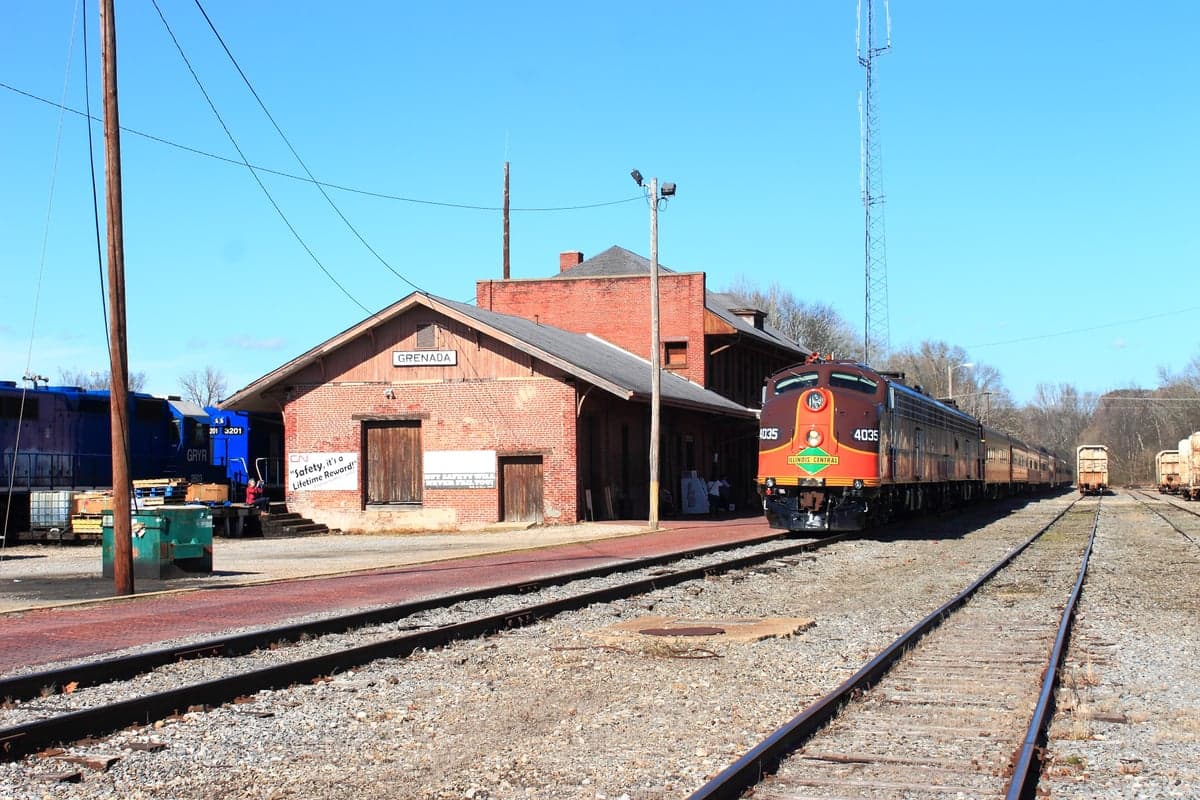
After the Civil War and Reconstruction, the county’s demographics shifted dramatically. The 1870 census recorded a Black population of roughly 55%, as freedmen and their families remained in the area as sharecroppers and tenant farmers. They concentrated in rural communities like Gore Springs, Elliott, and Holcomb, where they worked cotton and corn fields. The town of Grenada itself grew as a commercial and railroad center after the Mississippi Central Railroad arrived in 1860, later becoming part of the Illinois Central system. No significant European immigrant groups settled here — unlike the Mississippi Gulf Coast or the Delta’s Chinese enclaves, Grenada County remained almost entirely native-born White and Black through the early 20th century.
The Great Migration (1910–1970) saw a substantial outflow of Black residents from Grenada County to Northern industrial cities like Chicago, Detroit, and St. Louis, reducing the Black population share from a peak of around 60% in 1900 to roughly 45% by 1960. Meanwhile, White families consolidated in Grenada and the smaller towns of Oxberry and Bew Springs, supported by a diversified agricultural economy that included cotton, soybeans, and timber. The construction of Grenada Lake by the U.S. Army Corps of Engineers in the 1950s brought a temporary influx of construction workers and engineers, but most were temporary residents. By 1960, the county’s population stood at about 18,000, with a character that was deeply rural, Protestant, and segregated by custom and law.
Modern era (post-1965)
The 1965 Hart-Cellar Act had virtually no impact on Grenada County. The foreign-born population remains at 0.9% in 2026, and there are no significant immigrant enclaves — no Vietnamese, Indian, or Hispanic communities of note. The county’s demographic story since 1965 has been one of domestic migration, suburbanization, and racial stabilization rather than new immigration.
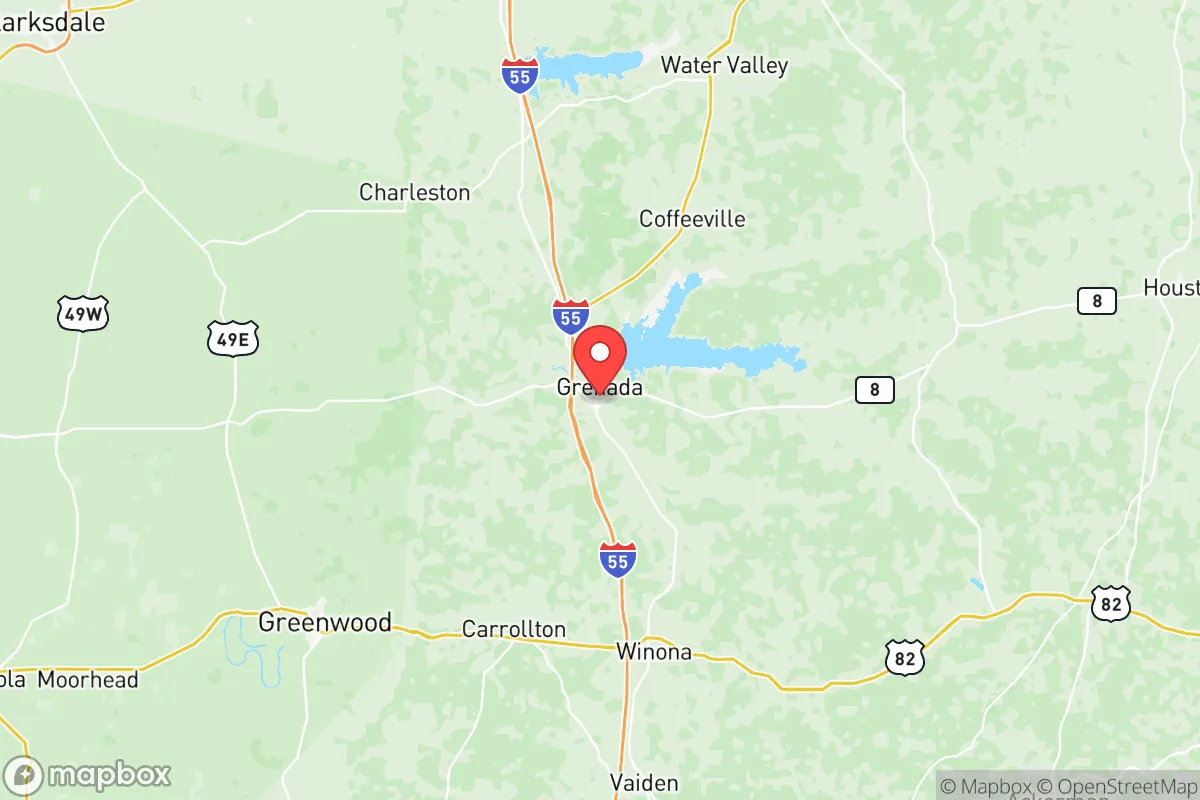
From the 1970s through the 1990s, Grenada County experienced modest growth as a bedroom community for workers commuting to larger cities like Greenwood (30 miles west) and Tupelo (60 miles east). The completion of Interstate 55 in the 1970s made the county more accessible, and new subdivisions sprouted around Grenada Lake and along Highway 51, attracting White families from rural areas and a small number of retirees from the Midwest. The lake itself became a recreational draw, with second homes and seasonal residents boosting the population during summer months.
Racially, the county has remained remarkably stable. The Black population share hovered around 44–46% from 1970 through 2020, while the White share stayed near 51–53%. This stability reflects the absence of large-scale in-migration from either group. The Hispanic population, which has grown rapidly across much of Mississippi since 1990, remains negligible at 0.3% in Grenada County — a stark contrast to counties like Scott or Lamar, where Hispanic shares exceed 5%. The East/Southeast Asian population is 0.1%, and the Indian-subcontinent population is 0.0%. The county’s population peaked at 23,263 in 2000 and has since declined slightly to 21,342, driven by out-migration of younger adults seeking jobs in Jackson, Memphis, or the Gulf Coast.
Suburbanization has been limited. The town of Grenada remains the dominant population center, with about 13,000 residents. Smaller communities like Bew Springs and Elliott have seen population declines as agriculture has mechanized and young people leave. The county’s economy has shifted from agriculture to manufacturing (auto parts, furniture) and healthcare, anchored by the Grenada County Hospital and several industrial parks. The college-educated share of 23.7% is below the national average but typical for rural Mississippi, reflecting the limited presence of four-year institutions (the nearest university is Delta State University in Cleveland, 50 miles north).
The future
Grenada County’s population is projected to continue a slow decline, with the 2030 census likely showing a number between 20,000 and 21,000. The county is not homogenizing or tribalizing into distinct enclaves — it is too small and too stable for that. Instead, it is aging: the median age has risen from 34 in 2000 to an estimated 41 in 2026, as younger adults leave and retirees stay. The Black and White populations are likely to remain near parity, with no significant immigrant influx on the horizon. The Hispanic and Asian shares may tick up slightly (to 1–2% combined) if manufacturing employers recruit labor from outside the region, but this will be gradual.
In-migration is minimal and largely consists of retirees from the Midwest and a small number of remote workers attracted by low housing costs and the recreational amenities of Grenada Lake. These newcomers are culturally similar to the existing White population — conservative, Protestant, and rural-oriented — so they are being absorbed without friction. The county’s cultural identity remains deeply Southern, with a strong emphasis on church, family, and hunting/fishing traditions. There is no sign of the coastal or urban migration that is reshaping parts of northern Mississippi (e.g., DeSoto County near Memphis).
For someone moving in now, Grenada County offers a stable, slow-paced environment with low crime relative to the Mississippi average, affordable housing (median home value around $120,000), and a population that is overwhelmingly native-born and English-speaking. The trade-off is limited economic opportunity, a shrinking job base for young adults, and a social fabric that remains racially separate in practice — the county’s schools are roughly 50% Black and 50% White, but residential and social integration is modest. It is a place where the past weighs heavily, and the future looks much like the present.

* Values derived from national, state, county, city and local statistics and may differ in a specific area. Last updated: 2026-06-01T07:49:32.000Z
Narrative content on this page is AI-generated and may contain mistakes. Verify any details that matter before acting on them.
ReloMaps may earn a commission from affiliate links at no extra cost to you.

