
Photo: Wikipedia
Political ClimatePolitical Climate in Alcorn County
Showing district-level results — no local-only data available.
Local Political AnalysisPolitical Analysis of Alcorn County
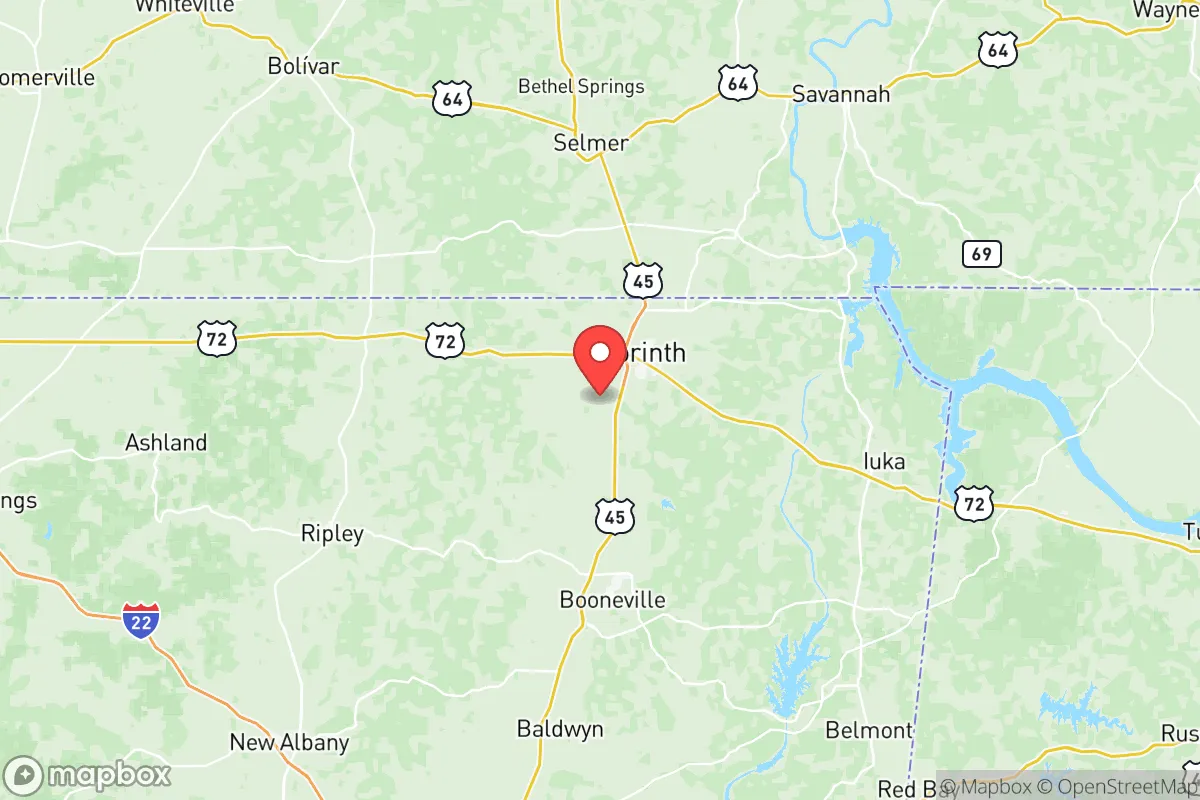
Alcorn County, Mississippi, is a reliably conservative area with a Cook Partisan Voting Index of R+18, making it significantly more Republican than the state of Mississippi as a whole, which sits at R+11. This isn't a recent shift; the county has been a Republican stronghold for decades, with margins only widening in presidential elections since 2000. The county seat, Corinth, acts as the political and economic hub, but even here, Democratic candidates rarely break 40% of the vote, with the surrounding rural precincts pushing the county's overall numbers further to the right.
How it compares
The seven-point gap between Alcorn County (R+18) and Mississippi (R+11) is substantial and reflects a deeper cultural and economic divide within the state. While Mississippi's R+11 rating already indicates a solidly red state, Alcorn County's R+18 places it in the company of the state's most conservative rural counties. This is a far cry from the Mississippi Delta or the Jackson metro area, where Democratic candidates can be competitive. Within Alcorn County itself, there is some variation: the city of Corinth shows slightly more moderate tendencies, with a handful of precincts near the downtown area and historically Black neighborhoods like the "South Side" occasionally voting for Democratic candidates in local races. In contrast, the rural communities of Glen, Rienzi, and Kossuth are deeply red, often delivering 80% or more of their vote to Republican candidates. The swing precincts, if they can be called that, are in the unincorporated areas just outside Corinth, where growth and new subdivisions are bringing in a mix of retirees and commuters who tend to vote Republican but are less predictable in local primaries.
What this means for residents
For conservative residents, Alcorn County's political climate means their values are reflected in local governance, from school board decisions to county commission policies. The local Republican Party is well-organized, and primary elections are often the decisive contests. For liberal or moderate residents, the reality is more complex. While they are a clear minority, they are not without a voice, particularly in Corinth, where a small but active Democratic club and a few progressive-leaning churches provide community. However, running for office as a Democrat in a countywide race is an uphill battle, and policy debates tend to skew heavily toward conservative priorities like tax cuts, gun rights, and limited government. The practical effect is that socially conservative policies on issues like abortion and LGBTQ+ rights are rarely challenged at the local level, while economic development initiatives, such as the expansion of the Magnolia Regional Health Center, tend to enjoy broad bipartisan support.
Culturally, Alcorn County's political identity is intertwined with its history as a railroad and manufacturing hub that has seen better economic days. There is a strong sense of self-reliance and a wariness of federal intervention, which fuels the county's Republican lean. Unlike some parts of Mississippi where race is a more overt political dividing line, Alcorn County's politics are more uniformly conservative across racial lines in many rural precincts, though the Black community in Corinth does provide a consistent base for Democratic candidates. Looking ahead, the trajectory is for the county to remain R+18 or even grow slightly redder, as in-migration from more conservative areas of the Midwest and a declining population in the more moderate precincts of Corinth reinforce the existing political order. For anyone moving here, understanding that this is a place where conservative values are the baseline, not a point of debate, is key to settling in comfortably.

State Political ClimatePolitical Climate in Mississippi
State Political AnalysisPolitical Environment in the State
Mississippi is one of the most reliably Republican states in the country, with a Cook PVI of R+11 and a political culture that has shifted sharply rightward over the past two decades. The state hasn't voted for a Democratic presidential candidate since 1976, and every statewide elected office is held by Republicans. But the real story is how the old "Blue Dog" Democratic tradition collapsed in the 2000s and 2010s, replaced by a GOP that now dominates from the courthouse to the capitol. For a relocator, this means you're moving into a state where conservative values are baked into the policy fabric, but where the intensity of that conservatism varies dramatically depending on whether you're in the Delta, the Pine Belt, or the Gulf Coast.
Urban vs. rural divide
The political map of Mississippi is a textbook study in the urban-rural split. The state's only reliably Democratic stronghold is the Jackson metro area, anchored by Hinds County, which consistently delivers 70-80% of its vote to Democrats. But even that is shrinking — Jackson's population decline has reduced its statewide electoral weight. The other notable blue pocket is the Mississippi Delta, where majority-Black counties like Bolivar, Washington, and Sunflower still vote heavily Democratic, though turnout has dropped. On the Republican side, the suburban explosion around the Gulf Coast — places like Harrison County (Biloxi, Gulfport) and Jackson County (Pascagoula, Ocean Springs) — has become deeply red, as has the DeSoto County metro area just south of Memphis, which is now the state's most populous county and a GOP stronghold. The northeastern corner around Tupelo and Lee County is reliably conservative, while Hattiesburg (Forrest County) is a fascinating microcosm: the city itself leans left thanks to the university population, but the surrounding county votes solidly Republican. The rural "reddest" areas are the Pine Belt counties like Jones, Covington, and Lamar, where GOP candidates routinely win by 40-50 points.
Policy environment
Mississippi's policy environment is among the most conservative in the nation. The state has no income tax on wages — the individual income tax was phased out entirely as of 2026, following legislation signed in 2022. Sales tax is 7%, among the highest in the country, and local add-ons can push it higher. Property taxes are very low by national standards, which is a major draw for relocators. The regulatory posture is strongly pro-business: Mississippi is a right-to-work state, has no state-level minimum wage above the federal $7.25, and offers generous economic development incentives. On education, the state has a robust school choice landscape, including charter schools and the Education Scholarship Account program for students with disabilities. Healthcare policy is notably restrictive: Mississippi did not expand Medicaid under the Affordable Care Act, leaving a coverage gap for about 100,000 low-income adults. Abortion is banned with very limited exceptions, and the state has some of the strictest abortion laws in the country. Election laws require voter ID, and the state has no-excuse absentee voting, though early in-person voting was expanded in 2024. Gun laws are among the most permissive: permitless carry for adults 18 and older, no state-level assault weapons ban, and strong castle doctrine and stand-your-ground protections.
Recent policy direction
The last five years have seen Mississippi accelerate its conservative policy trajectory. In 2022, the legislature passed the Mississippi Income Tax Elimination Act, which fully phased out the personal income tax by 2026 — a major draw for high-earning relocators. On gun rights, the state enacted permitless carry (HB 1029) in 2023, allowing any adult 18 or older to carry a concealed firearm without a license. In education, the Mississippi Parental Choice and Transparency Act expanded school choice options and required schools to post curricula online, a nod to the parental rights movement. On medical freedom, the state passed a COVID-19 vaccine mandate prohibition in 2023, barring employers from requiring vaccination as a condition of employment. Property rights were strengthened with a regulatory takings bill that requires compensation for landowners when government actions reduce property value. On the privacy front, Mississippi passed a consumer data privacy law in 2023, though it's weaker than California's. The state also enacted a gender-affirming care ban for minors in 2023, with the legislature overriding the governor's veto. Ballot access remains restrictive: Mississippi is one of the few states that still requires a voter to register 30 days before an election, and the state's unique electoral college-style system for statewide elections means a candidate must win both the popular vote and a majority of state House districts — a system that has been challenged in court.
Civil unrest & political movements
Mississippi has a quieter political landscape than many states, but there are real flashpoints. The Jackson water crisis of 2022-2023 became a national story and a political battleground, with state Republicans pushing for a takeover of the city's water system and local leaders accusing the state of neglect. The debate over the state flag — the old Confederate-themed flag was retired in 2020 and replaced with a magnolia design — was a major cultural moment that still resonates. Immigration politics are less visible here than in border states, but the legislature passed a bill in 2024 requiring local law enforcement to cooperate with federal immigration authorities. There's a small but active secessionist/nullification movement in some rural counties, though it's fringe. Election integrity was a hot topic after 2020, with the legislature tightening absentee ballot rules and banning ballot drop boxes. For a new resident, the most visible political expression is likely to be the prevalence of church-affiliated political activism, particularly around school board meetings and county supervisor races.
Projection
Over the next 5-10 years, Mississippi is likely to become even more Republican, but with interesting internal shifts. The population is slowly growing in the Gulf Coast suburbs and DeSoto County, while the Delta and Jackson continue to shrink. This demographic shift will further entrench GOP dominance at the state level. The income tax elimination will likely accelerate in-migration of remote workers and retirees from higher-tax states, particularly from California and Illinois, though these newcomers tend to be more moderate. The wild card is the state's Black population, which is about 38% of the total — if turnout increases, it could make statewide races more competitive, but current trends suggest continued low engagement. The biggest policy fights ahead will be over Medicaid expansion (which is gaining some GOP support), further education privatization, and potential tort reform. A relocator moving in now should expect a state that is solidly conservative, with low taxes and light regulation, but also with significant infrastructure challenges and a healthcare system that remains strained.
For a new resident, the bottom line is straightforward: Mississippi offers a genuinely low-tax, low-regulation environment with strong gun rights and school choice, but you'll need to be comfortable with a state that has limited public services and a healthcare system that leaves many without coverage. If you're a conservative looking for a place where your values are reflected in policy, you'll find it here. If you're a liberal, you'll find a small but active community in Jackson, Hattiesburg, and Oxford, but you'll be living under laws you likely disagree with. Either way, the state's trajectory is clear: more of the same, only more so.
* Values derived from national, state, county, city and local statistics and may differ in a specific area. Last updated: 2026-08-08T19:13:39.000Z
Narrative content on this page is AI-generated and may contain mistakes. Verify any details that matter before acting on them.
ReloMaps may earn a commission from affiliate links at no extra cost to you.

