Photo: Wikipedia
Demographics of Mineral Wells, TX
Affluence Level in Mineral Wells, TX
A low-income area with significant economic hardship. Household wealth and educational attainment are well below national averages.
People of Mineral Wells, TX
The people of Mineral Wells, Texas, today number 15,130, forming a predominantly White (62.9%) and Hispanic (26.8%) community with a small but notable Indian-subcontinent population (1.4%) and a modest Black share (4.9%). The city’s foreign-born population sits at 5.1%, well below the national average, and only 13.3% of adults hold a college degree—reflecting a working-class, family-oriented character rooted in the region’s ranching and energy economy. Distinctive identity markers include a strong sense of local pride tied to the historic downtown and the nearby Fort Wolters military legacy, alongside a growing Hispanic presence that is reshaping the city’s cultural and commercial life.
How the city was settled and grew
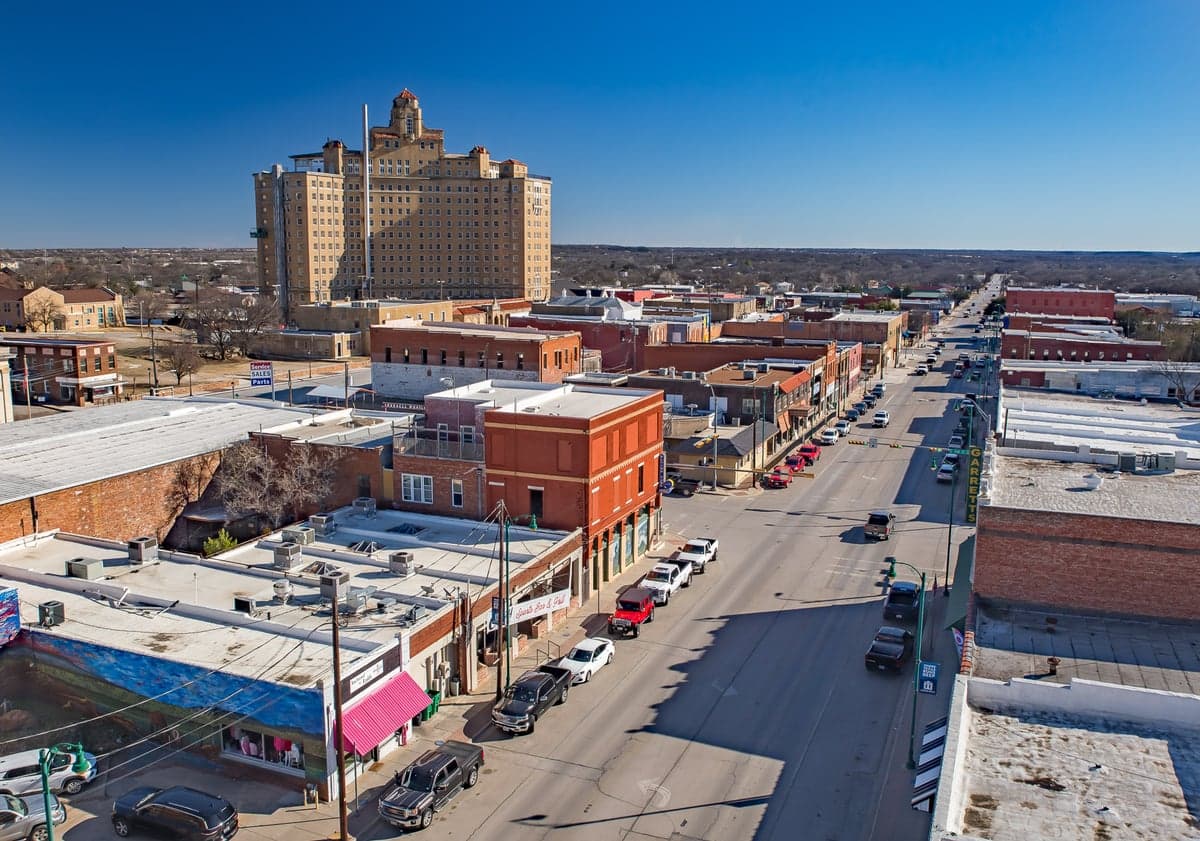
Mineral Wells was founded in the late 1870s as a railroad stop on the Texas & Pacific line, but its explosive growth came after the discovery of mineral springs in the 1880s. The first wave of settlers were Anglo-American ranchers and farmers drawn by cheap land grants from the state of Texas, followed by health-seekers arriving for the purported medicinal waters. By 1900, the city had become a national spa destination, with grand hotels like the Baker Hotel (opened 1929) drawing wealthy tourists from across the country. The original Anglo population built the West Ward neighborhood, a historic district of Victorian homes near the downtown springs, while railroad workers and service staff settled in the East Side along the tracks. During World War II, Camp Wolters (later Fort Wolters) brought a massive influx of military personnel and civilian contractors, many of whom stayed after the base’s 1970s closure, settling in the Lake Mineral Wells area and the Southwest Addition subdivisions built for veterans.
Modern era (post-1965)
After the 1965 Hart-Cellar Act, Mineral Wells saw limited direct immigration compared to larger Texas cities, but domestic in-migration accelerated as the post-military economy shifted toward manufacturing and energy. The Hispanic population began growing steadily from the 1980s onward, driven by agricultural and construction jobs, and today clusters in the North Side neighborhoods around Highway 180 and the Palo Pinto Road corridor, where Mexican-owned tiendas and taquerias have replaced older Anglo storefronts. The Black population (4.9%) remains concentrated in the historic South Side near the old railroad depot, a legacy of segregation-era housing patterns that have persisted despite formal integration. The Indian-subcontinent community (1.4%) is a newer arrival, primarily professionals and small-business owners drawn by lower housing costs and proximity to Fort Worth, settling in the Westward Addition and newer subdivisions near the high school. East/Southeast Asian residents (0.3%) are a tiny presence, mostly Vietnamese and Filipino families connected to the regional healthcare and oilfield service sectors, scattered across the city without a distinct enclave.
The future
The population is heading toward greater Hispanic plurality, with the White share declining from over 80% in 1990 to 62.9% today, while the Hispanic share has more than doubled. This trend is likely to continue as younger Anglo families move to larger metro areas for jobs, while Hispanic families—often larger and younger—remain anchored by local construction, hospitality, and agricultural work. The Indian-subcontinent community is growing slowly but steadily, drawn by affordable housing and small-business opportunities, but remains too small to form a visible enclave. The city is not tribalizing into hostile enclaves but is homogenizing along class lines: working-class families of all backgrounds live in the older central neighborhoods, while middle-class households (both Anglo and Hispanic) gravitate toward newer subdivisions on the city’s western edge. The next 10-20 years will likely see Mineral Wells become a majority-minority city, with Hispanic residents approaching 40-45% of the population, while the Anglo share drops below 50%—a shift already visible in the local school district, where Hispanic students now outnumber White students.
For someone moving in now, Mineral Wells is becoming a more diverse, working-class community with a strong Hispanic cultural influence and a small but growing Indian professional presence. The city retains its small-town feel and low cost of living, but the demographic shift means newcomers should expect a bilingual commercial landscape and a school system adapting to a majority-minority student body. The historic Anglo character of neighborhoods like West Ward and the East Side is fading, while the North Side and Palo Pinto Road corridor are emerging as the city’s new cultural and economic heart.

* Values derived from national, state, county, city and local statistics and may differ in a specific area. Last updated: 2026-10-10T16:28:27.000Z
Narrative content on this page is AI-generated and may contain mistakes. Verify any details that matter before acting on them.
ReloMaps may earn a commission from affiliate links at no extra cost to you.

