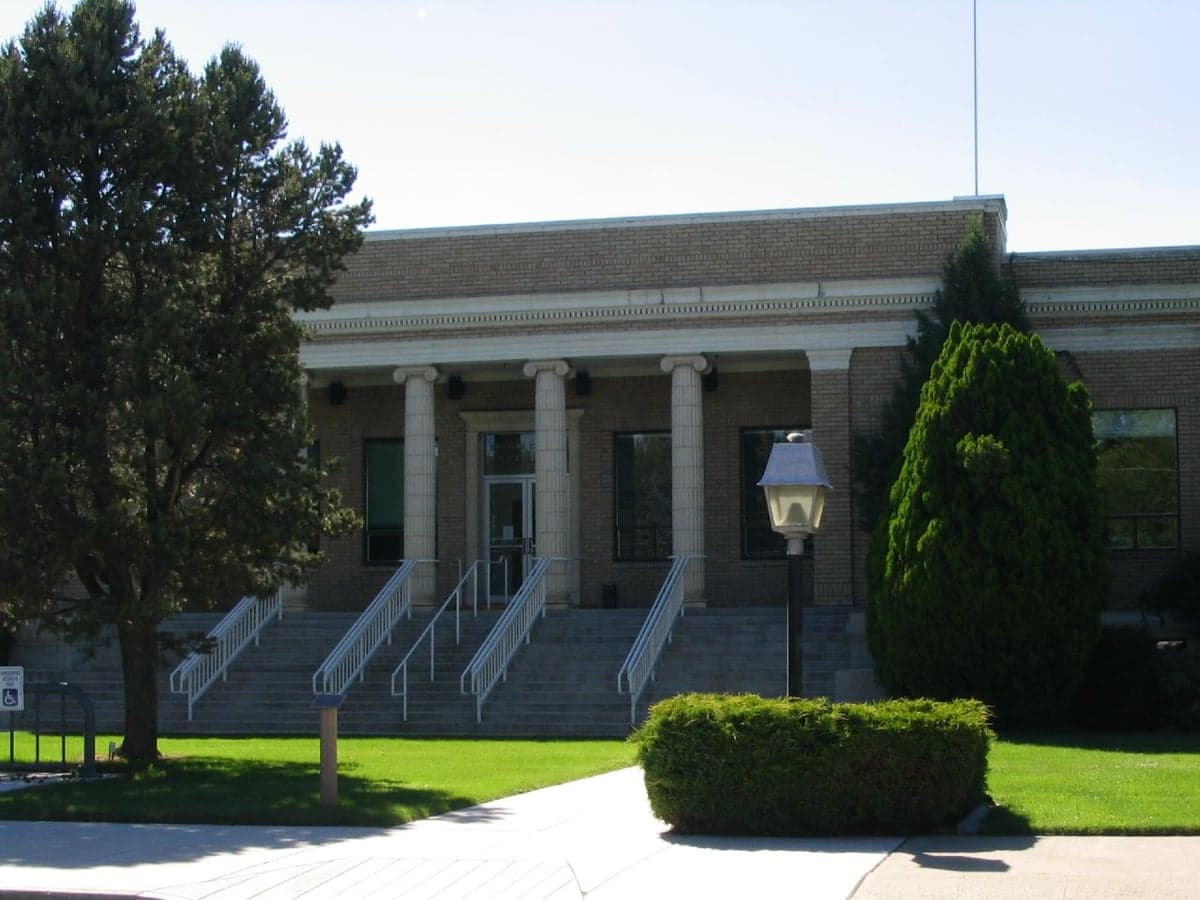
Photo: Wikipedia
Strategic Assessment of Minden, NV
Strong survivability profile. Good buffer from population centers, with manageable environmental and tactical risks.
What does the Strategic Assessment tell us?
Our Strategic Assessment grades tactical survivability of an area. Major population centers, military targets, fallout zones, natural disasters, and border exposure all drive risk — lower exposure means a more defensible position in a crisis.
This is heavily inspired by Joel Skousen's Strategic Relocation book. Highly recommended you checkout the book ($)What does this tell us?
Our Strategic Assessment grades tactical survivability of an area. Major population centers, military targets, fallout zones, natural disasters, and border exposure all drive risk — lower exposure means a more defensible position in a crisis.
This is heavily inspired by Joel Skousen's Strategic Relocation book. Highly recommended you checkout the book ($)Strategic Pillars

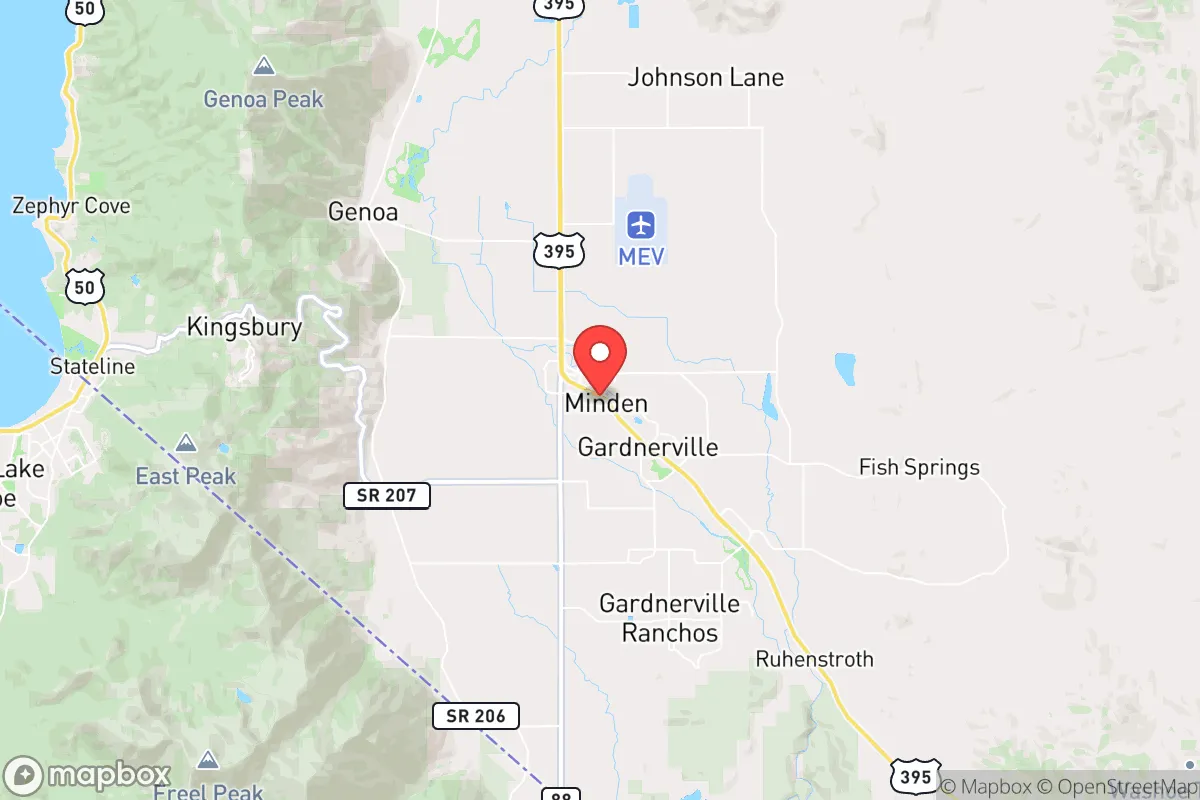
Key Distances
Regional Safe Places
Below is our recommended "safe zones" in Nevada and the surrounding area based on our strategic heuristics. For most people, it's unrealistic to live in a “safe zone” full-time due to work, family or other personal reasons. They tend to be more rural. However, many of these areas are perfect for second homes and retreat properties that double as a vacation home or even a short-term rental.
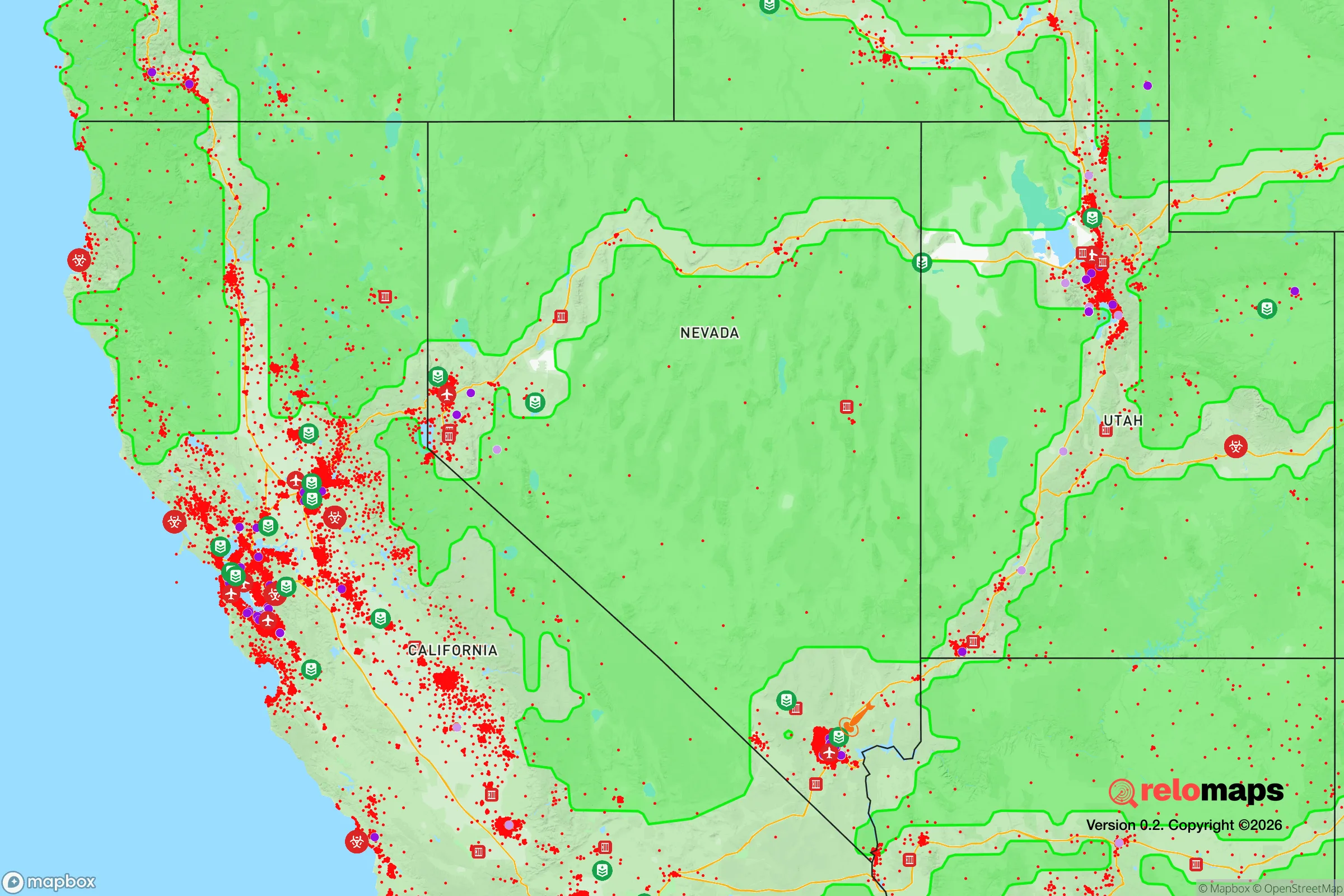
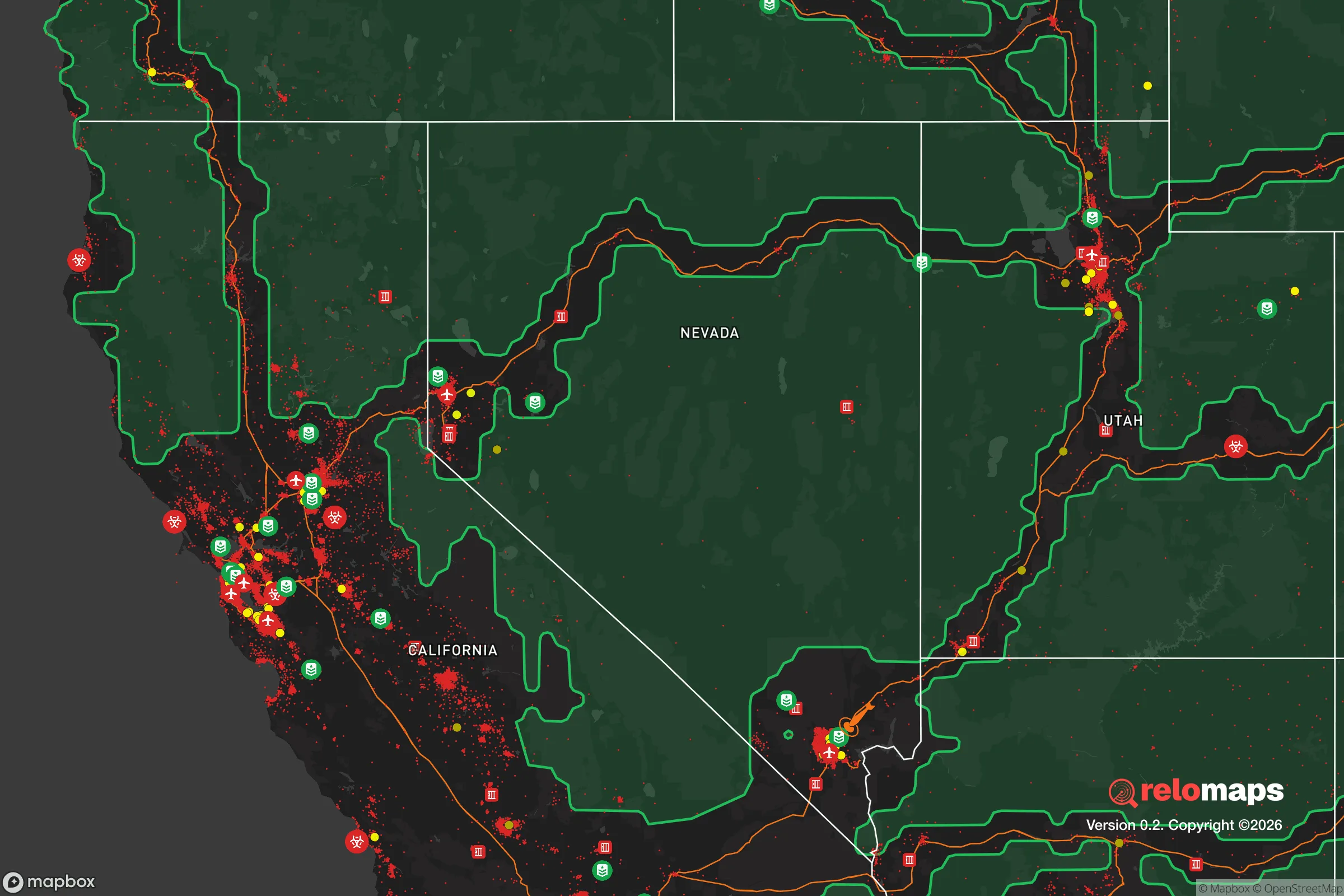


Important Note: For informational purposes only. This does not mean nothing bad ever happens in the green zones. Please use common sense. This is based on public data and modeled with AI. We tried to take a conservative approach but mistakes happen. We update this regularly as new information becomes available.
Solar Generator Recommendations
Backup power matters more here than in safer locations. We've picked three solar generators across budgets and capacity tiers — start with the budget unit if you only need a few essentials, or step up if you want to run a fridge and HVAC for days at a time.

Jackery Portable Power Station Explorer 300
Budget OptionPower on the Go: Weighing only 11 lbs, it's convenient to set up and store with book-sized foldable solar panels

BLUETTI Portable Power Station AC180
Designed for both indoor and outdoor scenarios, AC180 is highly capable as it has a robost capacity and continuous output power.

EF ECOFLOW DELTA Pro Ultra Power Station
Upgraded PickEcoFlow DELTA Pro Ultra is a whole-home energy system designed to grow with your family. Integrated with the Smart Home Panel 2, it scales to meet your evolving energy needs — keeping your home powered, intelligent, and secure through every stage of life.
We earn a commission, at no additional cost to you.
Strategic Assessment Analysis
Minden, Nevada, occupies a strategic position in the eastern Sierra Nevada foothills that offers a compelling blend of natural defensibility and practical self-sufficiency for the disaster-conscious relocator. Its location in the Carson Valley, roughly 15 miles south of Carson City and 45 miles southeast of Reno, provides meaningful separation from major urban centers while retaining access to critical infrastructure. The area’s resilience profile is shaped by its high-desert geography, low population density relative to the Reno-Sparks metro, and proximity to the Sierra Nevada rain shadow, which together create a set of advantages and trade-offs worth examining carefully.
Geographic position and natural advantages for self-sufficiency
Minden sits at an elevation of roughly 4,700 feet in the Carson Valley, a broad, fertile basin ringed by the Sierra Nevada to the west and the Pine Nut Mountains to the east. This topography provides a natural buffer against many common disaster scenarios. The valley’s agricultural soils and access to the Carson River and its tributaries support a local farming and ranching economy that gives the area a genuine food-production base—something rare in the Intermountain West. The surrounding mountains create a rain-shadow effect, meaning Minden receives only about 10–12 inches of precipitation annually, which reduces flood risk compared to the wetter western slopes of the Sierra. However, the same geography also means the area depends heavily on snowmelt from the Sierra for its water supply, making it vulnerable to drought cycles and multi-year snowpack deficits. The valley’s isolation is a double-edged sword: it offers physical separation from the congestion and target risks of Reno and Carson City, but the primary evacuation and supply routes—U.S. 395 and State Route 88—are narrow two-lane highways that can become bottlenecks during a crisis. For a relocator prioritizing defensibility, the ability to monitor and control access from these limited entry points is a meaningful advantage over more sprawling suburban areas.
Risks, exposures, and proximity to fallout-relevant landmarks
Minden’s risk profile is moderate compared to many Western relocation destinations, but it is not without serious exposures. The primary natural hazard is wildfire: the Carson Valley sits in a fire-prone ecosystem, and the 2021 Tamarack Fire and the 2022 Mosquito Fire both came within 20–30 miles of the area, demonstrating that large-scale fires can threaten the valley’s air quality and access routes. The region also experiences occasional seismic activity from the Walker Lane fault zone, which runs through western Nevada; while Minden has not seen a major earthquake in recorded history, the fault system is capable of a magnitude 6.5–7.0 event, which could disrupt water infrastructure and road access. From a man-made risk standpoint, Minden’s proximity to Fallon Naval Air Station (about 50 miles northeast) and the Hawthorne Army Depot (about 90 miles southeast) introduces a low but non-zero risk of industrial accidents or targeted disruption. More significantly, the area lies roughly 200 miles from the San Francisco Bay Area—a major population and economic center that could become a secondary fallout zone in a large-scale conflict or EMP event. While Minden is far enough to avoid direct blast effects from a Bay Area strike, prevailing westerly winds could carry radioactive fallout across the Sierra into the Carson Valley within 12–24 hours, depending on weather patterns. The area’s distance from major military targets like the Nevada Test Site (about 100 miles north) and the Hawthorne depot is a relative positive, but relocators should understand that no location in the western U.S. is entirely free from fallout risk given current geopolitical realities.
Practical resilience for a relocator: food, water, energy, and defensibility
For a relocator serious about self-sufficiency, Minden offers several structural advantages that are hard to replicate in more urbanized parts of the West. The Carson Valley is one of the few places in Nevada with a genuine local food economy: the area supports cattle ranching, alfalfa farming, and small-scale vegetable production, and the Minden Farmers Market (seasonal) and local CSAs provide direct access to regional growers. The Carson River and its tributaries offer a reliable surface water source, though water rights in Nevada are complex and heavily regulated—anyone planning to drill a well or divert water should budget for legal and permitting costs, which can run $10,000–$20,000. The valley’s groundwater basin is generally healthy, but drought years can lower the water table, so a deep well (300–500 feet) is advisable for long-term resilience. Energy infrastructure is mixed: NV Energy provides grid power, but the area’s high solar insolation (over 300 sunny days per year) makes rooftop solar with battery storage a highly viable option for grid independence. Natural gas is available in Minden proper, but propane is more common in outlying areas. Defensibility is a standout feature: the valley’s limited road access (primarily U.S. 395 and a few county roads) means that a small group could effectively monitor and control entry points, and the surrounding mountains provide natural observation points. However, the same geography means that a major disaster could trap residents in the valley if both 395 and the alternative route over Kingsbury Grade (State Route 207) become impassable. Stockpiling at least two weeks of food, water, and medical supplies is a baseline recommendation, with four weeks being more prudent given the potential for extended road closures after a seismic event or severe winter storm.
The overall strategic picture for Minden is one of moderate-to-high resilience with specific, manageable vulnerabilities. Its isolation from major urban centers is a genuine asset for those seeking to avoid the chaos of a city collapse, and its agricultural base gives it a food-security advantage that most Nevada towns lack. The trade-offs are real: wildfire risk, drought dependency, and the potential for fallout from a West Coast event are not hypotheticals but calculable probabilities that a serious relocator should plan for. For a family or individual willing to invest in solar, a deep well, and a solid emergency stockpile, Minden offers a defensible, self-sufficient lifestyle that is hard to find elsewhere in the region. It is not a bunker—it is a working valley with a real community and real vulnerabilities—but for the strategic thinker, it represents one of the more balanced options in the Intermountain West for long-term disaster preparedness without complete isolation from civilization.

* Values derived from national, state, county, city and local statistics and may differ in a specific area. Last updated: 2026-09-28T10:14:37.000Z
Narrative content on this page is AI-generated and may contain mistakes. Verify any details that matter before acting on them.
ReloMaps may earn a commission from affiliate links at no extra cost to you.

