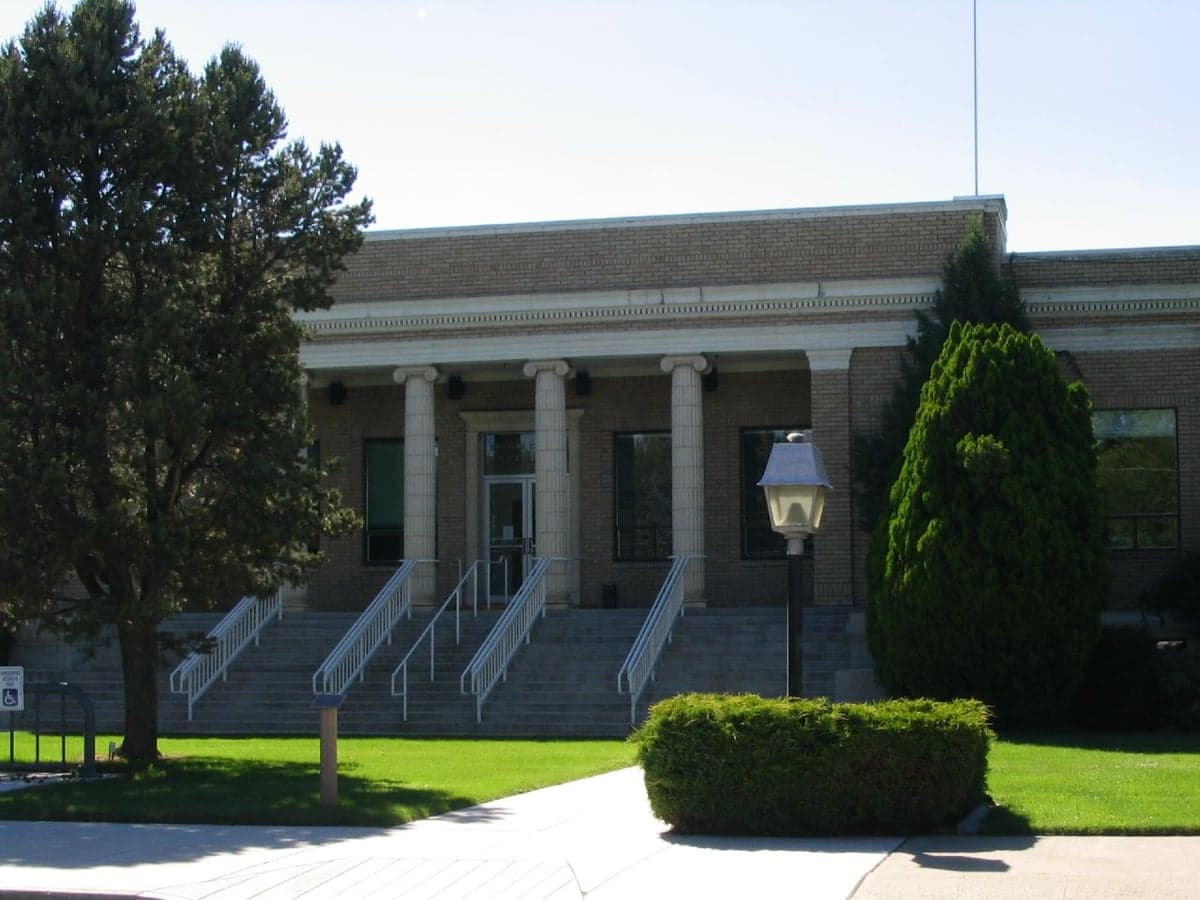
Photo: Wikipedia
Demographics of Minden, NV
Affluence Level in Minden, NV
A middle-class area roughly in line with national averages across income, home values, education, and employment.
People of Minden, NV
The people of Minden, Nevada today form a small, predominantly white community of 3,309 residents, characterized by a notably low foreign-born population of just 1.1% and a strong family-oriented, conservative-leaning culture. The city’s identity is rooted in its ranching and agricultural heritage, with a population density that feels distinctly rural despite its role as the Douglas County seat. Distinctive markers include a high homeownership rate, a visible presence of multi-generational ranching families, and a growing but still modest Hispanic community (6.8%) concentrated in specific older neighborhoods.
How the city was settled and grew
Minden was founded in 1905 as a planned railroad town by the Dangberg Land and Livestock Company, named after a town in Germany. The original population was drawn almost entirely by the promise of work in the region’s dominant industry: cattle ranching and hay farming. The Dangberg family, German immigrants themselves, recruited other German and Swiss families to work the vast ranchlands, and these early settlers built the core of what is now Historic Downtown Minden, centered around Esmeralda Avenue. A second wave arrived during the 1920s and 1930s, when Basque sheepherders, fleeing economic hardship in the Pyrenees, were brought in to work the high-desert ranges. These Basque families established a distinct cultural enclave in the Minden Ranchos area, a neighborhood of larger lots and horse properties just east of downtown, where their descendants still own many of the original ranch parcels. The town remained overwhelmingly white and agriculturally focused through the mid-20th century, with the 1950 census recording a population of just over 1,000, nearly all of European descent.
Modern era (post-1965)
After the 1965 Immigration and Nationality Act, Minden saw little direct foreign immigration; the foreign-born share remains under 1.5%. Instead, the modern era has been defined by domestic in-migration from California, beginning in the 1970s and accelerating through the 1990s and 2000s. Californians—many from the Bay Area and Los Angeles—were drawn by lower taxes, larger lots, and a perceived safer, more traditional lifestyle. This wave settled primarily in newer subdivisions on the town’s periphery, such as Mountain View Estates (built in the 1980s and 1990s west of Highway 395) and the Minden-Gardnerville Ranchos, a sprawling master-planned community of 1- to 5-acre parcels that attracted families seeking space. The Hispanic population, now 6.8%, grew during this period as workers moved into the area to support the construction and service industries tied to the California influx. These families concentrated in older, more affordable rental housing near Minden Lane and Buckeye Road, a corridor that remains the most ethnically diverse pocket of the city. The East/Southeast Asian community (2.2%) is small and dispersed, with no single neighborhood concentration, reflecting a pattern of professional in-migration tied to the nearby Carson Valley Medical Center and the tech-adjacent workforce commuting to Reno.
The future
Minden’s population is projected to grow slowly, likely reaching 3,800–4,000 by 2035, driven primarily by continued domestic migration from California and other high-cost Western states. The population is becoming slightly more diverse, but at a pace far slower than Nevada as a whole. The Hispanic share is expected to rise to 9–10% over the next decade, with new growth likely to concentrate in the Minden South area, where several new subdivisions are planned on former ranchland. The white non-Hispanic share will remain dominant, above 80%, as the town’s cultural identity—rooted in ranching, conservative politics, and a slow-growth ethos—continues to attract like-minded migrants. The foreign-born share is unlikely to rise significantly, as the local economy (dominated by government, healthcare, and retail) does not generate the labor demand that drives immigration in larger cities. The biggest demographic shift will be aging: the median age, already above 45, will climb as retirees from California continue to move in, while younger families are priced out by rising home values that now average over $600,000.
For someone moving in now, Minden is becoming an increasingly expensive, aging, and culturally stable community—a place where newcomers are expected to assimilate into an established ranching-and-retiree culture rather than reshape it. The population is not diversifying rapidly, and the town’s identity as a white, conservative, family-oriented enclave is likely to persist for at least another generation. New arrivals should expect a quiet, low-density lifestyle with strong community ties, limited ethnic diversity, and a political and social climate that prizes tradition and self-reliance.

* Values derived from national, state, county, city and local statistics and may differ in a specific area. Last updated: 2026-09-28T10:14:37.000Z
Narrative content on this page is AI-generated and may contain mistakes. Verify any details that matter before acting on them.
ReloMaps may earn a commission from affiliate links at no extra cost to you.

