Photo: Wikipedia
Strategic Assessment of Midlothian, TX
Meaningful friction. Expect exposure to either population pressure, blast zones, or natural disaster risk. Consider buying a retreat property.
What does the Strategic Assessment tell us?
Our Strategic Assessment grades tactical survivability of an area. Major population centers, military targets, fallout zones, natural disasters, and border exposure all drive risk — lower exposure means a more defensible position in a crisis.
This is heavily inspired by Joel Skousen's Strategic Relocation book. Highly recommended you checkout the book ($)What does this tell us?
Our Strategic Assessment grades tactical survivability of an area. Major population centers, military targets, fallout zones, natural disasters, and border exposure all drive risk — lower exposure means a more defensible position in a crisis.
This is heavily inspired by Joel Skousen's Strategic Relocation book. Highly recommended you checkout the book ($)Strategic Pillars

Key Distances
Regional Safe Places
Below is our recommended "safe zones" in Texas and the surrounding area based on our strategic heuristics. For most people, it's unrealistic to live in a “safe zone” full-time due to work, family or other personal reasons. They tend to be more rural. However, many of these areas are perfect for second homes and retreat properties that double as a vacation home or even a short-term rental.

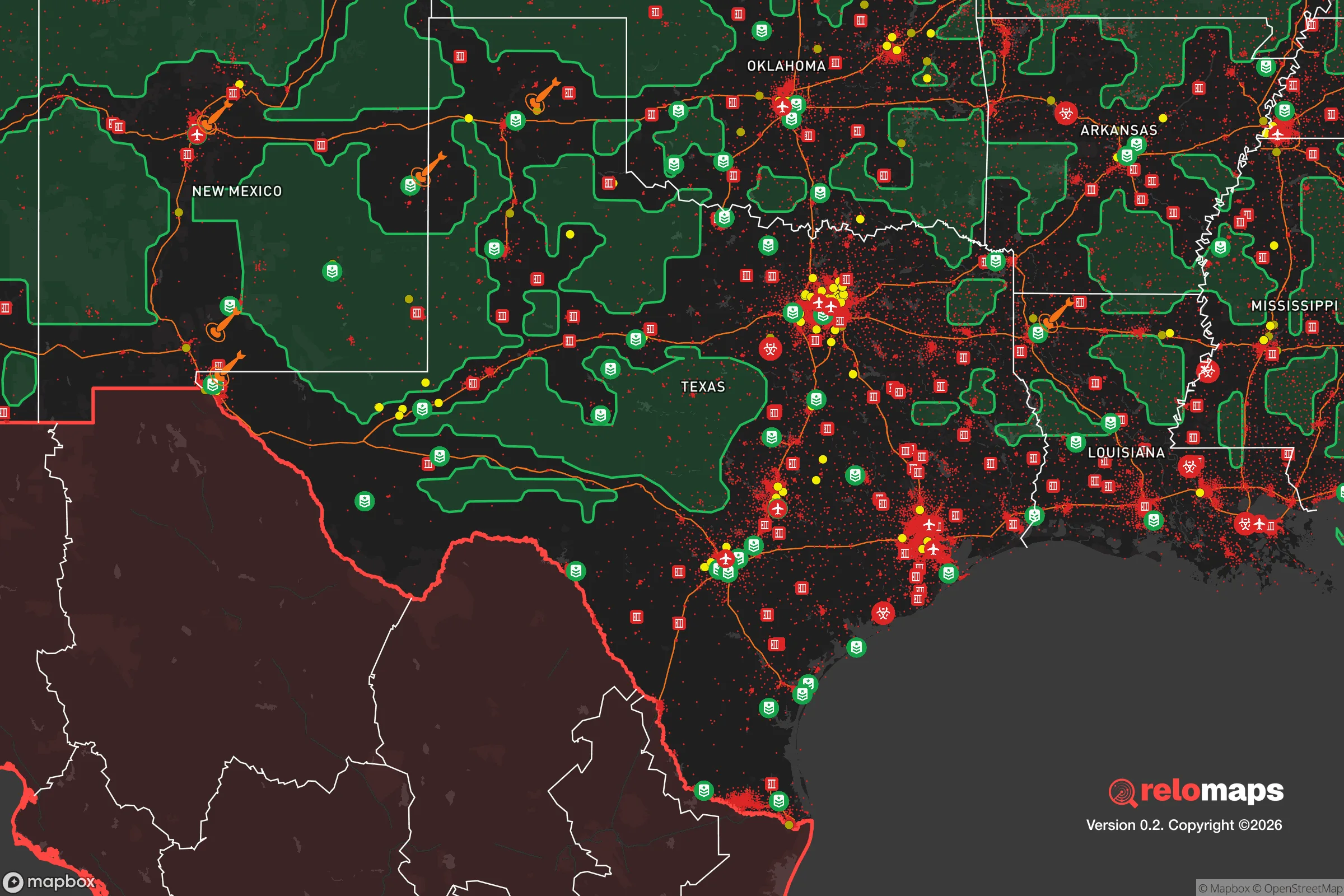


Important Note: For informational purposes only. This does not mean nothing bad ever happens in the green zones. Please use common sense. This is based on public data and modeled with AI. We tried to take a conservative approach but mistakes happen. We update this regularly as new information becomes available.
Solar Generator Recommendations
Backup power matters more here than in safer locations. We've picked three solar generators across budgets and capacity tiers — start with the budget unit if you only need a few essentials, or step up if you want to run a fridge and HVAC for days at a time.

Jackery Portable Power Station Explorer 300
Budget OptionPower on the Go: Weighing only 11 lbs, it's convenient to set up and store with book-sized foldable solar panels

BLUETTI Portable Power Station AC180
Designed for both indoor and outdoor scenarios, AC180 is highly capable as it has a robost capacity and continuous output power.

EF ECOFLOW DELTA Pro Ultra Power Station
Upgraded PickEcoFlow DELTA Pro Ultra is a whole-home energy system designed to grow with your family. Integrated with the Smart Home Panel 2, it scales to meet your evolving energy needs — keeping your home powered, intelligent, and secure through every stage of life.
We earn a commission, at no additional cost to you.
Strategic Assessment Analysis
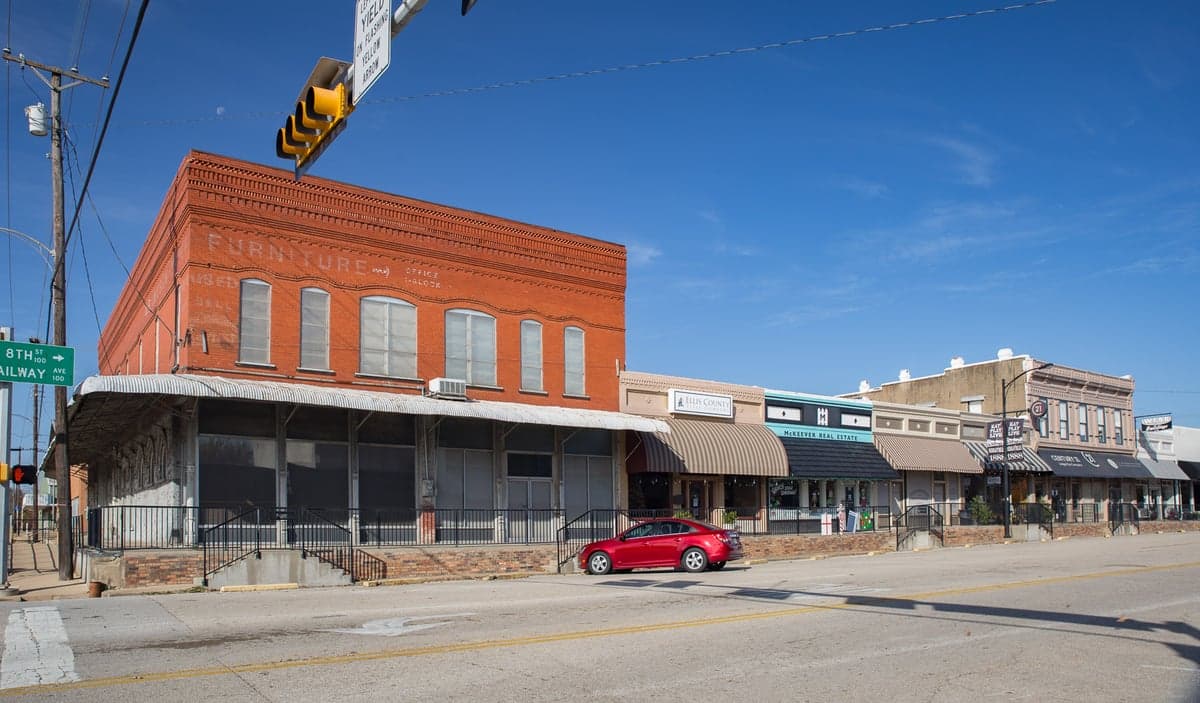
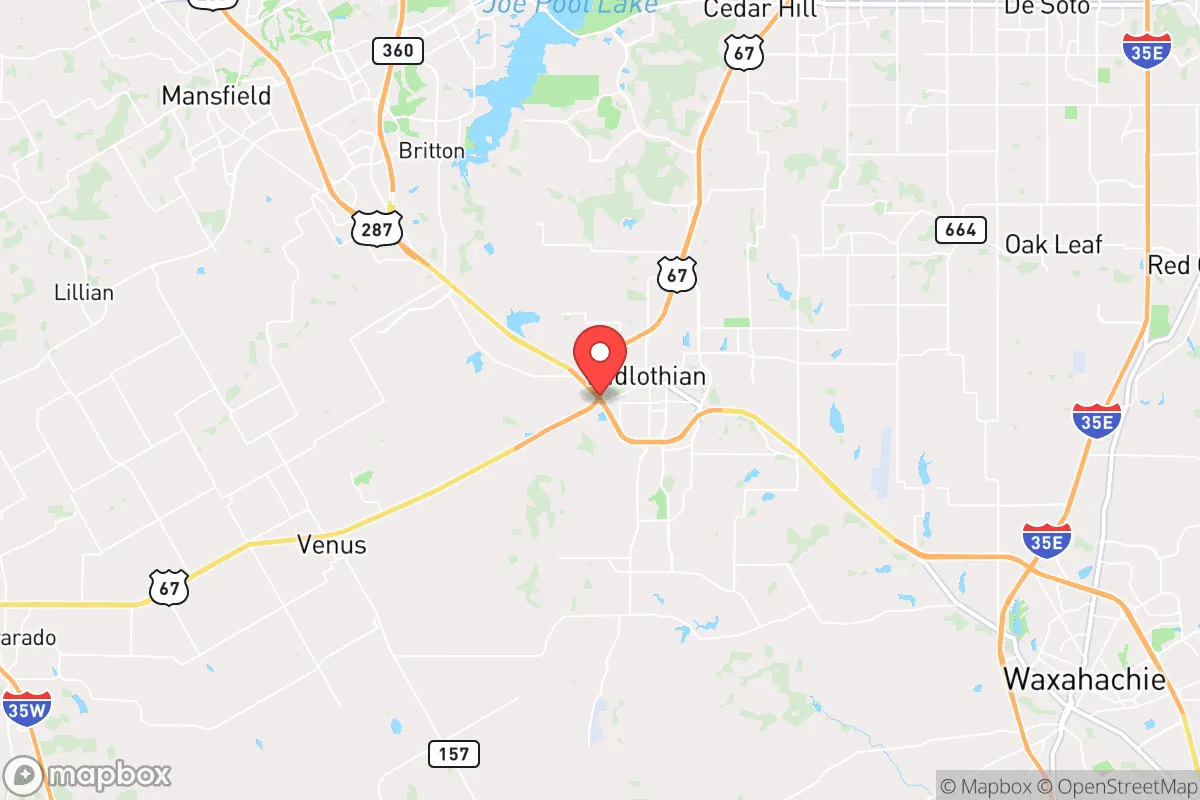
Midlothian, Texas, presents a mixed strategic picture for the conservative prepper or survivalist. Its primary advantage is a strong geographic buffer—situated roughly 30 miles southwest of downtown Dallas, it sits far enough from the immediate blast zone of a major urban target to avoid the worst of a nuclear event, yet close enough to be impacted by fallout and secondary chaos. The town’s location along the I-35E corridor and near the intersection of US-287 offers decent egress routes, but those same arteries are also chokepoints during a mass evacuation. For a relocator prioritizing resilience, Midlothian’s real value lies in its semi-rural character, growing local economy, and access to natural resources, but it is not a bug-out paradise—it’s a calculated compromise between proximity to civilization and survivability.
Geographic position and natural advantages for long-term survival
Midlothian sits on the edge of the Blackland Prairie, a region with fertile soil that historically supported agriculture. For a prepper, this means the potential for small-scale food production is real—backyard gardens, chicken coops, and even small orchards are viable here, unlike in the rocky, arid terrain of West Texas. The area receives roughly 37 inches of rain annually, which is enough to sustain rain catchment systems and cisterns without relying on municipal water. The Trinity Aquifer lies beneath much of Ellis County, and while well-drilling costs vary, a private well is a realistic option for those on larger lots. The terrain is gently rolling, offering some natural defensibility—low hills and creek bottoms provide cover and concealment for a retreat property. However, the lack of dense forest means you won’t have the same concealment as in East Texas; you’ll rely more on distance and low visibility than on thick canopy. The town’s elevation (roughly 750 feet) is unremarkable but keeps it above the floodplains of the Trinity River, which is a plus for avoiding post-disaster waterborne disease and infrastructure washouts.
Risks, exposures, and proximity to fallout-relevant landmarks
The biggest strategic liability is Midlothian’s proximity to multiple high-value targets. Dallas-Fort Worth (DFW) is a major population center, economic hub, and home to DFW International Airport, a likely first-strike target in a nuclear exchange. Midlothian is about 35 miles from the airport—close enough that a ground burst could produce fallout reaching the area within hours, depending on wind patterns. The town itself hosts two large cement plants (Ash Grove and Holcim) and a steel mill (Gerdau), which are industrial landmarks that could be secondary targets or cause hazardous material releases during a crisis. The nearby Lone Star Army Ammunition Plant in Texarkana (about 150 miles northeast) is another concern, though less immediate. On the plus side, Midlothian is not near any nuclear power plants (the closest is Comanche Peak in Glen Rose, about 70 miles southwest) or major military bases, reducing the risk of direct targeting. The I-35E corridor, while a lifeline for resupply, is also a funnel for refugees fleeing Dallas—during a mass evacuation, Midlothian could become a chokepoint where desperate populations pass through or settle. Civil unrest from Dallas spillover is a real risk, especially if the city’s infrastructure collapses and people head south toward the Hill Country.
Practical resilience for a relocator: food, water, energy, and defensibility
For a relocator looking to set up a sustainable homestead, Midlothian offers a workable baseline but requires deliberate investment. Water is the most critical resource: the municipal supply comes from the Trinity River and Lake Bardwell, but a prepper should not rely on it. Drilling a well to the Trinity Aquifer (typically 200-400 feet deep) costs $5,000–$10,000, but yields 10–30 gallons per minute—enough for a family and small garden. Rainwater harvesting is also viable; a 1,000-square-foot roof can collect about 600 gallons per inch of rain. Food production is feasible but not effortless—the growing season is long (March to November), and the soil is workable, but you’ll need to amend it with compost and plan for drought periods. Local farmers’ markets and co-ops exist, but they’ll be overwhelmed in a crisis. Energy independence is achievable with solar panels (the area gets about 220 sunny days per year) and battery storage, though grid-tied systems are common. Propane tanks for backup heating and cooking are a smart addition. Defensibility is moderate: the town’s layout is spread out, with many homes on 1–5 acre lots, giving you standoff distance from neighbors. However, the lack of natural barriers (mountains, rivers, dense woods) means you’ll need to harden your property with fencing, reinforced doors, and a clear line of sight. The local law enforcement presence is adequate for a town of 40,000, but during a collapse, you cannot count on them—you’ll need a community of like-minded neighbors. Midlothian’s gun culture is strong, with multiple gun shops and ranges nearby, and the county is generally pro-Second Amendment, which is a plus for self-defense.
Community and cultural fit for a conservative prepper
Midlothian’s demographic and political makeup is a significant factor for a conservative relocator. The town leans heavily Republican—Ellis County voted +30 points for Trump in 2020, and local politics reflect that. Churches are abundant (over 50 within a 10-mile radius), and the community is family-oriented, with a strong emphasis on self-reliance and volunteerism. This cultural alignment means you’re less likely to face friction over prepping activities like stockpiling, firearms ownership, or homeschooling. The local economy is anchored by manufacturing, logistics, and healthcare, which provides stable employment for those who need it. However, the town is growing fast—population increased by over 30% between 2010 and 2020—and that brings suburban sprawl, higher property taxes, and a dilution of the rural character that preppers value. If you buy land now, you’ll likely see more neighbors over time, which can be a security risk. The school district (Midlothian ISD) is well-regarded, with a B+ rating from Niche, but it’s large (over 10,000 students) and may not be ideal for parents who want to control their children’s education in a crisis. For a single individual, the town offers a low-crime environment (violent crime rates are about half the national average) and a quiet lifestyle, but the social scene is limited—you’ll need to be self-sufficient or join local churches, gun clubs, or volunteer fire departments to build a network.
The overall strategic picture for Midlothian is one of calculated risk. It is not a remote bunker location—it’s a semi-rural town within striking distance of a major metro area, which brings both opportunities and vulnerabilities. For a prepper who wants to maintain a normal job, access healthcare, and still have a fighting chance during a crisis, Midlothian is a solid choice. But you must plan for the worst: fallout from a Dallas strike, refugee flows down I-35E, and the gradual erosion of rural character as development continues. Your best bet is to buy a property with a well, solar panels, and enough land to grow food, then build a trusted network of neighbors who share your values. If you’re looking for a true off-grid retreat, look further west to the Hill Country or north to the Piney Woods. But if you want a defensible home base that lets you stay connected to civilization while preparing for its collapse, Midlothian deserves a hard look. Just don’t expect it to stay quiet forever—the world is tightening, and this town is on the edge of the storm.

* Values derived from national, state, county, city and local statistics and may differ in a specific area. Last updated: 2026-04-19T07:11:01.000Z
Narrative content on this page is AI-generated and may contain mistakes. Verify any details that matter before acting on them.
ReloMaps may earn a commission from affiliate links at no extra cost to you.

