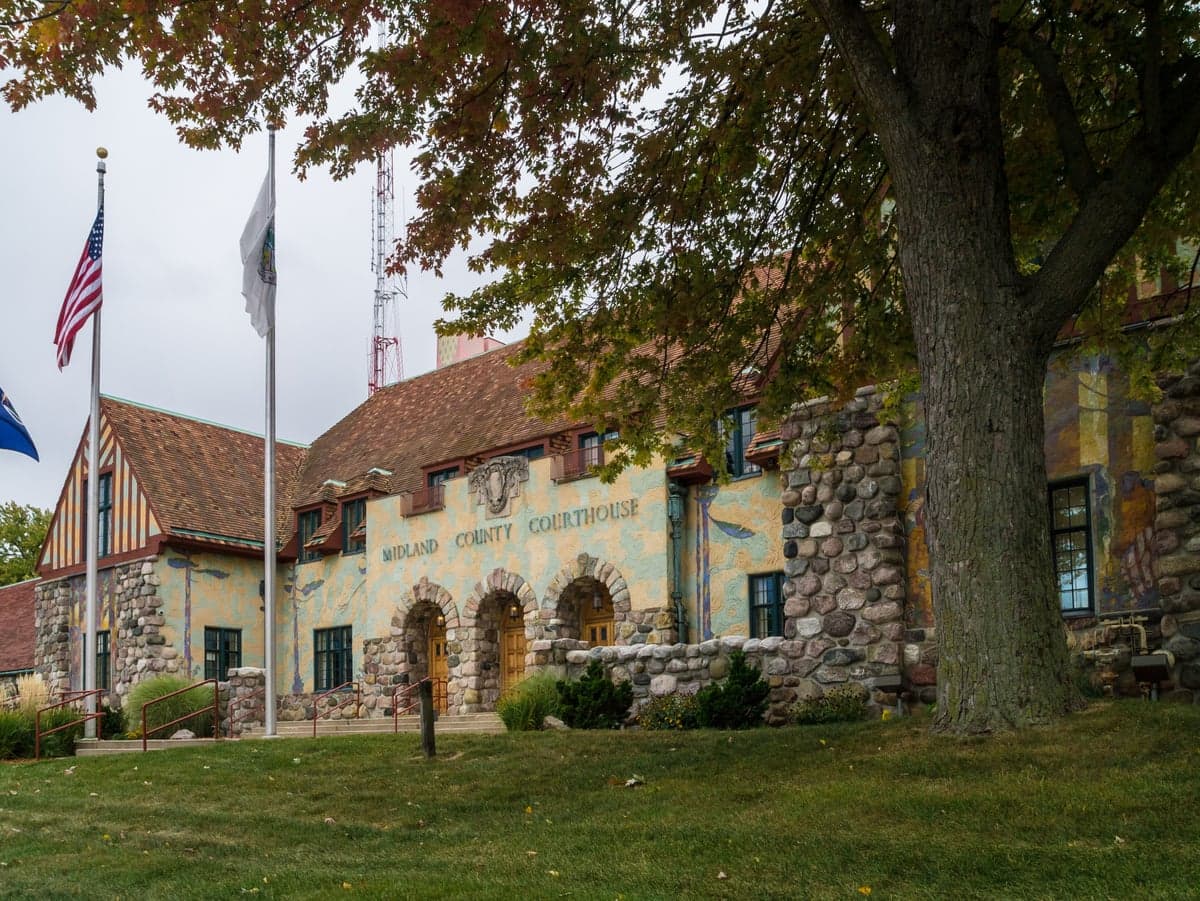
Photo: Wikipedia
Strategic Assessment of Midland, MI
Meaningful friction. Expect exposure to either population pressure, blast zones, or natural disaster risk. Consider buying a retreat property.
What does the Strategic Assessment tell us?
Our Strategic Assessment grades tactical survivability of an area. Major population centers, military targets, fallout zones, natural disasters, and border exposure all drive risk — lower exposure means a more defensible position in a crisis.
This is heavily inspired by Joel Skousen's Strategic Relocation book. Highly recommended you checkout the book ($)What does this tell us?
Our Strategic Assessment grades tactical survivability of an area. Major population centers, military targets, fallout zones, natural disasters, and border exposure all drive risk — lower exposure means a more defensible position in a crisis.
This is heavily inspired by Joel Skousen's Strategic Relocation book. Highly recommended you checkout the book ($)Strategic Pillars

Key Distances
Regional Safe Places
Below is our recommended "safe zones" in Michigan and the surrounding area based on our strategic heuristics. For most people, it's unrealistic to live in a “safe zone” full-time due to work, family or other personal reasons. They tend to be more rural. However, many of these areas are perfect for second homes and retreat properties that double as a vacation home or even a short-term rental.


Important Note: For informational purposes only. This does not mean nothing bad ever happens in the green zones. Please use common sense. This is based on public data and modeled with AI. We tried to take a conservative approach but mistakes happen. We update this regularly as new information becomes available.
Solar Generator Recommendations
Backup power matters more here than in safer locations. We've picked three solar generators across budgets and capacity tiers — start with the budget unit if you only need a few essentials, or step up if you want to run a fridge and HVAC for days at a time.

Jackery Portable Power Station Explorer 300
Budget OptionPower on the Go: Weighing only 11 lbs, it's convenient to set up and store with book-sized foldable solar panels

BLUETTI Portable Power Station AC180
Designed for both indoor and outdoor scenarios, AC180 is highly capable as it has a robost capacity and continuous output power.

EF ECOFLOW DELTA Pro Ultra Power Station
Upgraded PickEcoFlow DELTA Pro Ultra is a whole-home energy system designed to grow with your family. Integrated with the Smart Home Panel 2, it scales to meet your evolving energy needs — keeping your home powered, intelligent, and secure through every stage of life.
We earn a commission, at no additional cost to you.
Strategic Assessment Analysis
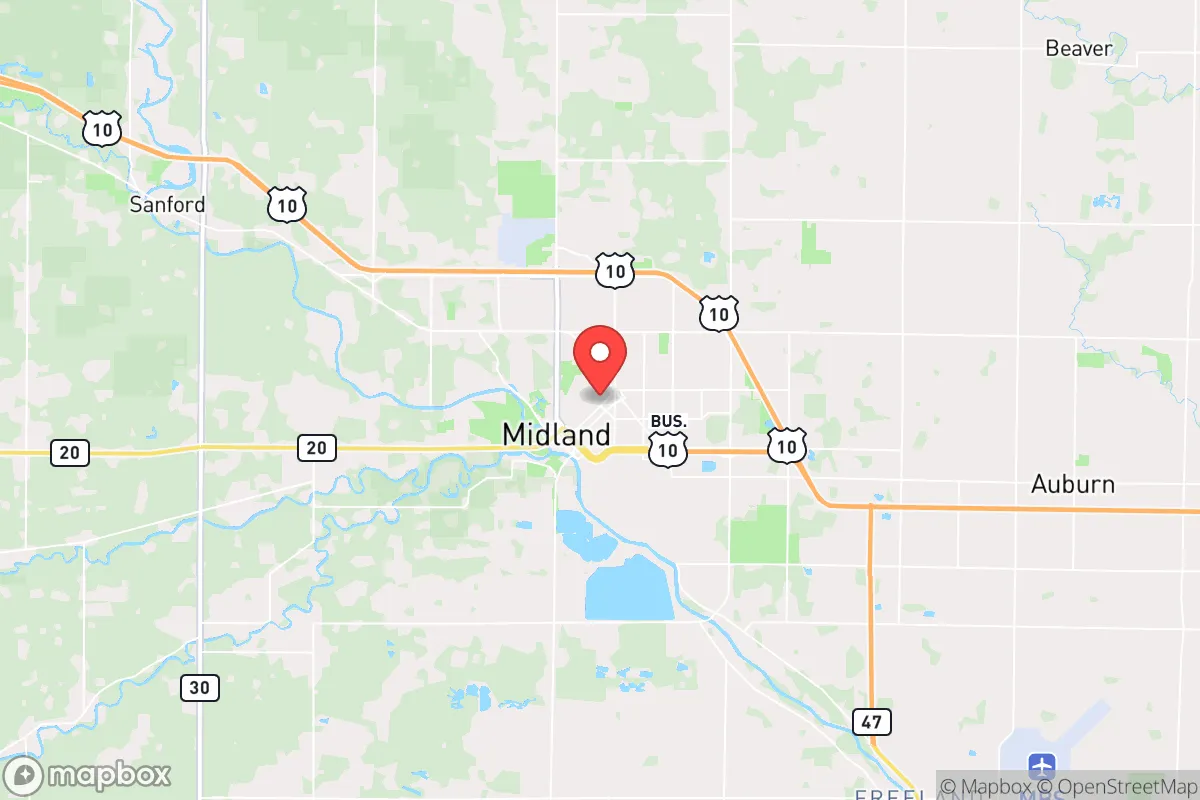
Midland, Michigan, offers a surprisingly robust strategic position for those prioritizing resilience and self-sufficiency, largely due to its location in the Great Lakes Bay Region and its distance from major population centers. While not a remote mountain redoubt, it sits roughly 130 miles northwest of Detroit and 120 miles north of Ann Arbor, placing it outside the immediate blast and fallout zones of those major targets while still providing access to critical infrastructure. The city’s proximity to Lake Huron via the Saginaw River and its position within a region known for freshwater abundance and agricultural capacity make it a serious contender for a relocation focused on long-term preparedness.
Geographic position and natural advantages for long-term security
Midland’s primary strategic asset is its location within the Great Lakes Basin, which holds roughly 20% of the world’s surface freshwater. The city sits at the confluence of the Tittabawassee and Chippewa rivers, providing multiple water sources that are less likely to be contaminated by a single event compared to a single reservoir system. The surrounding landscape is a mix of flat agricultural land and low, forested hills—not defensible terrain in a military sense, but offering ample space for dispersed homesteading and small-scale farming. The region’s climate is continental, with cold winters that naturally limit population movement and reduce the viability of prolonged civil unrest during the colder months. For a relocator, this means a built-in buffer: the area is not a primary migration corridor, and its seasonal weather patterns discourage transient populations. The proximity to the Saginaw Bay and Lake Huron also provides a potential waterborne evacuation route or supply chain alternative if ground transport is compromised.
Risks, exposures, and proximity to fallout-relevant landmarks
The most significant risk factor for Midland is the Dow Chemical complex, a massive industrial facility that has been a cornerstone of the local economy for over a century. In a major conflict or terrorist event, this site could be a secondary target, and its chemical storage presents a real hazard for airborne contamination. The city is also within roughly 100 miles of the Fermi 2 nuclear power plant near Monroe, Michigan, and about 150 miles from the Palisades nuclear plant (now decommissioned but still storing spent fuel). While these distances provide some safety from immediate blast effects, prevailing winds from the southwest could carry fallout toward Midland in a worst-case scenario. Additionally, the city is located in a floodplain; the 2020 dam failures on the Tittabawassee and Tobacco rivers caused catastrophic flooding, demonstrating that infrastructure failures—whether from neglect or sabotage—are a real concern. For the prepper, these risks mean that a relocation plan must include a bug-out location further north or west, such as into the Upper Peninsula or northern Wisconsin, and that a robust water filtration and air purification system is non-negotiable.
Practical resilience for a relocator: food, water, energy, and defensibility
Midland’s practical resilience is a mixed bag. On the positive side, the region is surrounded by some of the most productive agricultural land in the state, with corn, soybeans, and wheat being staple crops. Local farmers’ markets and a growing network of small-scale organic farms mean that a relocator could establish direct relationships with producers before any crisis hits. The city itself has a well-maintained municipal water system drawing from groundwater and surface sources, but a prepper should plan for a private well or rainwater catchment system, as the grid is vulnerable to both cyberattacks and physical sabotage. Energy-wise, Midland is served by Consumers Energy and DTE, with a mix of natural gas, coal, and some renewable sources. The area has decent solar potential, though winter cloud cover reduces output significantly. Wood heating is a viable backup, given the surrounding forests. Defensibility is the weakest point: Midland is a flat, suburban city with a population of about 42,000, and its layout is not designed for perimeter security. However, the surrounding rural townships—like Larkin, Homer, and Lee townships—offer larger lots, lower population density, and better opportunities for a hardened homestead. A relocator should prioritize buying land with a well, septic, and a woodlot, ideally on a dead-end road or near a natural barrier like a river or wetland.
The overall strategic picture for Midland is one of calculated trade-offs. It is not a survivalist’s paradise—it lacks the remoteness of the Rockies or the defensibility of a mountain valley. But it offers something arguably more valuable for the conservative-minded relocator: a functioning community with a strong industrial base, access to freshwater and farmland, and a location that is close enough to major resources (hospitals, hardware stores, fuel depots) to be practical, yet far enough from primary targets to offer a reasonable margin of safety. The key is to treat Midland as a base of operations, not a final redoubt. Establish a primary residence here for work and community, but maintain a secondary property or a well-stocked bug-out location in the more remote northern regions. The city’s resilience will depend on how well its residents prepare for the specific threats of industrial accidents, flooding, and regional supply chain disruptions. For those willing to invest in proper filtration, backup power, and a network of local allies, Midland represents a solid, if imperfect, strategic choice in an increasingly uncertain world.

* Values derived from national, state, county, city and local statistics and may differ in a specific area. Last updated: 2026-04-29T21:13:13.000Z
Narrative content on this page is AI-generated and may contain mistakes. Verify any details that matter before acting on them.
ReloMaps may earn a commission from affiliate links at no extra cost to you.

