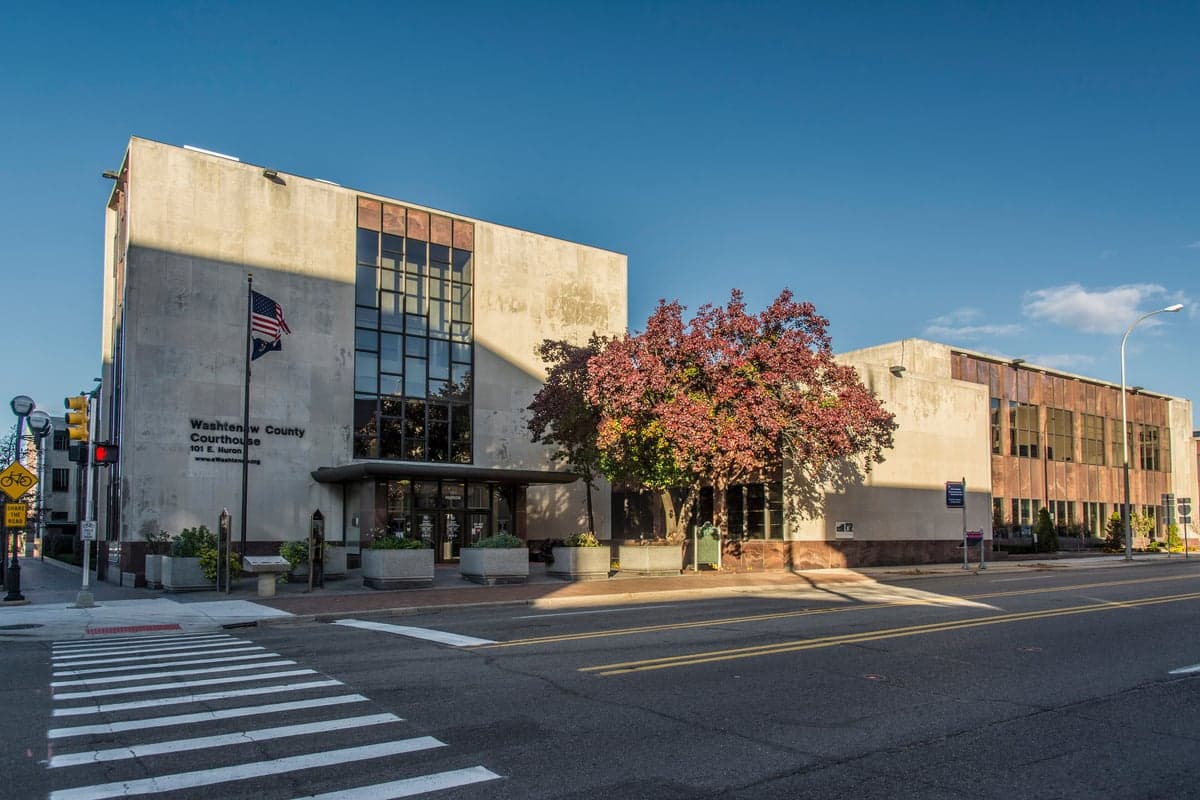
Photo: Wikipedia
Political ClimatePolitical Climate in Washtenaw County
Showing district-level results — no local-only data available.
Local Political AnalysisPolitical Analysis of Washtenaw County
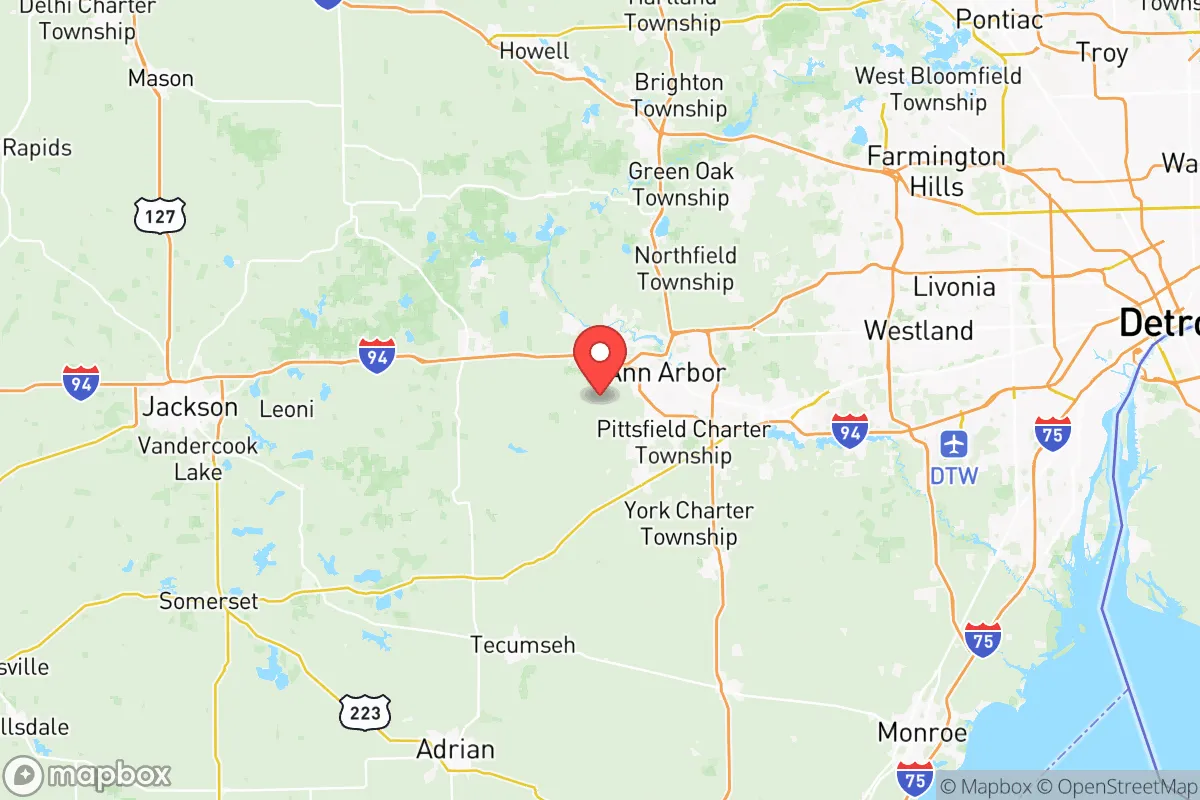
Washtenaw County is one of the most reliably Democratic strongholds in Michigan, anchored by the city of Ann Arbor and the University of Michigan. The county’s Cook Partisan Voting Index (PVI) of D+12 places it far to the left of the state as a whole, which sits at EVEN, meaning Michigan is a perfect swing state. This gap has widened over the past two decades as Ann Arbor’s population has grown more liberal and the surrounding rural townships have held steady or shifted slightly right, creating a sharp urban-rural divide within the county itself.
How it compares
While Michigan as a state oscillates between parties—voting for Trump in 2016, Biden in 2020, and Trump again in 2024—Washtenaw County has voted Democratic by double-digit margins in every presidential election since at least 1992. In 2024, the county delivered roughly 68% of its vote to Kamala Harris, even as the state narrowly flipped back to Trump. This makes Washtenaw one of the few counties in Michigan that consistently offsets Republican votes from rural and exurban areas like Livingston County to the east. Within Washtenaw, the variation is stark: Ann Arbor and Ypsilanti are deep blue, with precincts routinely hitting 80-85% Democratic, while towns like Dexter, Chelsea, and Saline lean blue but with more moderation. The rural townships of Northfield, Webster, and Sharon are more competitive, often splitting 50-50 or leaning slightly Republican, especially in down-ballot races. The city of Milan, which straddles the Washtenaw-Monroe county line, is a genuine swing area and one of the few places in the county where a Republican candidate can win a precinct outright.
What this means for residents
For liberal residents, Washtenaw County feels like a political safe zone where progressive policies on climate, housing, and social justice are the norm in local government. The Ann Arbor City Council and Washtenaw County Board of Commissioners are reliably Democratic, and ballot initiatives on issues like public transit funding and renewable energy tend to pass easily. For conservative residents, the county can feel isolating politically, but they are not without representation: the rural townships and smaller towns like Manchester and Milan often elect Republicans to local boards and the county commission, and the state legislative districts that cover the county’s outer edges are competitive. In practice, this means that a conservative living in rural Webster Township has a very different local political experience than a liberal in downtown Ann Arbor, even though they share the same county government. The county’s Democratic lean also means that property taxes and local spending tend to be higher than in neighboring counties, funding robust public services, schools, and social programs that many residents value but some see as excessive.
Culturally, Washtenaw County stands apart from much of Michigan due to the outsized influence of the University of Michigan. Ann Arbor is a college town with a highly educated, transient population that drives the county’s progressive politics and its reputation as a hub for tech, healthcare, and the arts. Ypsilanti, home to Eastern Michigan University, shares a similar but more working-class progressive vibe. Outside the I-94 corridor, the county’s small towns and farmlands retain a more traditional Midwestern character, with strong ties to agriculture and manufacturing. This cultural split mirrors the political one and is a defining feature of life in Washtenaw: you can drive 20 minutes and feel like you’re in a different state. The county’s trajectory is likely to remain Democratic as Ann Arbor continues to grow and attract younger, more liberal residents, but the rural townships will keep the county from becoming a monolith, ensuring that local elections remain genuinely contested in the areas outside the urban core.

State Political ClimatePolitical Climate in Michigan
State Political AnalysisPolitical Environment in the State
Michigan is the ultimate swing state, with a Cook PVI of EVEN that perfectly captures its knife-edge political balance. Over the past 20 years, the state has lurched from reliably blue (voting for Democrats in every presidential election from 1992 to 2012) to a true battleground where Donald Trump flipped it in 2016 by just 10,704 votes, only for Joe Biden to win it back in 2020 by 154,188 votes. The dominant coalitions are a shrinking, union-heavy, urban Democratic base in Southeast Michigan versus a growing, populist-conservative coalition in the rural north and west, with the critical swing voters living in the suburban "blue wall" counties around Detroit and Grand Rapids.
Urban vs. rural divide
The political map of Michigan is a story of three distinct regions. Wayne County (Detroit) and Washtenaw County (Ann Arbor) are the Democratic strongholds, delivering margins of 300,000+ votes that Democrats need to offset the rest of the state. In 2020, Detroit alone gave Biden 94% of the vote. The opposite pole is the rural Upper Peninsula and the northern Lower Peninsula — places like Oscoda County and Missaukee County — where Trump won 70%+ of the vote. The real battleground is the suburban ring: Macomb County (a classic Reagan Democrat stronghold that went +12 for Trump in 2016 but narrowed to +8 in 2020), Oakland County (once a GOP bastion that has shifted steadily blue, going +14 for Biden), and Kent County (Grand Rapids), which flipped from red to blue at the presidential level in 2020 for the first time since 1972. The I-96 corridor from Lansing to Grand Rapids is where the state's political future is being decided, as suburban moms and union tradespeople diverge on cultural issues.
Policy environment
Michigan's policy landscape is a mixed bag that reflects its swing-state status. The state has a flat income tax rate of 4.25%, which was temporarily reduced from 4.25% to 4.05% in 2023 due to a 2015 law that triggers automatic cuts when revenues exceed inflation — a rare example of a built-in tax relief mechanism. Property taxes are governed by the Headlee Amendment and Proposal A, which cap annual increases at the rate of inflation or 5%, whichever is less, meaning longtime homeowners pay far less than newcomers. The regulatory posture is moderate: Michigan is a right-to-work state as of 2012, but Democrats repealed that law in 2023, effective 2025, meaning union security agreements will return. Education policy is dominated by the 2020 "Student Opportunity Scholarship" program (vouchers for low-income students), which was struck down by the state Supreme Court, leaving school choice limited to charter schools and inter-district open enrollment. Healthcare is a mixed picture: Michigan expanded Medicaid under the Affordable Care Act in 2013, and the state has a Healthy Michigan Plan covering 1.1 million residents. Election laws are relatively accessible: no-excuse absentee voting was approved by voters in 2018 via Proposal 3, and same-day voter registration is available. The state has no voter ID law — voters without ID can sign an affidavit — which is a flashpoint for conservatives.
Recent policy direction
The 2023-2024 legislative session, under unified Democratic control for the first time in 40 years, produced a flurry of significant changes. On gun policy, Michigan passed universal background checks and safe storage laws in 2023, and a "red flag" extreme risk protection order law — a major shift in a state with deep hunting traditions. On abortion and bodily autonomy, voters enshrined reproductive freedom in the state constitution via Proposal 3 in 2022, which passed with 57% of the vote, overriding a 1931 law that had banned abortion. This means Michigan now has some of the strongest abortion protections in the Midwest. On LGBTQ rights, the Elliott-Larsen Civil Rights Act was expanded in 2023 to include sexual orientation and gender identity. On parental rights and education, the state repealed a 1990s-era law that banned discussing LGBTQ topics in sex education, and the state board of education has pushed for inclusive curriculum standards — a source of tension in conservative districts. On voting and ballot access, the 2022 midterms saw the passage of Proposal 2, which enshrined nine days of early voting, drop boxes, and automatic voter registration into the constitution. On property rights, the state has not passed any major reform to eminent domain or land use regulation, though local zoning battles over renewable energy siting are heating up. On privacy and surveillance, Michigan has no comprehensive data privacy law, though a bill is pending. The overall direction is clearly leftward on social and cultural issues, but the state's fiscal posture remains relatively restrained due to the flat tax and revenue-sharing caps.
Civil unrest & political movements
Michigan has been a flashpoint for political activism on both sides. The 2020 Whitmer kidnapping plot and the armed protests at the state capitol over COVID-19 restrictions put Michigan at the center of the national debate over public health mandates and militia activity. The Wolverine Watchmen militia group was implicated in the plot, and the trial of several members is ongoing. On the left, the 2020 George Floyd protests in Detroit and Grand Rapids saw significant property damage and clashes with police. Immigration politics are relatively quiet compared to border states, but Washtenaw County (Ann Arbor) is a self-declared "sanctuary county" that limits cooperation with ICE, while Macomb County has passed resolutions opposing such policies. Election integrity remains a live issue: the 2020 election in Michigan was the subject of numerous lawsuits and audits, with a GOP-led state Senate investigation concluding there was no widespread fraud but recommending changes to election administration. The 2024 presidential election is expected to be another battleground, with both parties investing heavily in the state. A new resident will notice the prevalence of political yard signs, the intensity of local Facebook groups, and the fact that Michigan is one of the few states where both a Democratic governor (Gretchen Whitmer) and a Republican-controlled legislature (until 2023) coexisted for years.
Projection
Over the next 5-10 years, Michigan is likely to remain a competitive swing state, but the demographic trends favor Democrats. In-migration from the Rust Belt and the South is modest, but the state is losing population overall (it lost a congressional seat after the 2020 census). The key demographic shift is the suburbanization of the Democratic vote — Oakland and Kent counties are becoming more liberal as college-educated professionals move in, while rural areas are becoming more conservative and older. The Arab American community in Dearborn, which leans Democratic but is culturally conservative, could be a wild card in close elections. The 2024 election will be a stress test: if Democrats can hold the "blue wall" states, Michigan will stay competitive; if Trump wins it back, expect a renewed focus on election laws and a potential push for voter ID requirements. The repeal of right-to-work will likely boost union membership and Democratic turnout in manufacturing areas, but it could also accelerate the decline of the auto industry as companies seek lower-cost states. The Great Lakes water resources and the transition to electric vehicles (with massive federal investment in battery plants in Marshall and Midland) will reshape the economy, potentially attracting a new wave of tech and manufacturing workers who may lean left. A conservative moving to Michigan should expect a state where their vote matters but where cultural and policy trends are moving leftward, especially on social issues. A liberal moving here will find a state where their policies can be enacted but where the political fight is constant and the margins are razor-thin.
For a new resident, the bottom line is this: Michigan is a state where your vote genuinely counts, where the political climate is shaped by the tension between a shrinking but powerful urban base and a growing rural conservative movement, and where the suburbs are the ultimate deciders. If you're conservative, you'll find strong communities in the exurbs and rural areas, but you'll need to accept that the state government will likely be controlled by Democrats for the foreseeable future. If you're liberal, you'll have the opportunity to shape policy, but you'll face constant pushback from a well-organized opposition. The state's politics are as unpredictable as its weather — expect four seasons in one day, and don't get too comfortable with any political forecast.
* Values derived from national, state, county, city and local statistics and may differ in a specific area. Last updated: 2026-08-08T15:47:25.000Z
Narrative content on this page is AI-generated and may contain mistakes. Verify any details that matter before acting on them.
ReloMaps may earn a commission from affiliate links at no extra cost to you.

