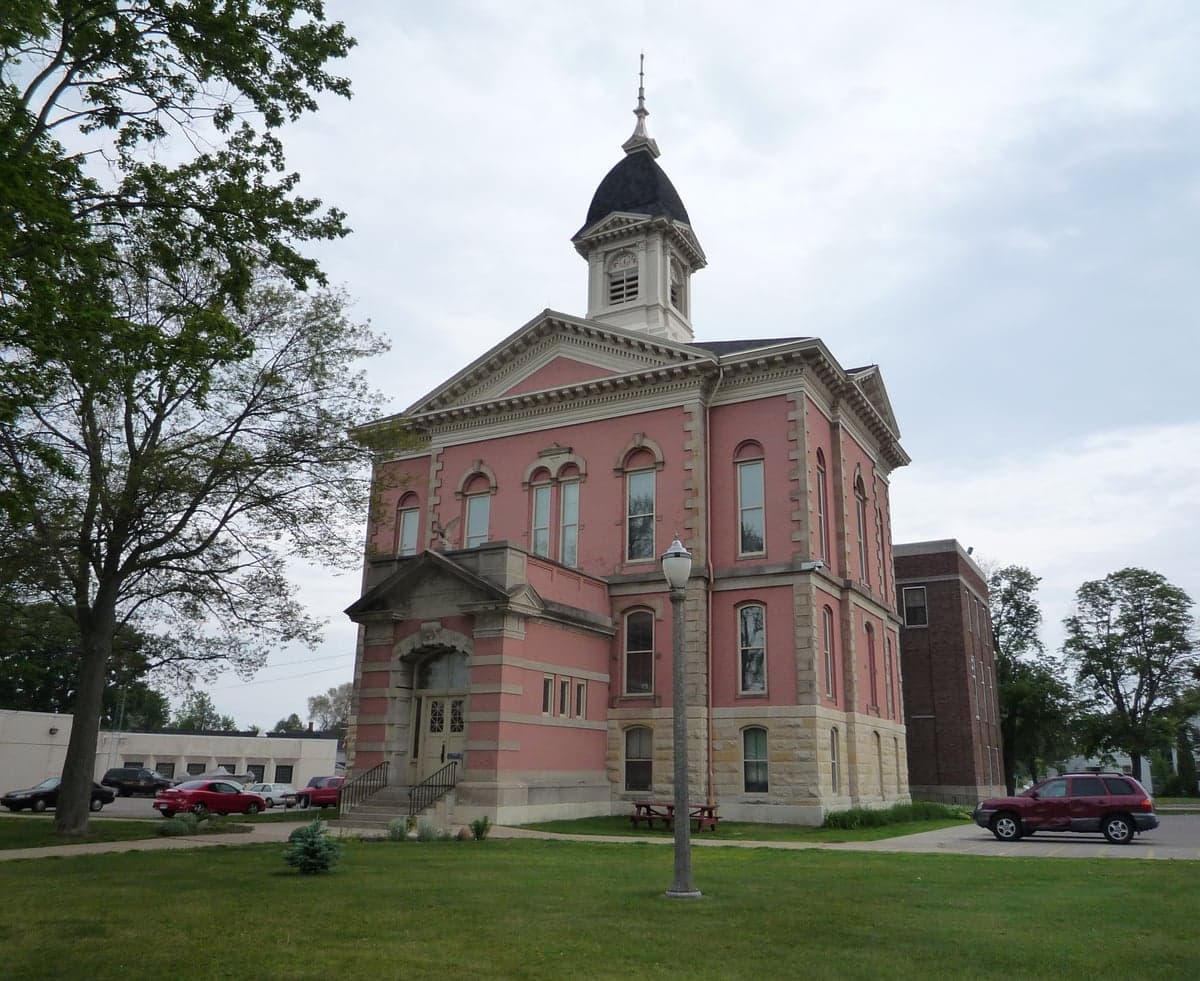
Photo: Wikipedia
Political ClimatePolitical Climate in Menominee County
Showing county-level results — no local-only data available.
Lean and PVI are calculated from this county’s 2020 and 2024 presidential results, Cook-style.
Political rankings in Michigan
- Most Conservative Cities in Michigan
- Most Liberal Cities in Michigan
- Best Liberal-Leaning Towns in the Midwest
- Safest Liberal-Leaning Towns in the Midwest
- Safest Conservative-Leaning Towns in the Midwest
- Affordable Small Towns for Conservatives
- Most Affordable Liberal-Leaning Small Towns in the U.S.
- Safest Conservative-Leaning Cities in the U.S.
- Most Conservative Counties in Michigan
- Most Liberal Counties in Michigan
Local Political AnalysisPolitical Analysis of Menominee County
Menominee County is a reliably Republican stronghold in Michigan’s Upper Peninsula, with a Cook Partisan Voting Index of R+17—meaning it votes about 17 points more Republican than the national average. That’s a stark contrast to the state of Michigan as a whole, which sits at EVEN on the PVI, reflecting its perennial swing-state status. The county has trended redder over the past decade, driven by rural cultural values and economic concerns tied to manufacturing and natural resources, though local pockets of blue persist in the county seat and along the Lake Michigan shoreline.
How it compares
Compared to Michigan’s statewide EVEN rating, Menominee County is an outlier. In the 2020 presidential election, Donald Trump carried the county by roughly 30 points, while Joe Biden won Michigan by 2.8 points. That gap has widened since the 1990s, when the county was more competitive—Bill Clinton actually won Menominee County in 1992 and 1996. Today, the political divide within the county is visible at the precinct level. The city of Menominee itself leans slightly more moderate, with some precincts near the downtown and waterfront voting Democratic in local races, thanks to union households and a small but active progressive base. In contrast, rural townships like Spalding, Stephenson, and Daggett are deeply red, often delivering 70% or more of their votes to Republican candidates. The swing precincts are in the more populated areas around Menominee and Marinette (just across the Wisconsin border), where independent voters and cross-border commuters can tip a close race. The county’s Republican lean is reinforced by its older, predominantly white population and a strong hunting, fishing, and outdoor recreation culture that aligns with conservative views on land use and gun rights.
What this means for residents
For conservative residents, Menominee County feels like a safe haven where their values are reflected in local government, school board decisions, and law enforcement priorities. The county commission and most township boards are solidly Republican, and issues like tax cuts, Second Amendment protections, and opposition to state-level environmental regulations on mining and logging get a sympathetic ear. For liberal residents, it can feel isolating—there’s no progressive caucus or Democratic stronghold to speak of, though the city of Menominee provides a small counterweight. Local Democrats tend to focus on kitchen-table issues like pothole repair, senior services, and school funding rather than national wedge topics. The practical upshot is that political debates here are less about ideology and more about resource allocation—how to keep the local hospital open, whether to support a new industrial park, or how to manage deer populations. National politics feels distant, but the county’s red tilt means state-level Democratic policies (like the 2023 minimum wage increase or renewable energy mandates) are often met with skepticism or outright resistance at the local level.
Culturally, Menominee County is distinct from downstate Michigan in ways that transcend party labels. The area’s Finnish and French-Canadian heritage fosters a strong sense of self-reliance and community mutual aid—neighbors help each other with snow removal or hunting camp repairs regardless of political affiliation. The county’s proximity to Wisconsin also blurs partisan lines; many residents commute to Marinette for work or shopping, and the local media market is shared with Green Bay, so political ads and news coverage often feel more Wisconsin-centric than Michigan-centric. Policy-wise, the county has pushed back against state-level gun laws and environmental regulations on mining, but it has also embraced local initiatives like the Menominee County Community Foundation and the M&M Area Community Foundation that fund nonpartisan projects in education and health. Looking ahead, the county’s Republican lean is likely to persist, but demographic shifts—like an influx of remote workers from downstate and out-of-state retirees—could slowly moderate the politics, especially around Menominee city. For now, it’s a place where the national political storm feels muffled, and most folks just want the roads plowed and the schools funded.

State Political ClimatePolitical Climate in Michigan
State Political AnalysisPolitical Environment in the State
Michigan is the ultimate swing state, with a Cook PVI of EVEN that perfectly captures its knife-edge political balance. Over the past 20 years, the state has lurched from reliably blue (voting for Gore, Kerry, Obama twice) to a Trump pickup in 2016, then back to Biden in 2020 by just 154,000 votes, and now into a full-blown purple trench war where control of the legislature, governor’s mansion, and congressional delegation flips every cycle. The dominant coalitions are a shrinking union-and-auto-worker base in the southeast versus a growing, Trump-friendly exurban and rural vote across the rest of the state, with the critical swing bloc being independent-leaning voters in suburban Macomb County and the Grand Rapids corridor.
Urban vs. rural divide
The political map is a stark checkerboard. Detroit and Wayne County are the Democratic anchor, delivering 68% of the vote for Biden in 2020, but their population has dropped by over 100,000 since 2010, weakening that base. Ann Arbor (Washtenaw County) is the state’s most liberal enclave, voting 80% Democratic, driven by the University of Michigan’s academic and activist culture. Grand Rapids (Kent County) was once a GOP stronghold but has flipped purple—Biden won it by 1 point in 2020, fueled by a growing professional class and moderate Republican defections. Meanwhile, Macomb County (north of Detroit) is the iconic bellwether: it went Obama-Obama-Trump-Trump, and its working-class voters—many union members who broke for Trump on trade and cultural issues—are the most courted demographic in the state. The rural Upper Peninsula and northern Lower Peninsula (counties like Oscoda, Alpena, and Cheboygan) are deep red, often voting 65-70% Republican, but they have tiny populations. The real story is the exurban ring around Detroit—Livingston County voted 62% Trump—and the fast-growing Ottawa County (west of Grand Rapids), which is reliably red but seeing a slow blue trickle from Grand Rapids spillover.
Policy environment
Michigan’s policy landscape is a mixed bag that reflects its swing-state status. Taxes: The state has a flat 4.25% income tax, but a 2023 law tied future rate cuts to revenue triggers—currently suspended, so the rate is effectively locked. Property taxes are capped by Proposal A (1994), which limits annual increases to 5% or inflation, whichever is lower, but reassess on sale can be a shock for new buyers. Education: School funding is per-pupil and relatively equitable, but the state’s 2023 repeal of right-to-work laws (Act 2 of 2023) was a major union win, restoring mandatory dues for public-sector workers. School choice is robust—charter schools and inter-district open enrollment are widely available. Healthcare: Michigan expanded Medicaid under the ACA in 2013, and the Healthy Michigan Plan covers about 1 million residents. Abortion rights were enshrined in the state constitution via Proposal 3 in 2022, with a 56% vote, making Michigan a Midwest abortion-access hub. Election laws: Michigan has no-excuse absentee voting, same-day voter registration, and 9 days of early in-person voting (passed via 2022 Proposal 2). Voter ID is required but can be satisfied with a signed affidavit—a compromise that keeps both sides grumbling.
Recent policy direction
The 2023-2024 Democratic trifecta (Governor Gretchen Whitmer, state House, and Senate) produced a flurry of legislation that shifted the state leftward after decades of GOP control. Gun laws: In 2023, Michigan passed universal background checks, safe storage requirements, and red-flag (extreme risk protection) orders—a major change in a state with strong hunting and gun culture. Parental and education rights: The 2023 repeal of the 1931 abortion ban and the expansion of LGBTQ+ anti-discrimination protections (including in schools) have energized conservative parents, who are now organizing around school board races and curriculum transparency. Speech and privacy: No major changes, but the state’s shield law for journalists is weak, and surveillance via license plate readers is common in metro Detroit. Property rights: Michigan has no statewide rent control, and zoning is largely local, but a 2023 law (HB 5025) preempted local bans on accessory dwelling units, a nod to housing supply. Taxes: The 2023 repeal of the pension tax (retirement income exemption) was a bipartisan win for seniors. Voting and ballot access: Proposal 2 (2022) made Michigan one of the most accessible states for voting, with automatic voter registration at DMVs and no-excuse absentee ballots—a change that Republicans argue increases fraud risk, though no evidence of widespread fraud has emerged.
Civil unrest & political movements
Michigan has been a flashpoint for both left and right activism. The 2020 Whitmer kidnapping plot (involving militia members from the Wolverine Watchmen) and the Operation Gridlock protests at the state capitol (April 2020, where armed demonstrators opposed COVID-19 restrictions) put Michigan on the national map for right-wing mobilization. On the left, the 2020 George Floyd protests in Detroit and Grand Rapids saw significant property damage, and the 2022 abortion rights campaign (Proposal 3) was the most well-funded ballot initiative in state history. Immigration politics: Michigan is not a border state, but the 2023 expansion of driver’s licenses to undocumented immigrants (passed along party lines) has been a rallying cry for conservatives. Election integrity: The 2020 election in Michigan was the subject of intense litigation and a GOP-led audit of Wayne County, which found no systemic fraud but deepened distrust. The 2024 election saw razor-thin margins in several state House races, with recounts in a few districts. New residents will notice the “Trump 2024” flags flying alongside “Whitmer 2026” yard signs in equal measure, especially in the I-96 corridor between Lansing and Grand Rapids.
Projection
Over the next 5-10 years, Michigan’s political trajectory points toward continued deadlock with a slight blue tilt, driven by demographic shifts. In-migration: The state is gaining population from Illinois and Ohio, particularly in the Grand Rapids and Traverse City areas, and these newcomers tend to be moderate-to-liberal professionals. Out-migration: Detroit’s population decline is slowing, but rural counties are aging and shrinking. The 2024 redistricting (done by an independent commission) created more competitive seats, meaning the state legislature will likely remain narrowly divided. The wild card is the 2026 gubernatorial race: if Whitmer runs for Senate or leaves, the GOP has a real shot at retaking the governor’s mansion, especially if they nominate a moderate like former Rep. Fred Upton. Expect continued fights over school funding, energy policy (the 2023 clean energy standard requiring 100% carbon-free electricity by 2040 is a flashpoint), and the ongoing implementation of the 2023 gun laws. A new resident moving in now should expect a state where no policy is safe from reversal—the 2023 right-to-work repeal could be reinstated if the GOP wins back the legislature, and the abortion rights amendment is likely to face legislative challenges around parental consent and late-term limits.
Bottom line for a new resident: Michigan is not a place where you can assume your political views are the majority—you will live next to people who voted the opposite way in every election. For conservatives, the state offers low property taxes (thanks to Proposal A), strong school choice, and a vibrant outdoor culture, but you’ll need to navigate a Democratic governor and a state-level policy environment that has moved left on guns, abortion, and labor. For liberals, Michigan provides strong abortion protections, union-friendly laws, and a robust voting system, but you’ll face a deeply entrenched conservative rural vote that keeps every election competitive. The practical takeaway: your vote matters more here than almost anywhere else in the country, and your local school board and county commission races will have outsized impact on your daily life. If you want a state where your politics are the default, look elsewhere. If you want a place where every election feels like a Super Bowl, welcome to Michigan.
* Values derived from national, state, county, city and local statistics and may differ in a specific area. Last updated: 2026-11-23T09:52:40.000Z
Narrative content on this page is AI-generated and may contain mistakes. Verify any details that matter before acting on them.
ReloMaps may earn a commission from affiliate links at no extra cost to you.

