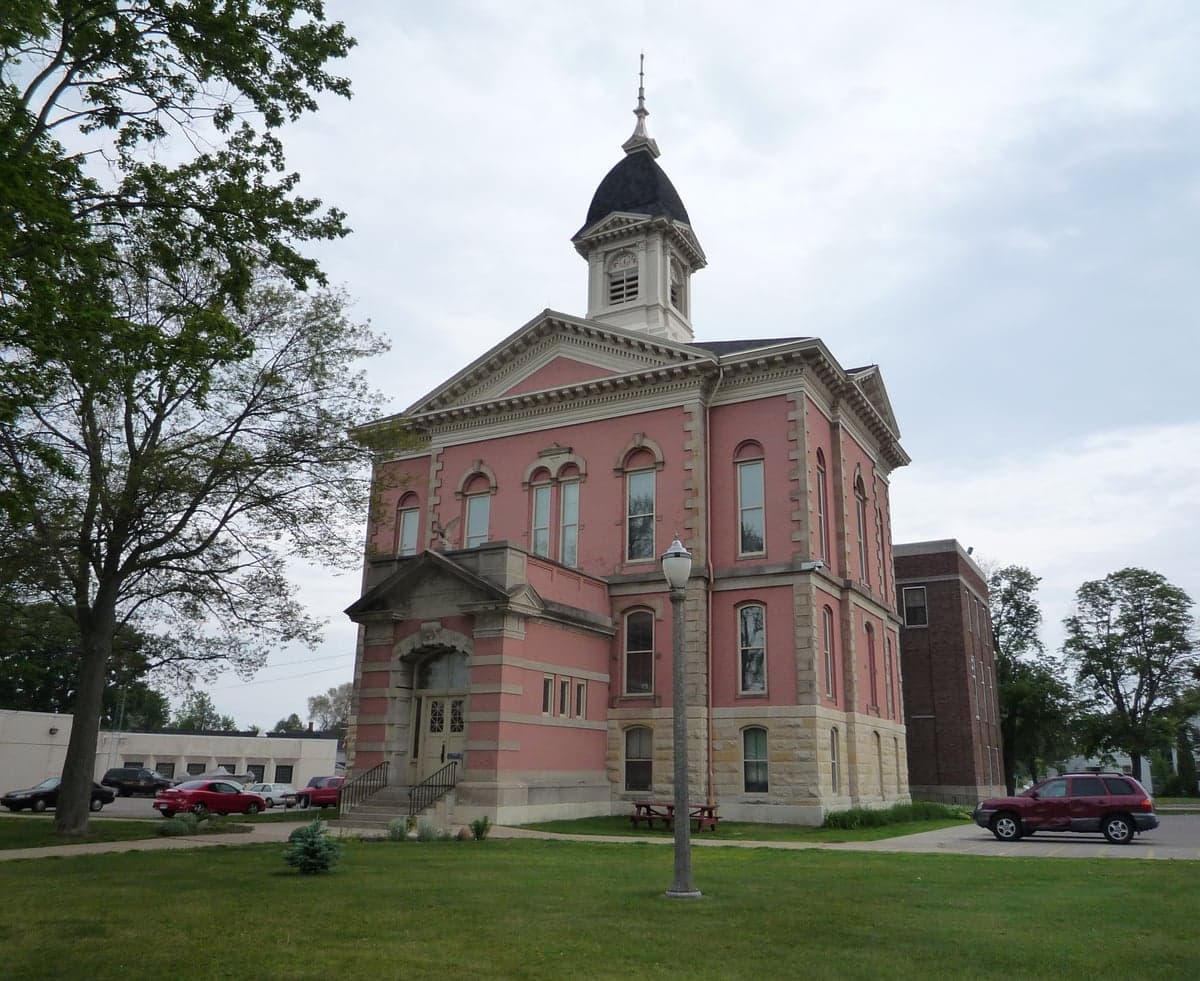
Photo: Wikipedia
Demographics of Menominee County
Affluence Level in Menominee County
A below-average socioeconomic profile. Incomes, home values, and educational attainment trail the U.S., with higher poverty and unemployment.
People of Menominee County
Menominee County, Michigan, is home to 23,295 residents, a population that is 91.5% White and deeply rooted in a working-class, small-town character shaped by its Upper Peninsula location along the Green Bay shoreline. With a foreign-born population of just 0.7% and a college attainment rate of 18.0%, the county is one of the least ethnically diverse in Michigan, retaining a distinctly Northern European and Native American heritage. The people here are defined by a quiet resilience, a connection to the lumber and paper industries that built the region, and a strong sense of place in communities like Menominee, Stephenson, and Powers.
Settlement & growth (pre-1960)
Long before European settlement, the Menominee County area was the ancestral homeland of the Menominee Native American nation, who lived along the Menominee River and its tributaries for centuries. The river itself, which forms the county's southern border with Wisconsin, was a vital transportation and fishing corridor. French fur traders and Jesuit missionaries arrived in the 17th century, establishing a sparse presence, but it was not until the 1830s that American settlers began to arrive in significant numbers, drawn by the region's vast white pine forests.
The first major wave of American settlement came in the 1840s and 1850s, driven by the lumber boom. Yankees from New England and New York, along with French-Canadian loggers and river drivers, established the earliest permanent settlements. The city of Menominee, founded in 1863, quickly grew into a major lumber port, processing timber from the surrounding forests and shipping it across the Great Lakes. By the 1870s, the county's population was a mix of these groups, with French-Canadian families concentrating in Menominee and the nearby farming community of Stephenson.
A second, larger wave of immigration arrived between 1880 and 1910, as the lumber industry matured and diversified into paper manufacturing. This period brought a significant influx of German, Polish, and Swedish immigrants, who came to work in the sawmills, paper mills, and logging camps. The Germans and Poles settled heavily in Menominee and the mill town of Powers, while Swedish families established farming communities in the rural townships of Ingallston and Spalding. These groups formed the backbone of the county's Catholic and Lutheran congregations, which remain prominent today. A smaller number of Italian and Finnish immigrants also arrived, working in the iron ore docks and railroad yards of Menominee.
By the 1920s, the lumber boom had faded, but the paper industry—anchored by the Menominee Paper Company and later the Scott Paper Company—sustained the local economy. The county's population peaked at around 28,000 in the 1930s and remained stable through the post-war era. The 1950s saw a modest suburbanization around Menominee, with new housing developments in Harris and Nadeau townships, but the county's rural character persisted. The Native American population, primarily the Menominee tribe, was largely displaced or assimilated during this period, though a small community remained in the county.
Modern era (post-1965)
The 1965 Hart-Cellar Act had a negligible impact on Menominee County. Unlike urban centers or Sun Belt suburbs, the county received virtually no new immigration from Asia, Latin America, or the Middle East. The foreign-born population today stands at just 0.7%, and the county's racial composition has remained overwhelmingly White—91.5%—with only modest increases in Hispanic (2.3%) and Black (0.6%) populations since 2000. The East/Southeast Asian community is 0.3%, and the Indian-subcontinent population is 0.1%, both concentrated almost entirely in Menominee itself, often tied to professional roles at the local hospital or paper mills.
Domestic migration has been the primary demographic force since 1970, and it has been a story of slow decline. The county's population has fallen from a post-war peak of 28,000 to its current 23,295, as younger residents have left for larger job markets in Green Bay, Appleton, and the broader Midwest. This out-migration has been partially offset by an influx of retirees and second-home buyers from Wisconsin and Illinois, drawn to the county's low cost of living, lakefront property, and quiet lifestyle. These newcomers tend to settle along the Lake Michigan shoreline in Menominee and the unincorporated community of Cedar River, where seasonal homes and year-round retirement communities have grown.
The county's Hispanic population, while small, has grown from under 1% in 1990 to 2.3% today, driven by a small number of migrant farmworkers and their families who have settled in the agricultural areas around Stephenson and Powers. The Black population remains tiny at 0.6%, with most individuals living in Menominee and working in the service or manufacturing sectors. The Native American population, now less than 1%, is primarily of Menominee and Ojibwe descent, with a small community in the rural areas near the Wisconsin border.
The future
Menominee County is projected to continue its slow population decline over the next 10-20 years, as the region's aging demographic profile and limited job growth in high-skill sectors persist. The county's median age is already above the state average, and the out-migration of young adults is unlikely to reverse without a major economic shift. The county is becoming slightly more diverse, but from a very low base: the Hispanic share may reach 3-4% by 2040, and the East/Southeast Asian and Indian populations will likely remain below 1% each, concentrated in professional roles in Menominee.
The cultural identity of the county is evolving from a purely industrial, lumber-and-paper heritage toward a more recreation-and-retirement economy. New residents are increasingly drawn to the county's natural assets—the Menominee River, Lake Michigan, and the sprawling forests—rather than its manufacturing base. This is leading to a subtle cultural shift, with a growing emphasis on outdoor recreation, tourism, and seasonal living. The county's political character, historically conservative and union-oriented, is likely to remain stable, as the new arrivals tend to be older and politically moderate to conservative.
For someone moving in now, Menominee County offers a deeply rooted, low-density, and ethnically homogeneous community where the pace of life is slow and the cost of living is low. The county is not becoming a diverse or cosmopolitan destination; it is becoming a quieter, older, and more recreation-focused version of its former self. The people who thrive here are those who value solitude, natural beauty, and a strong sense of local history—and who are comfortable in a place where the population is slowly shrinking and the faces remain largely the same.

* Values derived from national, state, county, city and local statistics and may differ in a specific area. Last updated: 2026-11-23T09:52:40.000Z
Narrative content on this page is AI-generated and may contain mistakes. Verify any details that matter before acting on them.
ReloMaps may earn a commission from affiliate links at no extra cost to you.

