Photo: Wikipedia
Political ClimatePolitical Climate in Michigan City, IN
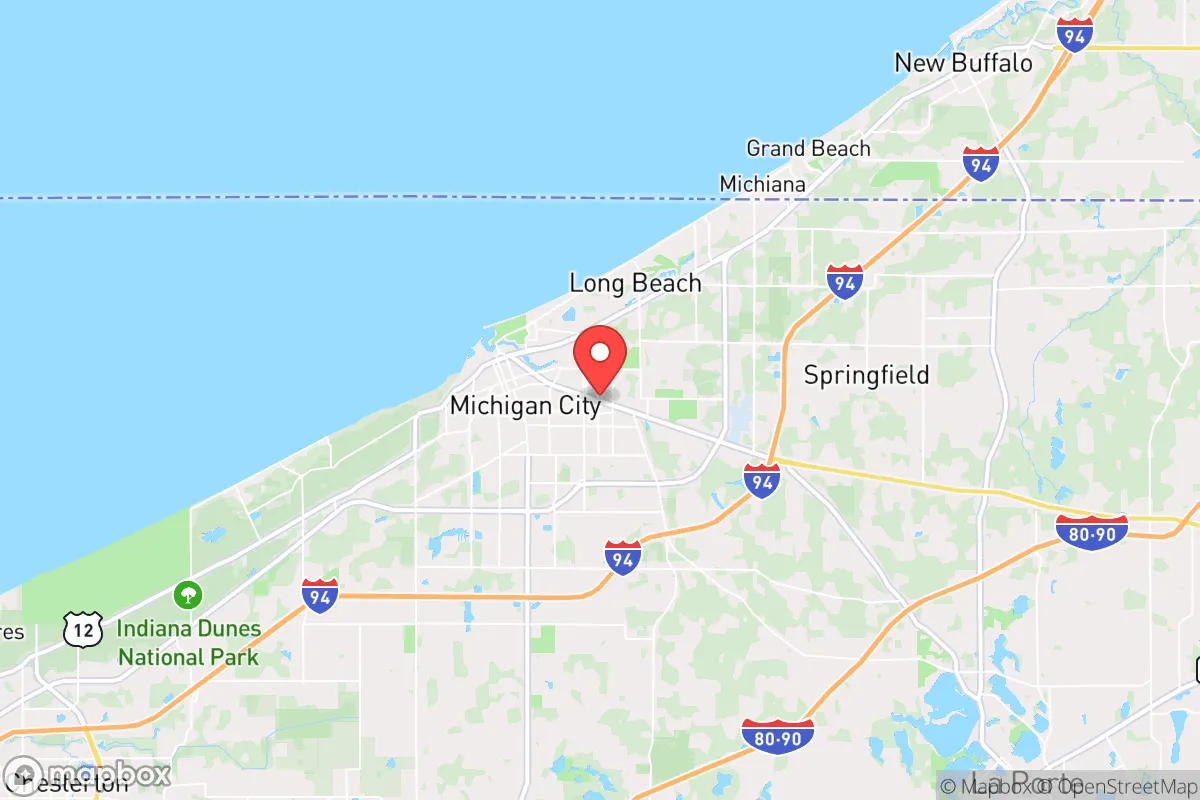
District shown is the primary district for this city’s centroid. Cities may span multiple districts.
Local Political AnalysisPolitical Analysis of Michigan City, IN
Michigan City, Indiana, sits in a political gray zone that’s been shifting leftward over the past decade, and if you’ve lived here as long as I have, you’ve felt it. The Cook PVI rating of D+1 tells you it’s a true toss-up district, but the trend line is concerning for anyone who values limited government and personal freedoms. Back in the 2000s, this area leaned more conservative, with LaPorte County often splitting tickets and sending moderates to Indianapolis. Now, you see progressive policies creeping into city council meetings and school board decisions, and the surrounding towns—like conservative-leaning LaPorte to the south or rural New Buffalo across the state line—offer a stark contrast in how they handle taxes, zoning, and local control.
How it compares
Drive 15 minutes south to LaPorte, and you’re in a community that still votes reliably red in county races, with a focus on property rights and lower spending. Head east to the lakeshore communities like Long Beach, and you’ll find a mix of retirees and second-home owners who lean more libertarian than progressive. But Michigan City itself has become a magnet for Chicago transplants and state-funded projects that push a bigger government footprint. The city council has passed ordinances on rental inspections and short-term rental caps that feel like overreach to anyone who remembers when the motto was “live and let live.” Compare that to nearby towns like Chesterton or Valparaiso, where the tax burden is lower and the school boards haven’t embraced the same level of DEI programming or critical race theory curriculum. The contrast is real, and it’s widening.
What this means for residents
For families and small business owners, the shift means more red tape and higher costs. The city’s push for “equity” initiatives has led to new permitting fees and zoning overlays that make it harder to open a shop or renovate a home without jumping through hoops. Property taxes have crept up as the city borrows for infrastructure projects tied to state grants, and there’s a growing sense that your voice at town hall matters less than the priorities of outside advocacy groups. If you value the Second Amendment, you’ll notice that while Indiana has preemption laws, local officials have tried to create “sensitive places” restrictions that chip away at carry rights. The school system has also seen curriculum changes that emphasize social justice over core academics, which is a dealbreaker for many conservative parents who are now looking at private or homeschool options. Long-term, if the trend continues, Michigan City could become a smaller version of Gary—a place where government dependency replaces self-reliance.
Culturally, Michigan City still has its charms—the lake, the dunes, the small-town feel in certain neighborhoods—but the political climate is making it harder to ignore the overreach. The city’s embrace of sanctuary city policies, even in a symbolic form, sends a message that local law enforcement won’t fully cooperate with federal immigration authorities, which rubs many long-time residents the wrong way. And the push for a “climate action plan” tied to state funding has led to talk of banning natural gas in new construction, which would hit homeowners’ wallets hard. If you’re considering a move here, I’d say keep an eye on the next few elections. The old guard is fading, and the new wave of progressive leadership is determined to reshape this town in ways that might not sit well with anyone who believes the government that governs least governs best.

State Political ClimatePolitical Climate in Indiana
State Political AnalysisPolitical Environment in the State
Indiana has been a reliably red state for decades, but it’s not the deep-red fortress many assume. The state leans Republican at the presidential level by about 10-15 points, but that margin has narrowed slightly over the last two cycles as suburban areas drift left and rural counties hold firm. Over the past 20 years, Indiana has shifted from a solidly conservative, union-influenced swing state to a more reliably Republican one, though the coalition is fracturing along familiar lines: the booming Indianapolis suburbs are becoming more moderate, while the rest of the state is digging in culturally and politically.
Urban vs. rural divide
The political map of Indiana is a study in contrasts. Indianapolis (Marion County) is the blue anchor, consistently voting Democratic by double digits, driven by a diverse population, major universities (IUPUI), and a growing tech sector. The surrounding donut counties—Hamilton, Hendricks, Johnson, and Boone—are the real story. Hamilton County, home to Carmel and Fishers, was once a GOP stronghold but has shifted noticeably left, with Biden winning 47% there in 2020. These are affluent, educated suburbs where social issues take a backseat to fiscal conservatism and quality-of-life concerns. Meanwhile, Fort Wayne (Allen County) and Evansville (Vanderburgh County) are more conservative than Indy but still have blue pockets near their downtowns. The real red meat is in the rural counties: Kosciusko, Dubois, and Ripley routinely vote 70-80% Republican. Lake County (Gary/Hammond) is the state’s other blue stronghold, but its population is declining, reducing its statewide influence. The divide isn’t just urban vs. rural—it’s suburban drift vs. small-town stability, and that’s where the tension lives.
Policy environment
Indiana’s policy environment is broadly conservative, but with a pragmatic, business-first twist. The state has a flat income tax rate of 3.05% (down from 3.23% in 2023), with a scheduled phase-down to 2.9% by 2027. Property taxes are capped at 1% of assessed value for owner-occupied homes, which keeps housing affordable but strains local services. There’s no inheritance tax, and the sales tax is 7%. On education, Indiana has a robust school choice program—vouchers are available to any family below 300% of the federal poverty line, and charter schools are plentiful. However, the state’s 2023 “Parents’ Bill of Rights” (HB 1608) requires schools to notify parents of any changes in a child’s health or well-being, including mental health and gender identity discussions—a win for parental rights that has drawn legal challenges. Healthcare is a mixed bag: Indiana expanded Medicaid under Pence, but the state has not adopted a public option. Election laws are moderately restrictive: voter ID is required, and early voting is available but not universal mail-in. The state also passed a near-total abortion ban in 2022 (SB 1), with exceptions only for rape, incest, and life of the mother—a major draw for pro-life families.
Trajectory & freedom
On the freedom front, Indiana is moving in a positive direction for conservatives, but not without caveats. Constitutional carry (permitless carry) became law in 2022 (HB 1296), allowing any law-abiding adult to carry a handgun without a license—a clear expansion of Second Amendment rights. The state also passed a preemption law (SB 209) in 2023 that blocks local governments from enacting their own gun restrictions, preventing a patchwork of city-level bans. On medical freedom, Indiana was one of the first states to ban COVID-19 vaccine passports (SB 5, 2021) and has resisted federal mandates for state employees. However, the state’s emergency powers remain broad—the governor can still issue executive orders during a declared emergency, which was a flashpoint during COVID. Property rights are strong: Indiana is a “right-to-work” state (2012), and there’s no state-level rent control. The biggest freedom concern is eminent domain abuse, particularly for the LEAP Lebanon project, a massive water and infrastructure grab in Boone County that has pitted farmers against the state’s economic development arm. That’s a local issue, but it’s a reminder that “freedom” in Indiana sometimes means freedom for corporations, not individuals.
Civil unrest & political movements
Indiana has seen its share of political flashpoints, but nothing like the West Coast or Chicago. The 2020 George Floyd protests in Indianapolis turned violent, with looting and fires along Mass Ave, and the city’s police department is still under a federal consent decree. On the right, the “Indiana Freedom Coalition” and local Moms for Liberty chapters have been active in school board races, particularly in Hamilton County and Johnson County, pushing for curriculum transparency and parental oversight. Immigration politics are relatively quiet—Indiana is not a border state, but Elkhart and Goshen have seen tensions over a growing Hispanic population in the RV manufacturing corridor. There’s no sanctuary city policy anywhere in the state; in fact, SB 590 (2023) requires local law enforcement to cooperate with ICE. Election integrity is a live issue: the 2020 election was secure here, but Secretary of State Diego Morales has pushed for stricter voter roll maintenance and signature verification. The most visible political movement is the “Parents’ Rights” wave, which has turned school board meetings in Zionsville and Westfield into battlegrounds over library books and gender ideology. You won’t see street protests daily, but the culture war is alive and well in the suburbs.
Projection
Over the next 5-10 years, Indiana will likely remain red but with a softer shade. The in-migration from Illinois and California is real—people are moving to Noblesville, Brownsburg, and Greenwood for lower taxes and housing costs—but these newcomers tend to be moderate Republicans or independents who care more about schools and commute times than culture war battles. The Indianapolis suburbs will continue to drift left, especially as tech and finance jobs grow, while rural counties will harden their conservatism. The state’s demographic future is mixed: the white population is aging, but Hispanic and Asian populations are growing in Marion and Lake counties, which could shift the needle slightly blue over time. The biggest wildcard is education policy—if school choice expands further and public schools continue to lose enrollment, the suburban moderates may feel alienated. Expect the flat tax to drop to 2.5% or lower, and expect more preemption laws to block local progressive ordinances (like plastic bag bans or rent control). The LEAP Lebanon project will be a test case for whether the state respects property rights or bulldozes them for economic development—if it goes badly, it could galvanize a libertarian backlash.
Bottom line for a new resident: If you’re moving to Indiana for freedom, you’ll find it—especially on guns, taxes, and school choice. But don’t expect a libertarian paradise. The state government is pro-business, not necessarily pro-individual, and the suburban culture is increasingly moderate. Pick your county carefully: Hamilton County is great for schools but politically shifting, Kosciusko County is rock-ribbed conservative but quieter, and Marion County is a blue island you’ll want to avoid if you value low taxes and conservative governance. Indiana is a good bet for the next decade, but keep an eye on the suburbs—that’s where the future is being decided.
* Values derived from national, state, county, city and local statistics and may differ in a specific area. Last updated: 2026-04-22T08:59:38.000Z
Narrative content on this page is AI-generated and may contain mistakes. Verify any details that matter before acting on them.
ReloMaps may earn a commission from affiliate links at no extra cost to you.

