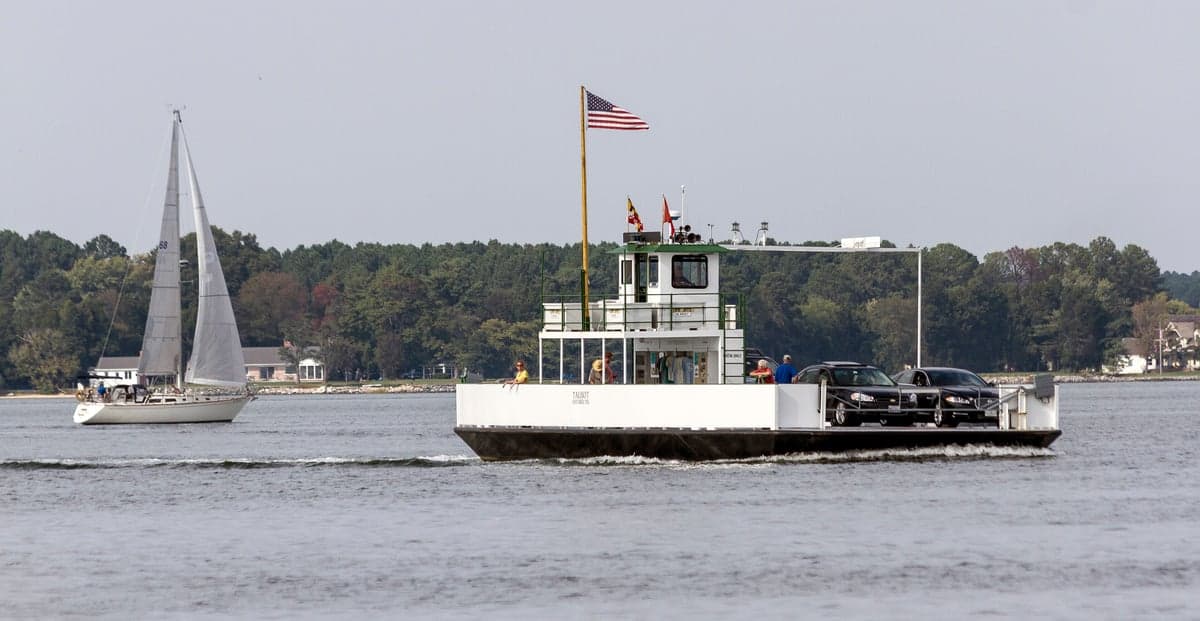
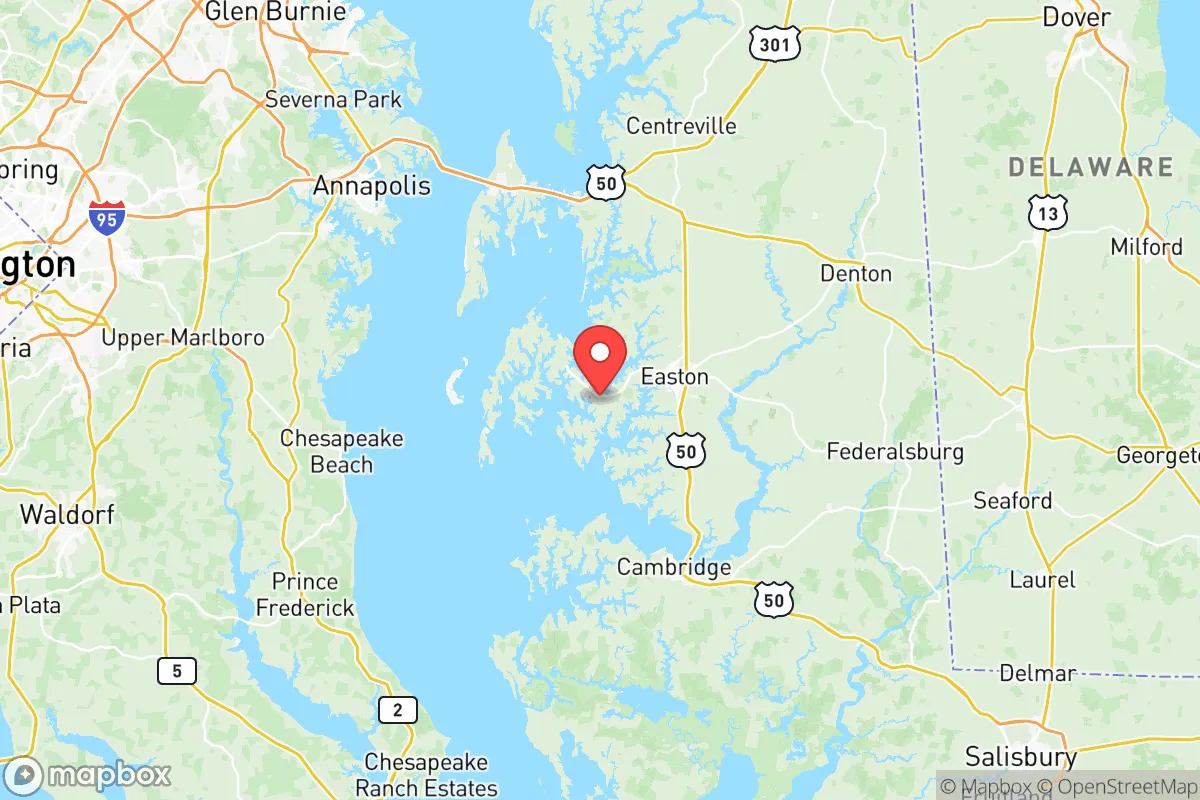
Photo: Wikipedia
Demographics of Talbot County
Affluence Level in Talbot County
A middle-class area roughly in line with national averages across income, home values, education, and employment.
People of Talbot County
Talbot County, Maryland, today is a predominantly white (74.2%), well-educated (41.3% college degree) community of 37,707 residents, characterized by a blend of historic Eastern Shore aristocracy and a growing, diversifying workforce. The county’s identity is rooted in its deep colonial history, its role as a center for Chesapeake Bay seafood and agriculture, and its modern status as a destination for affluent retirees and second-home owners drawn to towns like Easton, St. Michaels, and Oxford. While still less diverse than the national average, the population is slowly shifting, with a notable Hispanic community (9.1%) and a stable Black population (12.0%) that traces its lineage to the region’s plantation-era past.
Settlement & growth (pre-1960)
The human history of Talbot County begins with the indigenous peoples of the Algonquian-speaking Choptank tribe, who inhabited the shores and tributaries of the Chesapeake Bay for centuries before European contact. English colonists, primarily from the Tidewater region of Virginia and directly from England, began settling the area in the 1630s, establishing tobacco plantations along the Miles River and the Choptank River. The county was officially formed in 1661 from Kent County, and its early economy was built on enslaved African labor, with the Black population concentrated on large estates near what is now Easton and along the waterfronts of Oxford and St. Michaels.
Throughout the 18th and 19th centuries, the population remained overwhelmingly of English and African descent, with a small influx of Scots-Irish and German farmers moving into the interior around Trappe and Cordova. The county’s economy shifted from tobacco to wheat, shipbuilding, and seafood packing, particularly in the towns of St. Michaels (a center for oyster and crab canning) and Tilghman Island (a working watermen’s community). The Civil War and Reconstruction era saw the emancipation of enslaved people, but Talbot County’s Black population remained largely rural and economically tied to agriculture and the seafood industry, with communities forming in areas like Unionville and Copperville.
The early 20th century brought little new immigration; the county’s population was stable and insular. The Great Depression and World War II saw outmigration of both Black and white residents to urban centers like Baltimore and Philadelphia. The post-war period, however, marked a turning point: the construction of the Chesapeake Bay Bridge in 1952 (connecting the Eastern Shore to the Baltimore-Washington metropolitan area) began to open Talbot County to tourism and second-home development. Easton, the county seat, started to attract retirees and professionals seeking a quieter, waterfront lifestyle, while St. Michaels transformed from a working fishing village into a historic resort town.
Modern era (post-1965)
The 1965 Hart-Cellar Act had a limited direct impact on Talbot County compared to urban areas, but its effects are visible in the slow diversification of the population. The most significant demographic shift since the 1970s has been the arrival of Hispanic immigrants, primarily from Mexico and Central America, who came to work in the county’s agricultural sector—picking vegetables, working in nurseries, and processing seafood. This community has concentrated in and around Easton, particularly in the neighborhoods near the industrial park and along Route 50, as well as in the rural areas around Trappe and Cordova. The Hispanic share of the population now stands at 9.1%, making it the fastest-growing ethnic group in the county.
Domestic migration has been the larger driver of change. The Chesapeake Bay Bridge’s expansion and the rise of telecommuting have made Talbot County increasingly attractive to affluent professionals and retirees from the Washington, D.C., and Baltimore suburbs. This wave has concentrated in the historic waterfront towns: St. Michaels (known for its inns and yacht clubs), Oxford (a quiet sailing community), and the historic district of Easton. These newcomers are disproportionately white, college-educated, and politically moderate to conservative, reinforcing the county’s Republican lean while also supporting local preservation and environmental causes. The Black population, which was historically a larger share (around 20-25% in the early 20th century), has declined to 12.0% as younger Black residents have moved to cities for education and employment, though a stable community remains in Easton’s older neighborhoods and in the rural enclave of Unionville.
The East/Southeast Asian population (0.5%) and Indian subcontinent population (0.7%) are very small, consisting largely of professionals in healthcare and technology who have settled in Easton and, to a lesser extent, St. Michaels. The foreign-born share of the population is just 4.9%, well below the national average, reflecting the county’s limited industrial base and its reliance on domestic migration rather than international immigration.
The future
Talbot County’s population is projected to grow slowly, driven primarily by continued domestic migration of affluent retirees and remote workers from the Washington-Baltimore corridor. The county’s demographic future will likely see a gradual increase in Hispanic representation, as the existing community grows through both births and continued labor migration to agriculture and service industries. The Black population share is expected to remain stable or decline slightly, as outmigration of younger Black residents continues to outpace in-migration. The white population, while still the overwhelming majority, will continue to age, with the county’s median age (already above the national average) rising further as younger families are priced out of the historic waterfront towns.
New residential development is concentrated in and around Easton, particularly in planned subdivisions and 55+ communities, as well as along the Route 50 corridor toward Trappe. The county’s cultural identity is evolving from a quiet, insular Eastern Shore community into a more cosmopolitan, amenity-rich destination for those seeking a slower pace with access to high-end dining, boating, and historic preservation. The tension between preservationists (who want to limit growth) and pro-development interests (who want to expand the tax base and attract younger families) will shape the county’s future character.
For someone moving in now, Talbot County offers a stable, safe, and scenic environment with strong schools and a conservative-leaning political culture, but it is not a place of rapid demographic change or ethnic diversity. The county is becoming more affluent, more oriented toward tourism and retirement, and slightly more Hispanic, while remaining a predominantly white, well-educated community where newcomers are expected to respect the area’s historic character and environmental sensitivity.

* Values derived from national, state, county, city and local statistics and may differ in a specific area. Last updated: 2026-08-09T12:32:40.000Z
Narrative content on this page is AI-generated and may contain mistakes. Verify any details that matter before acting on them.
ReloMaps may earn a commission from affiliate links at no extra cost to you.

