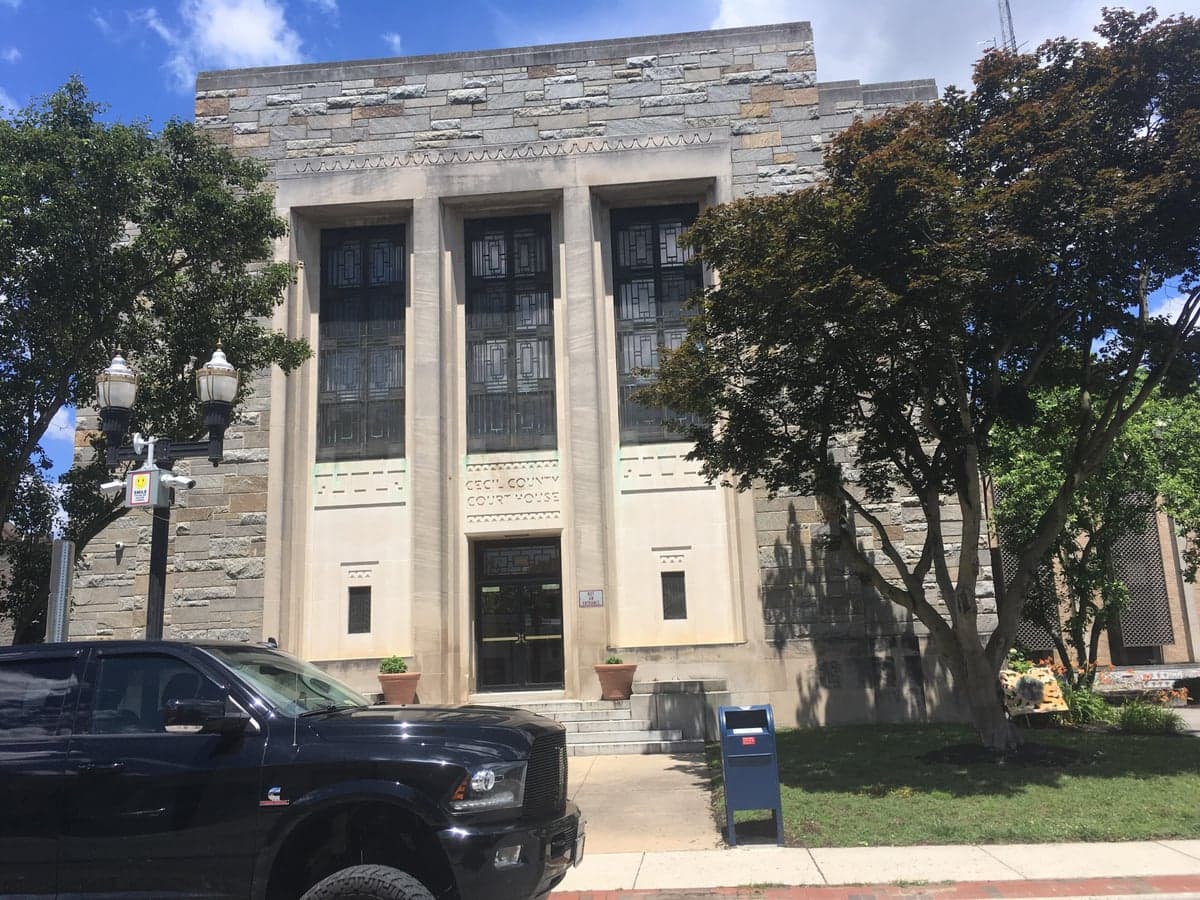
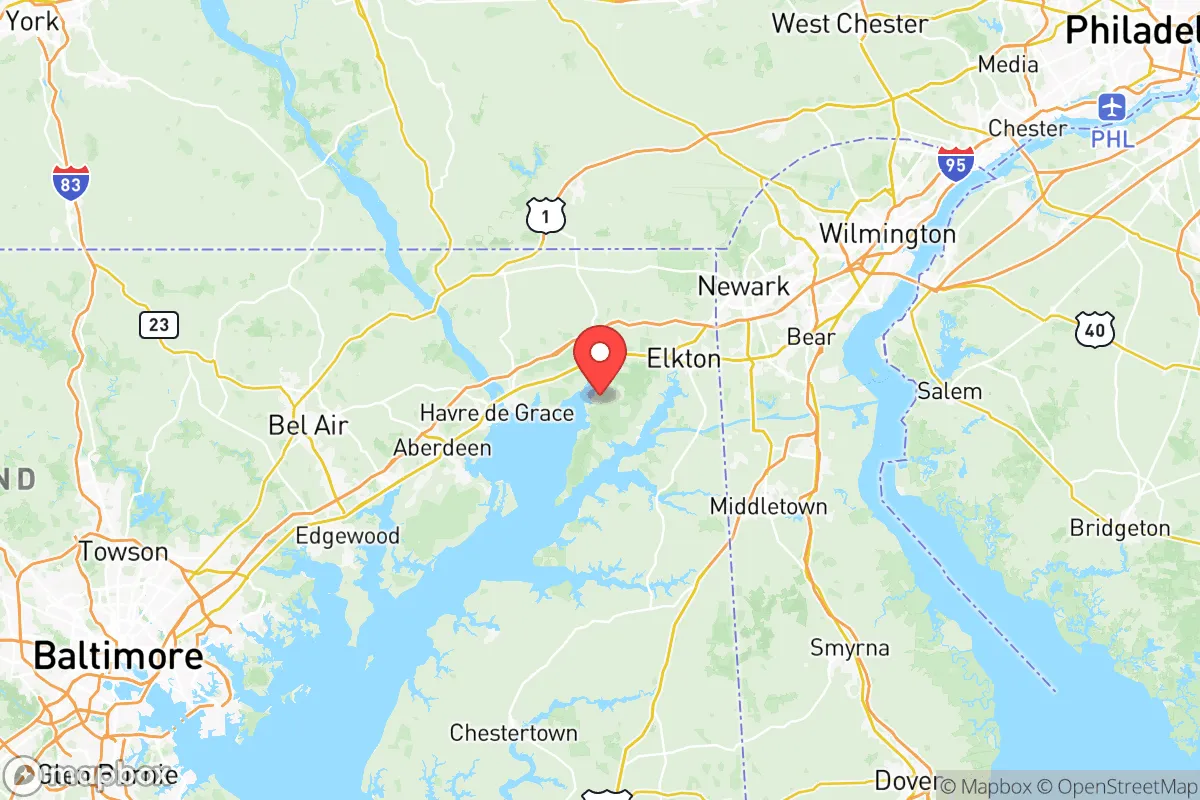
Photo: Wikipedia
Demographics of Cecil County
Affluence Level in Cecil County
A middle-class area roughly in line with national averages across income, home values, education, and employment.
People of Cecil County
Cecil County’s 104,366 residents today form one of Maryland’s most distinctive population profiles: overwhelmingly white (81.4%), with a foreign-born share of just 1.6% that ranks among the lowest in the state. This is a working-class, family-oriented county of small towns and rural crossroads, where the largest minority groups are Black residents (6.9%) and Hispanic residents (5.4%), and where the college-educated share (26.9%) trails the state average by a wide margin. The people of Cecil County are defined less by any single ethnic enclave than by a deep, multi-generational rootedness in the land between the Susquehanna River and the Delaware border.
Settlement & growth (pre-1960)
Long before European settlement, the territory that became Cecil County was home to the Susquehannock people, an Iroquoian-speaking nation whose principal villages lined the Susquehanna River and its tributaries. The Susquehannocks were decimated by disease and warfare with the Iroquois Confederacy by the 1670s, and the region was effectively depopulated of Native inhabitants by the time English colonists began arriving in earnest. The county was formally created in 1674 from Baltimore and Kent counties, named for Cecil Calvert, the second Lord Baltimore.
The first permanent English settlers were largely planters and farmers of middling means who came from southern Maryland and Virginia's Eastern Shore, drawn by the rich tobacco-growing soils along the Elk River and the Sassafras River. They established the county's oldest settlements — Elkton (originally Head of Elk), Charlestown, and Cecilton — as tobacco ports and courthouse towns. By the mid-1700s, a second wave of Scots-Irish and German immigrants pushed inland from the Chesapeake, clearing the dense hardwood forests of the county's northern and western reaches. These newcomers founded the crossroads communities of Rising Sun and Colora, where their descendants still form the backbone of the rural population today.
The 19th century brought a third wave: Irish immigrants fleeing the Great Famine in the 1840s and 1850s, who settled in Elkton and Port Deposit to work on the Susquehanna Canal and the Philadelphia, Wilmington and Baltimore Railroad. A smaller number of German immigrants arrived in the same period, settling around North East and Perryville as farmers and millers. The county's Black population, which had existed since the colonial era as enslaved labor on tobacco plantations, grew substantially after the Civil War as freedmen concentrated in the county's southern towns — Chesapeake City and Earleville — where they worked as watermen, farm laborers, and domestic servants.
Through the first half of the 20th century, Cecil County remained a quiet, agrarian corner of Maryland. Its population grew slowly, sustained by dairy farming, chicken processing, and the shipyards of Charlestown and Port Deposit during the World War II era. The construction of U.S. Route 40 and the Pennsylvania Railroad's main line through the county brought modest commercial growth to Elkton, but the county's character remained overwhelmingly rural and white well into the 1950s.
Modern era (post-1965)
The 1965 Hart-Cellar Act, which abolished national-origin quotas, had remarkably little direct effect on Cecil County. With a foreign-born share of just 1.6% — roughly one-tenth the national average — the county has been almost entirely bypassed by the post-1965 immigration waves that transformed nearby Baltimore and Wilmington. The small Hispanic population (5.4%) is a recent phenomenon, driven primarily by Mexican and Central American workers recruited to the county's mushroom farms and poultry processing plants around Elkton and North East since the 1990s. The county's East/Southeast Asian population (0.9%) and Indian-subcontinent population (0.4%) are tiny, concentrated almost entirely among professional families in the Elkton and Perryville areas.
The county's modern demographic story is instead one of domestic migration and suburban spillover. Beginning in the 1980s, the completion of Interstate 95 through the county's eastern edge transformed Cecil County from a rural backwater into a commuter exurb. Families priced out of Delaware's New Castle County and Maryland's Harford County began moving to Elkton, North East, and the new developments around Perryville, drawn by lower housing costs and easy access to jobs in Wilmington, Baltimore, and Philadelphia. This influx has been overwhelmingly white and domestic — the county's Black population (6.9%) has remained stable for decades, concentrated in the historic communities of Chesapeake City and Earleville, while the Hispanic population has grown steadily but slowly from a very small base.
Suburbanization has been uneven. The county's eastern half, closest to the Delaware line, has seen the most new residential construction, with sprawling single-family subdivisions around Elkton and North East. The western half, anchored by Perryville and Port Deposit along the Susquehanna, has remained more industrial and working-class. The county's interior — the farm country around Rising Sun and Colora — has changed least, retaining a distinctly rural character that now feels increasingly out of step with the commuter-oriented eastern corridor.
The future
Cecil County's population is projected to grow modestly over the next two decades, perhaps reaching 115,000 by 2040, but the character of that growth is uncertain. The county's low foreign-born share is unlikely to change dramatically; without a major employer or refugee resettlement program, international immigration will remain a minor factor. The more significant question is domestic migration: if housing costs in the Baltimore-Washington corridor continue to rise, Cecil County's relative affordability could attract a more diverse, more educated influx of younger families. If the regional economy stagnates, the county could instead see continued out-migration of its college-educated young adults, who currently leave for jobs in Wilmington and Baltimore at rates well above the national average.
The Hispanic population is the county's fastest-growing demographic group and is likely to double or triple in share over the next 20 years, driven by natural increase and continued agricultural labor demand. This growth is dispersing rather than concentrating — there is no single Hispanic enclave in Cecil County, but rather small clusters of families in Elkton, North East, and the mushroom-growing areas around Kemblesville on the Pennsylvania border. The county's Black population is aging and, without significant in-migration, is likely to decline slightly as a share of the total. The East/Southeast Asian and Indian populations, while tiny, are growing slowly as professionals are drawn to the county's lower housing costs and good schools in the Elkton and Perryville districts.
Culturally, Cecil County is becoming less uniformly white but remains far more homogeneous than the rest of the Baltimore-Washington metropolitan area. The county's political identity — solidly Republican in a blue state — is reinforced by its demographic profile, and the cultural divide between the commuter-oriented eastern towns and the rural interior is likely to widen as development pressure increases.
For someone moving to Cecil County today, the bottom line is this: you are choosing one of the last affordable, predominantly white, family-oriented corners of the Northeast corridor. The county offers genuine small-town community, low crime, and easy access to three major metros, but it is not a diverse or cosmopolitan place, and it is not becoming one quickly. The people who thrive here are those who value rootedness, neighborliness, and space over urban amenities — and who are comfortable with a population that, while slowly changing, will remain overwhelmingly native-born and white for decades to come.

* Values derived from national, state, county, city and local statistics and may differ in a specific area. Last updated: 2026-10-19T07:47:58.000Z
Narrative content on this page is AI-generated and may contain mistakes. Verify any details that matter before acting on them.
ReloMaps may earn a commission from affiliate links at no extra cost to you.

