
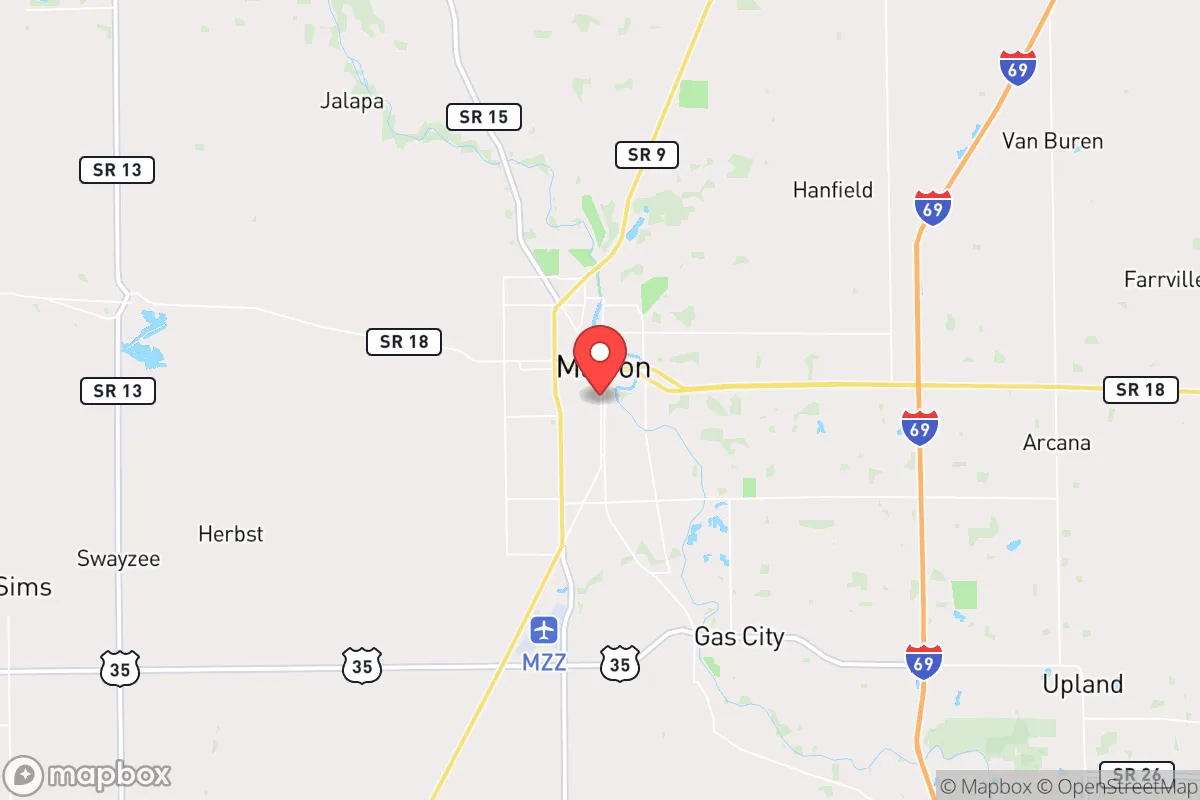
Photo: Wikipedia
Personal Sovereignty in Marion, IN
Viable for self-reliance. Generally workable, though some barriers may limit total independence.
What does Personal Sovereignty tell us?
Personal Sovereignty measures your capacity for self-reliance and independence with minimal government friction. Higher scores mean fewer barriers between you and the way you want to live... but it assumes you have the space you need and good neighbors.
What does this tell us?
Personal Sovereignty measures your capacity for self-reliance and independence with minimal government friction. Higher scores mean fewer barriers between you and the way you want to live... but it assumes you have the space you need and good neighbors.
State Policy
Energy independence: Importer (35% of energy produced in-state)
Personal Liberty
Homesteading

Personal Liberty Analysis
Marion, Indiana, offers a notably high degree of personal sovereignty compared to many other Midwestern locales, particularly for those who prioritize minimal government interference in daily life. Nestled in Grant County, this city of roughly 28,000 operates within a state that has consistently pushed back against federal overreach, maintaining a legal and cultural environment where individual autonomy is the default. For the survivalist or prepper, Marion represents a strategic balance—close enough to regional infrastructure to be practical, yet far enough from the regulatory heavy hand of larger urban centers to allow for genuine self-reliance. The key question for the relocation-minded conservative is not whether freedom exists here, but how deeply the state’s protective legal framework actually translates into day-to-day liberty on the ground.
Tax burden and regulatory posture: How Indiana’s fiscal restraint affects your autonomy
Indiana’s tax structure is a clear win for those seeking to keep more of their own earnings. The state imposes a flat income tax rate of 3.15% as of 2026, with no progressive brackets that penalize higher earners or those running side businesses—a critical factor for preppers who may operate multiple income streams. Property taxes in Grant County are among the lowest in the state, with effective rates often hovering around 0.8% to 1.0% of assessed value, meaning a modest homestead can be held for a few hundred dollars annually. More importantly, Indiana’s regulatory environment is deliberately lean. The state has a right-to-work law, meaning you cannot be forced to join a union as a condition of employment, and it maintains a relatively low number of occupational licensing requirements compared to states like California or New York. For the individualist, this means fewer bureaucratic hurdles when starting a small farm, a repair business, or a home-based manufacturing operation. The city of Marion itself has not imposed the kind of onerous business license fees or zoning overlays common in larger Indiana cities like Indianapolis or Bloomington. This fiscal and regulatory posture directly supports personal sovereignty by leaving more money and time in your hands, not the government’s.
Self-defense and gun law specifics: What the Second Sanctuary status means for you
Indiana is a constitutional carry state, meaning no permit is required to carry a handgun openly or concealed for anyone legally allowed to possess a firearm. This is a foundational liberty for anyone serious about self-defense. Marion sits in Grant County, which has formally declared itself a Second Amendment Sanctuary—a symbolic but meaningful stance that signals local law enforcement and prosecutors will not cooperate with federal gun control measures they deem unconstitutional. The practical effect is that you can own standard-capacity magazines, suppressors, and short-barreled rifles without the harassment seen in blue states. Indiana also has a strong Stand Your Ground law, with no duty to retreat in any place you are lawfully present. For the prepper, this legal clarity is invaluable: if a threat materializes on your property or in a public space, you have unambiguous legal backing to defend yourself. The state preempts local gun ordinances, so Marion cannot enact its own bans on certain firearms or ammunition types—a critical protection against city council overreach. Ammunition and reloading components are widely available at local shops like Marion Gun & Pawn or through larger retailers in nearby Kokomo, and there are no state-level restrictions on online ammo purchases. This legal environment allows you to build and maintain your defensive capabilities without fear of sudden regulatory changes.
Self-reliance and homesteading viability: Lot sizes, zoning, and off-grid feasibility in Marion
For those looking to reduce dependency on centralized systems, Marion’s zoning and land-use policies are generally favorable. Within the city limits, standard residential lots range from one-quarter to one-half acre, but many neighborhoods—especially on the outskirts—feature lots of one acre or more. The city’s zoning code does not prohibit backyard chickens, small-scale vegetable gardens, or even a modest greenhouse, though you should check for specific HOA covenants if buying in a newer subdivision. More importantly, Grant County’s rural zoning allows for true homesteading on parcels as small as two to five acres without the kind of minimum lot size requirements that plague suburban counties. Off-grid feasibility is moderate: Indiana’s net metering policy allows you to connect solar panels to the grid and sell back excess power, but the state has not aggressively incentivized full off-grid setups. Rainwater collection is legal for non-potable uses, and composting toilets are permitted under state plumbing codes for rural properties. The biggest practical consideration is water—Marion sits atop a reliable aquifer, so well drilling is common and affordable for rural parcels. For the serious prepper, the real draw is the ability to own land with minimal interference: no state-level restrictions on food storage, no bans on keeping livestock for personal consumption, and no prohibitions on storing fuel or generators. The county’s agricultural heritage means neighbors are generally tolerant of the sights and sounds of self-sufficient living—a stark contrast to suburban HOA environments.
Personal liberties: Parental rights, medical autonomy, speech, and property protections
Indiana has become a battleground for parental rights, and the current legal landscape strongly favors family autonomy. The state’s 2023 law requiring schools to notify parents of any changes in a child’s mental, emotional, or physical health—including gender-related matters—remains in effect, giving parents the final say in their children’s upbringing. Medical autonomy is similarly protected: Indiana does not have a state-level vaccine mandate for adults, and while school vaccine requirements exist, medical and religious exemptions are available and generally respected. The state’s response to federal health mandates has been defiant, with the governor signing executive orders prohibiting state agencies from enforcing federal vaccine mandates on employees. Free speech protections are robust, with no hate speech laws that criminalize political or religious expression—a critical consideration for those who may hold views outside the mainstream. Property rights are constitutionally protected, and Indiana has a strong eminent domain reform law that limits the government’s ability to seize land for private development. For the survivalist, this means your bug-out location or homestead cannot be taken for a shopping mall or solar farm without a genuine public use and fair compensation. The combination of these protections creates an environment where you can live according to your own values, raise your children as you see fit, and speak your mind without fear of legal retaliation.
Overall, Marion, Indiana, ranks as a strong contender for anyone prioritizing personal sovereignty in a relocation decision. It lacks the extreme libertarian legal framework of states like New Hampshire or Alaska, but it compensates with a practical, low-cost environment where the government is more of a background presence than an active manager of your life. The city’s modest size means you are unlikely to face the kind of progressive overreach seen in college towns or major metros, while the state’s preemption laws and sanctuary status provide a legal buffer against federal encroachment. For the conservative prepper or survivalist, Marion offers a realistic middle ground: enough freedom to build a self-reliant life, enough infrastructure to make it practical, and a legal system that largely stays out of your way. It is not a utopia, but in a country where personal liberties are increasingly contested, it is a place where you can still breathe.

* Values derived from national, state, county, city and local statistics and may differ in a specific area. Last updated: 2026-04-22T10:36:51.000Z
Narrative content on this page is AI-generated and may contain mistakes. Verify any details that matter before acting on them.
ReloMaps may earn a commission from affiliate links at no extra cost to you.

