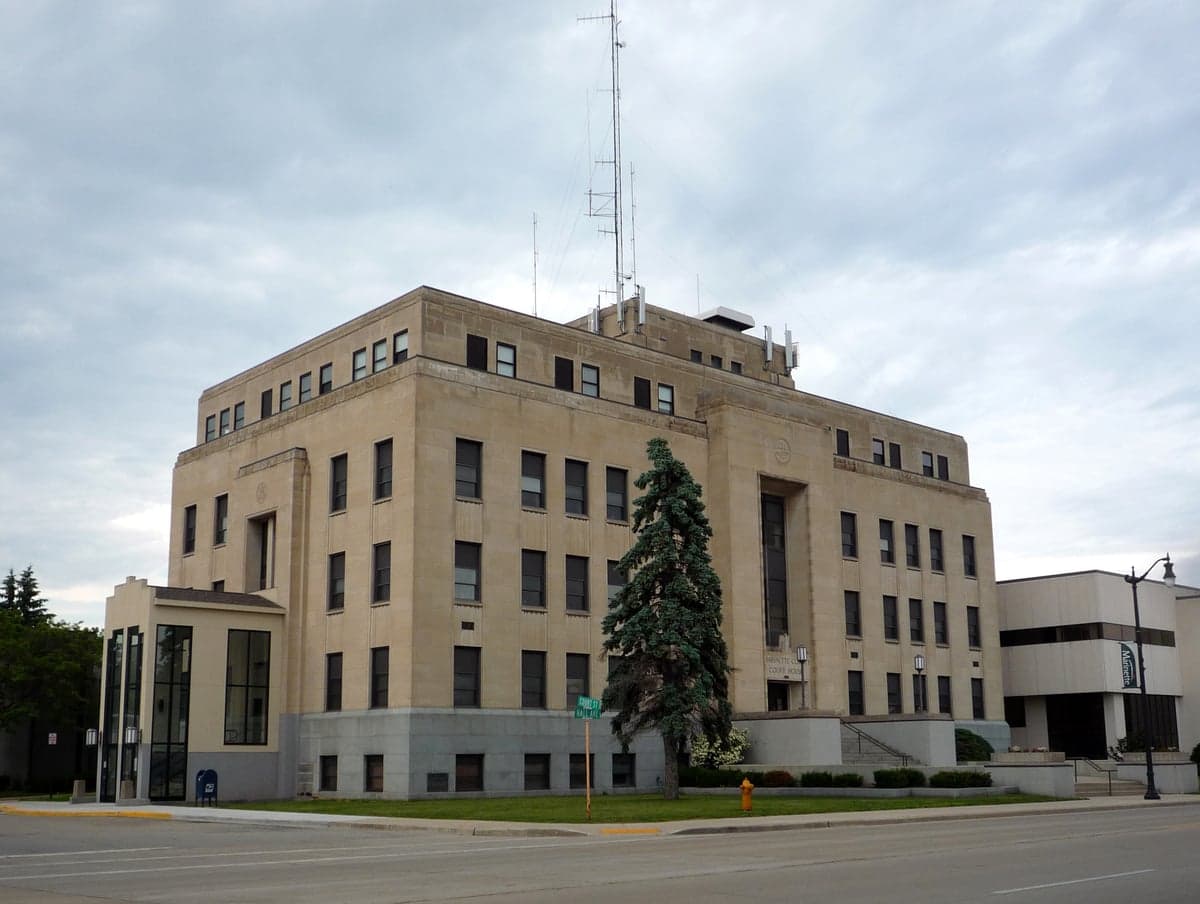
Photo: Wikipedia
Strategic Assessment of Marinette, WI
Workable tactical position. Some exposure to population density or targets, but generally defensible in a crisis.
What does the Strategic Assessment tell us?
Our Strategic Assessment grades tactical survivability of an area. Major population centers, military targets, fallout zones, natural disasters, and border exposure all drive risk — lower exposure means a more defensible position in a crisis.
This is heavily inspired by Joel Skousen's Strategic Relocation book. Highly recommended you checkout the book ($)What does this tell us?
Our Strategic Assessment grades tactical survivability of an area. Major population centers, military targets, fallout zones, natural disasters, and border exposure all drive risk — lower exposure means a more defensible position in a crisis.
This is heavily inspired by Joel Skousen's Strategic Relocation book. Highly recommended you checkout the book ($)Strategic Pillars
Key Distances
Regional Safe Places
Below is our recommended "safe zones" in Wisconsin and the surrounding area based on our strategic heuristics. For most people, it's unrealistic to live in a “safe zone” full-time due to work, family or other personal reasons. They tend to be more rural. However, many of these areas are perfect for second homes and retreat properties that double as a vacation home or even a short-term rental.
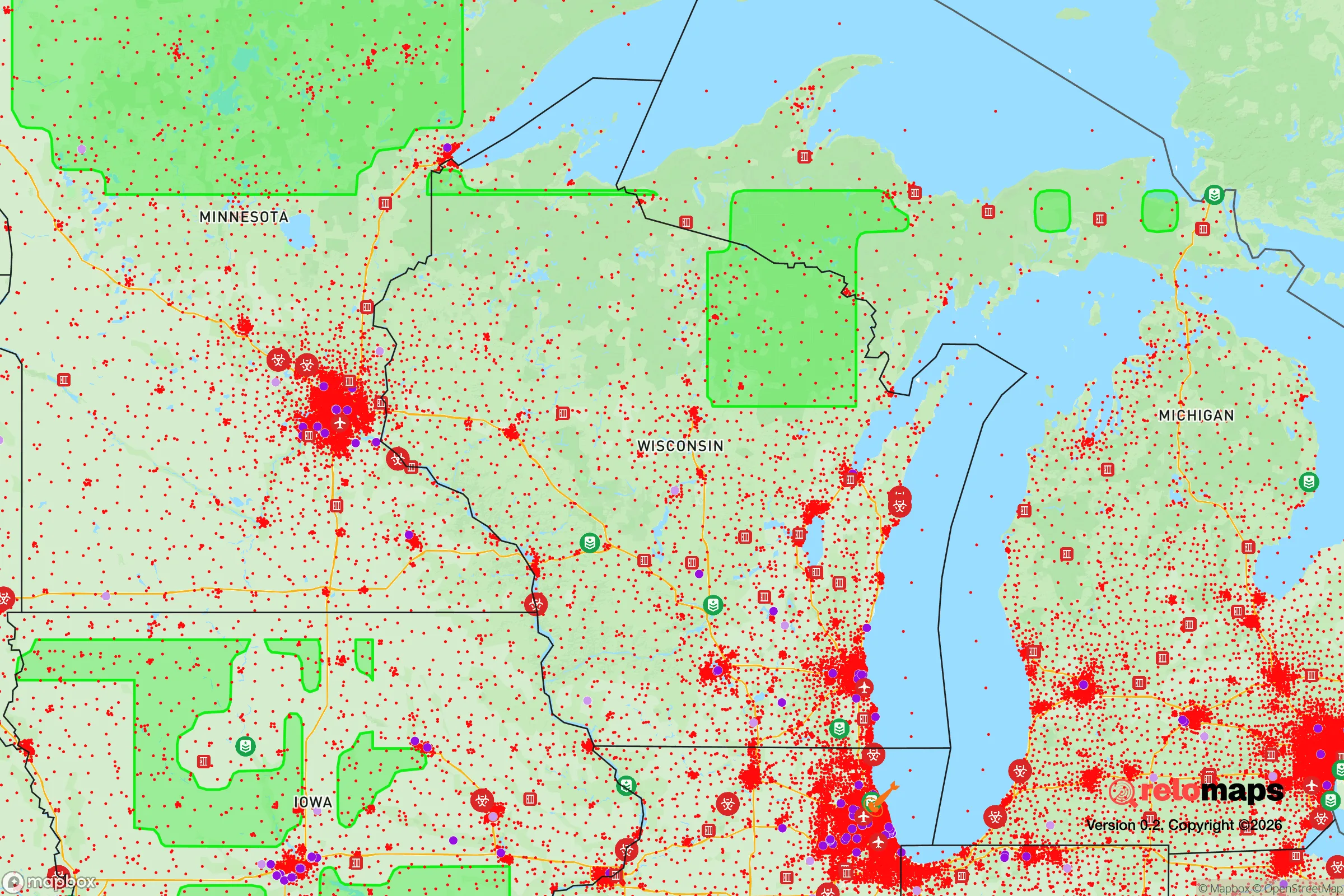
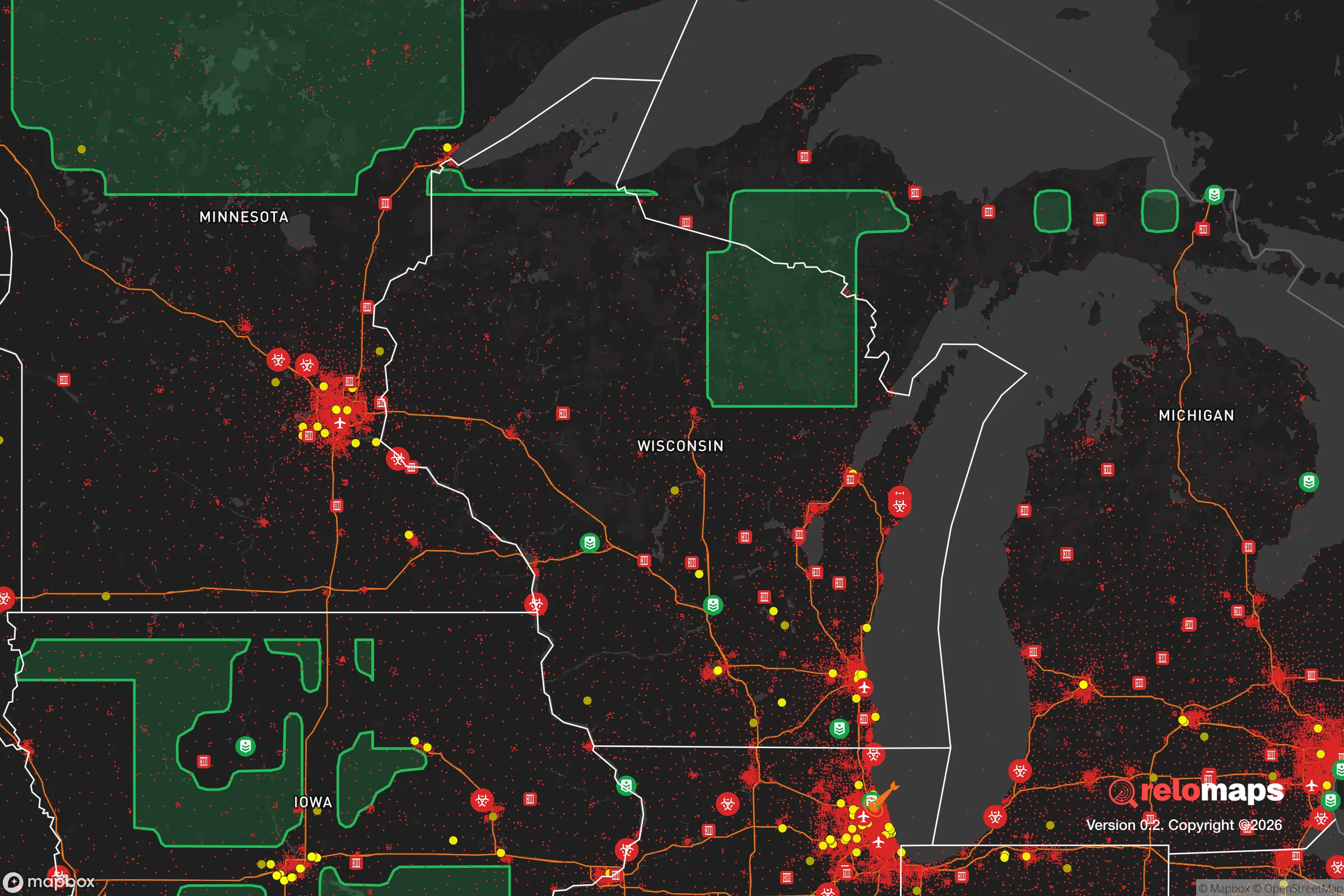


Important Note: For informational purposes only. This does not mean nothing bad ever happens in the green zones. Please use common sense. This is based on public data and modeled with AI. We tried to take a conservative approach but mistakes happen. We update this regularly as new information becomes available.
Solar Generator Recommendations
Backup power matters more here than in safer locations. We've picked three solar generators across budgets and capacity tiers — start with the budget unit if you only need a few essentials, or step up if you want to run a fridge and HVAC for days at a time.
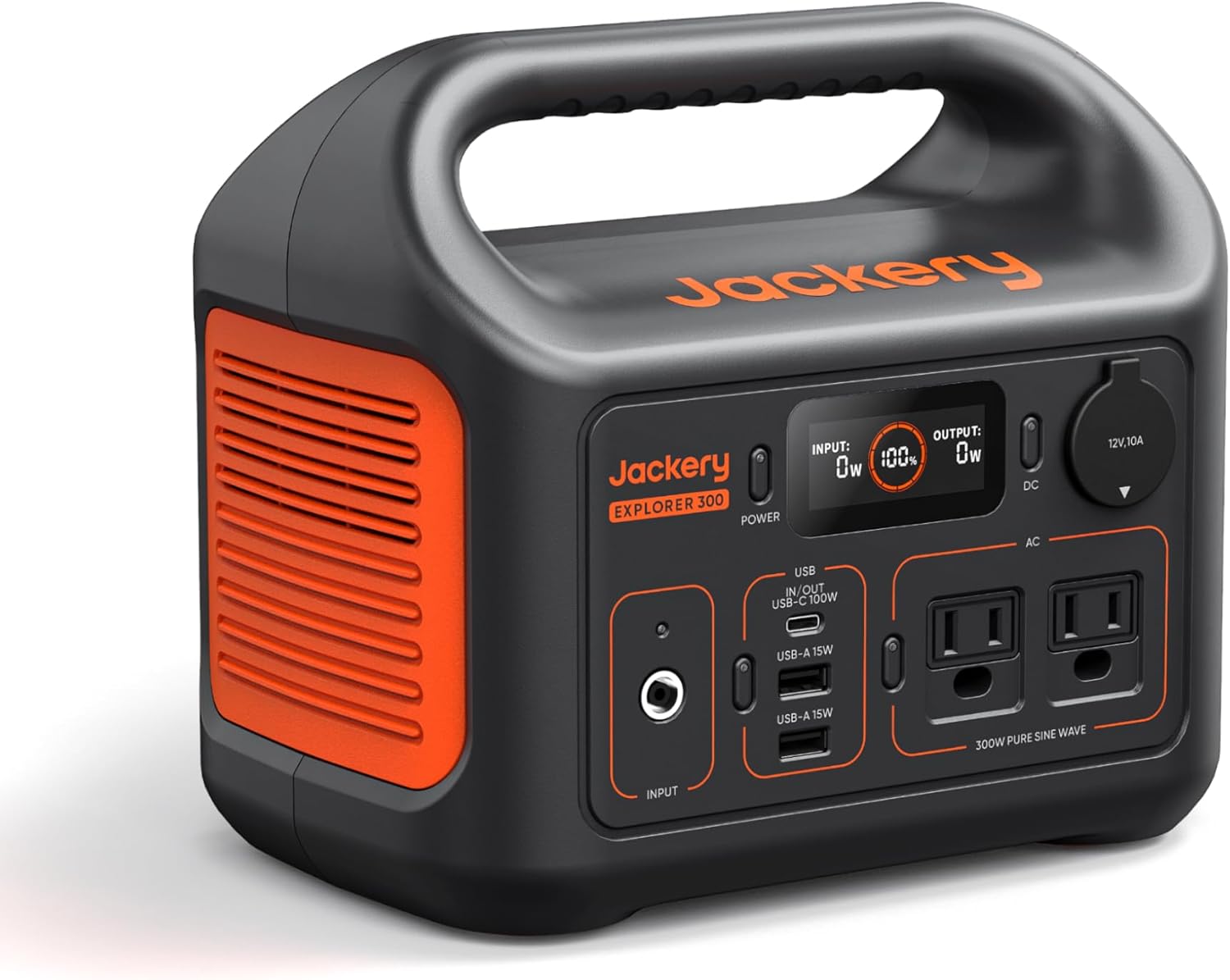
Jackery Portable Power Station Explorer 300
Budget OptionPower on the Go: Weighing only 11 lbs, it's convenient to set up and store with book-sized foldable solar panels

BLUETTI Portable Power Station AC180
Designed for both indoor and outdoor scenarios, AC180 is highly capable as it has a robost capacity and continuous output power.

EF ECOFLOW DELTA Pro Ultra Power Station
Upgraded PickEcoFlow DELTA Pro Ultra is a whole-home energy system designed to grow with your family. Integrated with the Smart Home Panel 2, it scales to meet your evolving energy needs — keeping your home powered, intelligent, and secure through every stage of life.
We earn a commission, at no additional cost to you.
Strategic Assessment Analysis
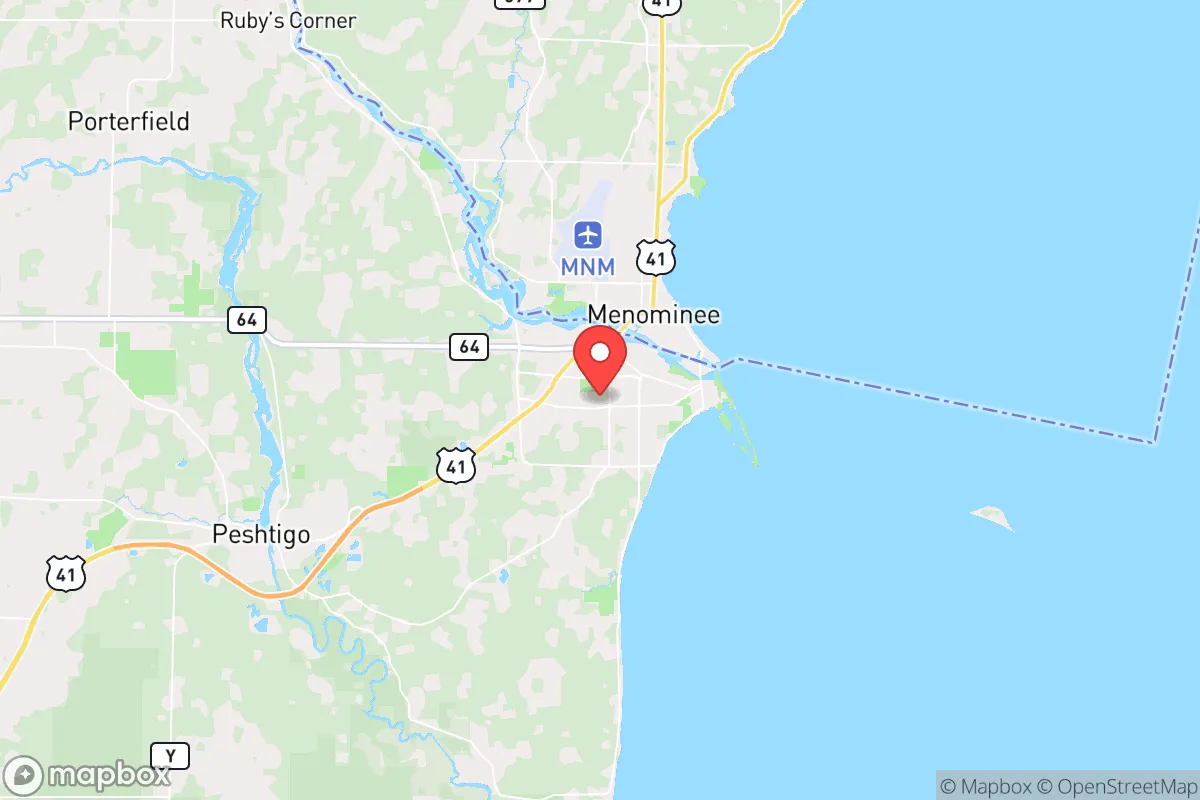
Marinette, Wisconsin, presents a mixed strategic picture for the relocation-minded reader focused on resilience and self-sufficiency. Its position on the Michigan border, at the mouth of the Menominee River where it empties into Green Bay, offers distinct geographic advantages, but its proximity to major industrial and military infrastructure introduces risks that require careful consideration. For a conservative-leaning individual or family weighing disaster readiness, Marinette is neither a fortress nor a vulnerability — it is a place where practical trade-offs must be understood before committing.
Geographic position and natural advantages for long-term stability
Marinette sits in a corner of Wisconsin that benefits from relative isolation without being completely cut off. The city is roughly 50 miles north of Green Bay and about 120 miles north of Milwaukee, placing it far enough from major urban centers to avoid the immediate chaos of a metropolitan collapse, yet close enough to access supplies and medical care if roads remain open. The Menominee River provides a reliable freshwater source, and the surrounding region is part of the Niagara Escarpment, a geological feature that offers varied topography and natural drainage — useful for both water management and defensive positioning. The area’s climate, while harsh in winter with average January lows around 10°F, also limits the spread of many vector-borne diseases and reduces the year-round pressure on food storage. The dense forests of the Chequamegon-Nicolet National Forest and the vast wetlands of the Green Bay shoreline create a natural buffer against large-scale development, preserving the region’s low population density. For a relocator, this means less competition for local resources in a crisis, but also fewer immediate neighbors to rely on for mutual aid.
Risks, exposures, and proximity to fallout-relevant landmarks
The most significant strategic liability for Marinette is its proximity to the Fincantieri Marinette Marine shipyard, a major defense contractor building Littoral Combat Ships and Constellation-class frigates for the U.S. Navy. This facility is a high-value target in any conflict scenario involving state-level adversaries, and its location on the Menominee River within city limits means that a conventional or asymmetric strike could directly impact the surrounding community. Additionally, the Kewaunee Power Station, a decommissioned nuclear plant about 30 miles southeast, still contains spent fuel in dry cask storage — a potential radiological hazard if compromised by natural disaster or sabotage. The J. R. Simplot fertilizer plant in Marinette itself stores anhydrous ammonia, which poses an industrial accident risk. On the natural disaster front, the region is not immune to severe storms; the 2018 Menominee River flood caused significant damage, and the area lies within the Lake Michigan snowbelt, where lake-effect snow can dump over 100 inches annually, potentially isolating the city for days. Tornado risk is moderate but real, with the 2007 Marinette tornado serving as a local reminder. For the relocator, these risks are not deal-breakers, but they demand a clear-eyed assessment: the shipyard is a permanent feature, and any long-term plan must account for the possibility of evacuation or shelter-in-place protocols tied to its operations.
Practical resilience for a relocator: food, water, energy, and defensibility
Marinette’s practical resilience is a study in contrasts. Water is abundant — the Menominee River provides a year-round, gravity-fed source that requires minimal treatment for basic use, and the city’s municipal water system draws from groundwater wells that are less vulnerable to surface contamination. However, the city’s water treatment plant is aging, and a prolonged power outage could disrupt pumping. For the self-sufficient relocator, a hand pump or rainwater catchment system would be a wise investment. Food security is moderate: the surrounding farmland is productive, with dairy, corn, and soybeans dominating, but the growing season is short (roughly 120 frost-free days), limiting year-round local produce. The city has a small but active farmers’ market and several grocery stores, but a major supply chain disruption would quickly strain these resources. Hunting and fishing are viable — deer, turkey, and waterfowl are plentiful, and the river and bay offer walleye, perch, and salmon — but these require skill, equipment, and legal access. Energy resilience is a weak point. Marinette is served by Wisconsin Public Service, with the grid reliant on a mix of natural gas, coal, and nuclear from the now-closed Kewaunee plant. The region has seen increasing interest in solar, but large-scale installations are rare. A relocator should plan for off-grid solar or a backup generator, as winter storms can knock out power for days. Defensibility is mixed: the city’s layout along the river and bay creates natural chokepoints, but the flat terrain and dense residential areas near the shipyard offer limited cover. The surrounding forests provide good concealment for a rural retreat, but the city itself is not easily fortified. For a family, the best approach is to secure a property on the outskirts, with a well, septic system, and wood-burning heat, while maintaining a low profile in the community.
The overall strategic picture for Marinette is one of cautious viability. It offers genuine advantages — abundant fresh water, low population density, and a location that buffers against the worst of urban collapse — but these are offset by the hard reality of the shipyard’s presence and the region’s industrial infrastructure. For the relocator who values self-sufficiency and is willing to invest in off-grid systems, Marinette can work, provided they accept the risks and plan accordingly. It is not a hidden gem for the unprepared, but for the disciplined, it is a place where resilience is possible — not guaranteed, but possible. The key is to treat it as a base of operations, not a final refuge, and to maintain the mobility and skills to adapt if the strategic calculus shifts.

* Values derived from national, state, county, city and local statistics and may differ in a specific area. Last updated: 2026-11-22T17:24:42.000Z
Narrative content on this page is AI-generated and may contain mistakes. Verify any details that matter before acting on them.
ReloMaps may earn a commission from affiliate links at no extra cost to you.

