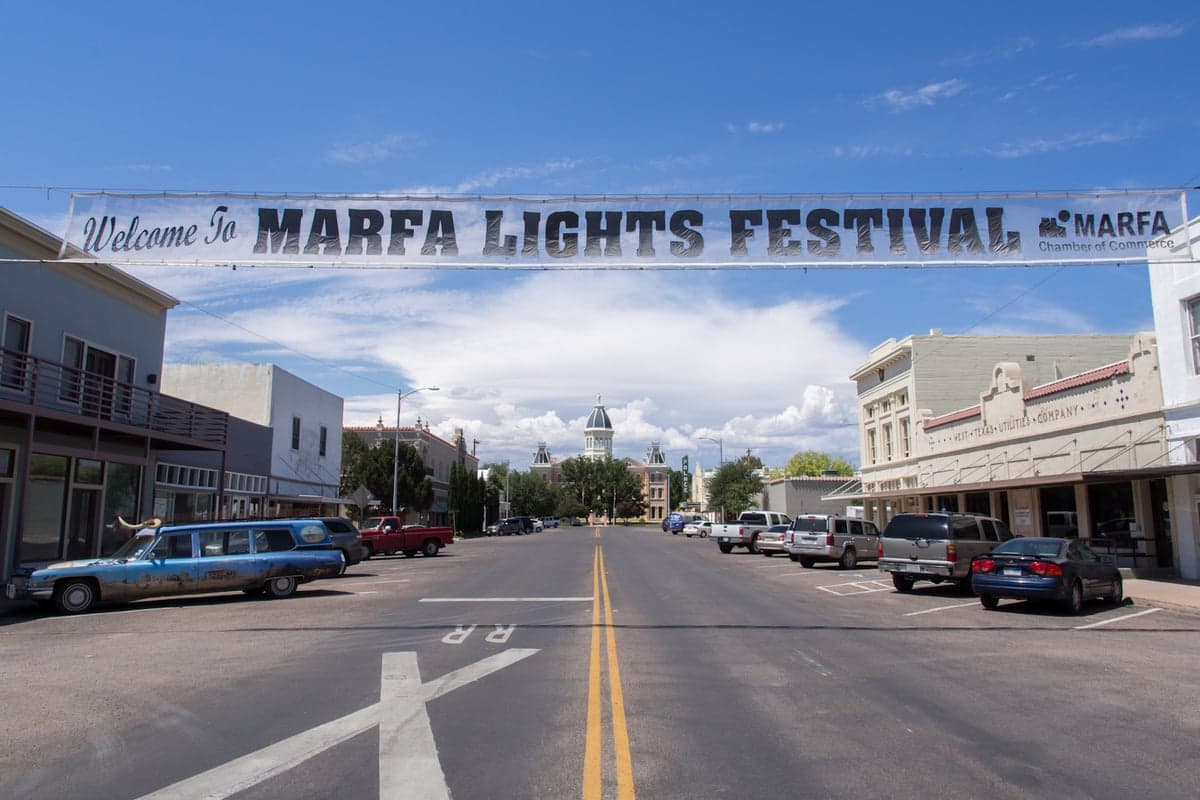
Photo: Wikipedia
Strategic Assessment of Marfa, TX
Workable tactical position. Some exposure to population density or targets, but generally defensible in a crisis.
What does the Strategic Assessment tell us?
Our Strategic Assessment grades tactical survivability of an area. Major population centers, military targets, fallout zones, natural disasters, and border exposure all drive risk — lower exposure means a more defensible position in a crisis.
This is heavily inspired by Joel Skousen's Strategic Relocation book. Highly recommended you checkout the book ($)What does this tell us?
Our Strategic Assessment grades tactical survivability of an area. Major population centers, military targets, fallout zones, natural disasters, and border exposure all drive risk — lower exposure means a more defensible position in a crisis.
This is heavily inspired by Joel Skousen's Strategic Relocation book. Highly recommended you checkout the book ($)Strategic Pillars

Key Distances
Regional Safe Places
Below is our recommended "safe zones" in Texas and the surrounding area based on our strategic heuristics. For most people, it's unrealistic to live in a “safe zone” full-time due to work, family or other personal reasons. They tend to be more rural. However, many of these areas are perfect for second homes and retreat properties that double as a vacation home or even a short-term rental.

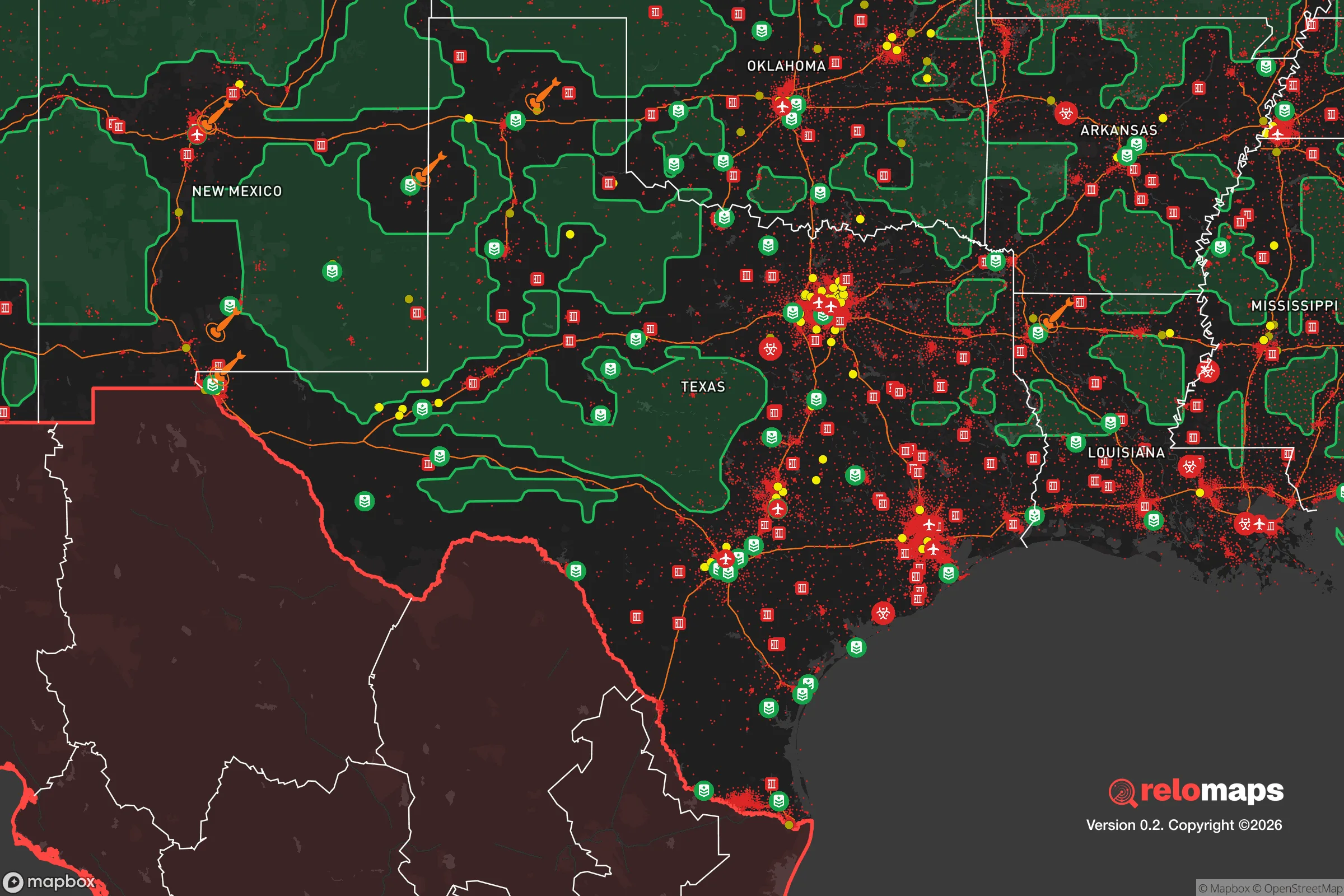


Important Note: For informational purposes only. This does not mean nothing bad ever happens in the green zones. Please use common sense. This is based on public data and modeled with AI. We tried to take a conservative approach but mistakes happen. We update this regularly as new information becomes available.
Solar Generator Recommendations
Backup power matters more here than in safer locations. We've picked three solar generators across budgets and capacity tiers — start with the budget unit if you only need a few essentials, or step up if you want to run a fridge and HVAC for days at a time.

Jackery Portable Power Station Explorer 300
Budget OptionPower on the Go: Weighing only 11 lbs, it's convenient to set up and store with book-sized foldable solar panels

BLUETTI Portable Power Station AC180
Designed for both indoor and outdoor scenarios, AC180 is highly capable as it has a robost capacity and continuous output power.

EF ECOFLOW DELTA Pro Ultra Power Station
Upgraded PickEcoFlow DELTA Pro Ultra is a whole-home energy system designed to grow with your family. Integrated with the Smart Home Panel 2, it scales to meet your evolving energy needs — keeping your home powered, intelligent, and secure through every stage of life.
We earn a commission, at no additional cost to you.
Strategic Assessment Analysis
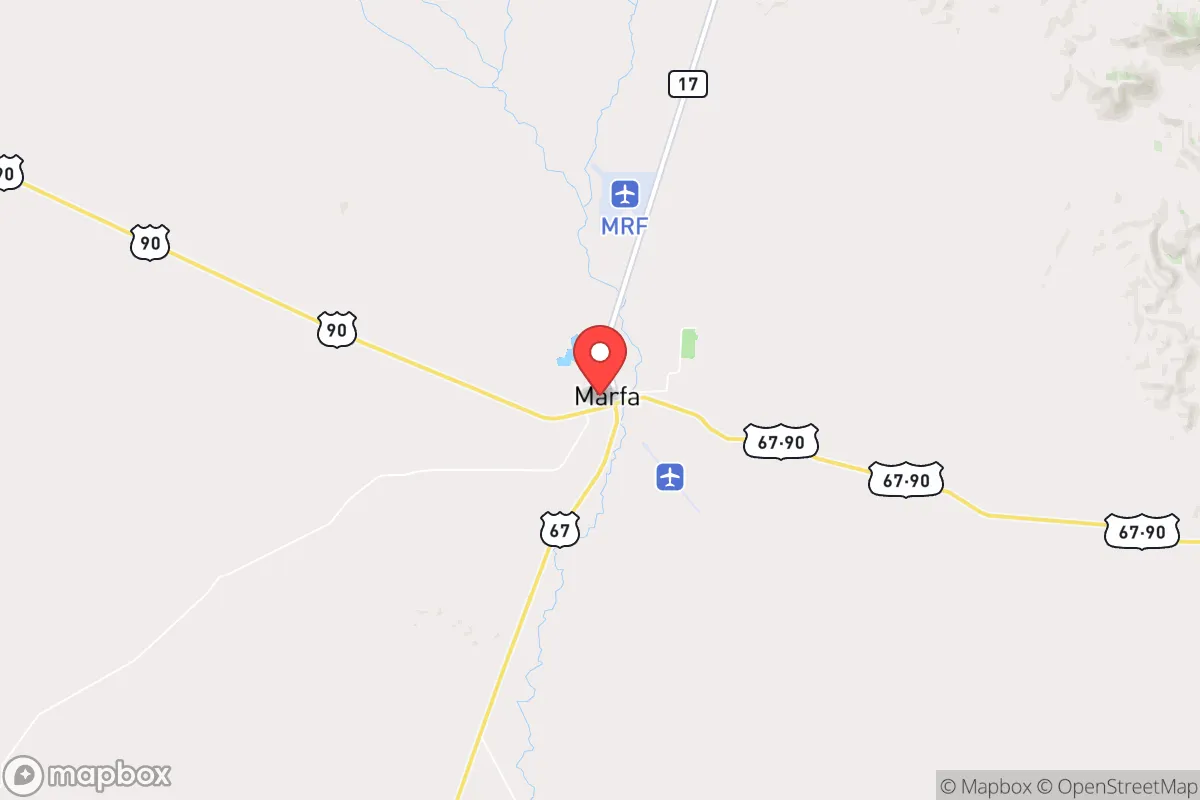
Marfa, Texas, offers a unique strategic proposition for those prioritizing resilience and distance from major population centers, but its remote location in the high desert of the Big Bend region comes with a distinct set of trade-offs. Sitting roughly 60 miles from the Mexican border and over 200 miles from the nearest major city (El Paso), Marfa provides genuine geographic isolation that is increasingly rare in the continental United States. This isolation, combined with a small year-round population of around 1,700, means the area is far removed from the immediate fallout zones of large-scale civil unrest or a major disaster targeting a metropolitan hub. However, that same remoteness creates significant logistical challenges for long-term self-sufficiency, and the area's proximity to certain federal infrastructure warrants a hard look.
Geographic position and natural advantages for long-term security
Marfa sits on a high plateau at roughly 4,800 feet elevation, which provides a natural defensive advantage in terms of visibility and a climate that is generally dry and cool compared to lower desert areas. The surrounding landscape is vast, open ranchland with sparse population density—Presidio County has about 7 people per square mile. This low density is a core strength for a prepper mindset: fewer neighbors mean fewer potential conflicts over resources during a crisis, and the wide-open terrain makes it difficult for large groups to approach undetected. The area is also far from major interstate highways (I-10 is about 60 miles north), which in a collapse scenario would likely become corridors of movement for desperate populations fleeing coastal cities. Marfa's position off the beaten path means it is not a natural destination for refugees, unlike towns directly on major evacuation routes. The local water table, while not abundant, is accessible via deep wells, and the region's solar exposure is excellent for off-grid energy generation, with over 300 days of sunshine annually.
Risks, exposures, and proximity to fallout-relevant landmarks
The most significant strategic concern for Marfa is its proximity to the U.S.-Mexico border and the associated federal law enforcement and military presence. While the border itself is a source of potential instability—cartel activity and illegal cross-border traffic are real issues—the bigger risk for a prepper is the concentration of federal assets. The Marfa Municipal Airport is used by U.S. Customs and Border Protection and the Texas Department of Public Safety, and the area sees regular drone and helicopter patrols. In a scenario of widespread civil unrest or a breakdown of federal authority, this infrastructure could become a target or a staging ground for government forces, drawing unwanted attention to the area. Additionally, the nearby Big Bend National Park and the Davis Mountains are popular tourist destinations, meaning that during a sudden crisis, Marfa could see a temporary influx of people seeking refuge in the wilderness, straining local resources. There are no major nuclear power plants or large military bases within 100 miles, but the border itself is a volatile variable that cannot be ignored. The risk of a mass casualty event directly in Marfa is low, but the area is not immune to spillover effects from border-related violence or federal responses to it.
Practical resilience for a relocator: food, water, energy, and defensibility
For a single individual or family looking to establish a resilient homestead, Marfa presents a mixed bag. Water is the single most critical vulnerability. The region averages only about 12 inches of rain per year, and surface water is scarce. Reliable access requires a deep well (often 200-400 feet) and a robust rainwater catchment system, both of which are expensive to install. The local municipal water supply comes from the Marfa Water System, which draws from the Edwards-Trinity Aquifer, but this is a finite resource that could be compromised during a prolonged drought or grid failure. Food production is equally challenging. The growing season is short (about 180 days) and the soil is alkaline and rocky. Successful gardening requires raised beds, imported soil, and significant water inputs. Hunting is an option—mule deer, javelina, and quail are present—but the desert ecosystem cannot support a large population on game alone. Energy is a bright spot. Solar panels are highly effective here, and many off-grid properties already have them. Battery storage is essential for nighttime and cloudy periods, but the sun is reliable. Defensibility is excellent for a small, prepared group. The open terrain means you can see threats coming from miles away, and the lack of dense cover makes ambush tactics difficult for adversaries. However, the same openness means your own position is visible. A well-placed property with a long driveway and good sightlines is ideal. The local community is small and generally self-reliant, but it is also tight-knit and wary of outsiders—building trust takes time. There is a small but active prepper and homesteading community in the broader Big Bend region, but it is not a hub of organized preparedness like some areas in the Pacific Northwest or Appalachia.
The overall strategic picture for Marfa is one of high isolation and low immediate risk from urban collapse, but with significant practical hurdles to long-term self-sufficiency. It is a strong choice for someone who values distance from the chaos of major cities and is willing to invest heavily in water infrastructure, soil improvement, and off-grid energy. The border proximity is a double-edged sword: it provides a buffer against large-scale refugee flows from the north, but it also introduces a persistent risk of cartel activity and federal attention. For a conservative-leaning relocator who is serious about being prepared for civic unrest or a major disaster, Marfa offers a defensible, low-density environment that is unlikely to be a primary target. But it is not a place for beginners. The learning curve for desert living is steep, and the margin for error is thin. If you have the capital, the skills, and the temperament for extreme isolation, Marfa can be a viable long-term redoubt. If you need easy access to supplies, medical care, or a larger community of like-minded people, you would be better served looking at the Hill Country or the Panhandle. Marfa is a strategic outlier—strong on defense, weak on logistics, and demanding in every practical sense.

* Values derived from national, state, county, city and local statistics and may differ in a specific area. Last updated: 2026-05-16T21:52:13.000Z
Narrative content on this page is AI-generated and may contain mistakes. Verify any details that matter before acting on them.
ReloMaps may earn a commission from affiliate links at no extra cost to you.

