Strategic Assessment of Mandeville, LA
Meaningful friction. Expect exposure to either population pressure, blast zones, or natural disaster risk. Consider buying a retreat property.
What does the Strategic Assessment tell us?
Our Strategic Assessment grades tactical survivability of an area. Major population centers, military targets, fallout zones, natural disasters, and border exposure all drive risk — lower exposure means a more defensible position in a crisis.
This is heavily inspired by Joel Skousen's Strategic Relocation book. Highly recommended you checkout the book ($)What does this tell us?
Our Strategic Assessment grades tactical survivability of an area. Major population centers, military targets, fallout zones, natural disasters, and border exposure all drive risk — lower exposure means a more defensible position in a crisis.
This is heavily inspired by Joel Skousen's Strategic Relocation book. Highly recommended you checkout the book ($)Strategic Pillars

Key Distances
Regional Safe Places
Below is our recommended "safe zones" in Louisiana and the surrounding area based on our strategic heuristics. For most people, it's unrealistic to live in a “safe zone” full-time due to work, family or other personal reasons. They tend to be more rural. However, many of these areas are perfect for second homes and retreat properties that double as a vacation home or even a short-term rental.

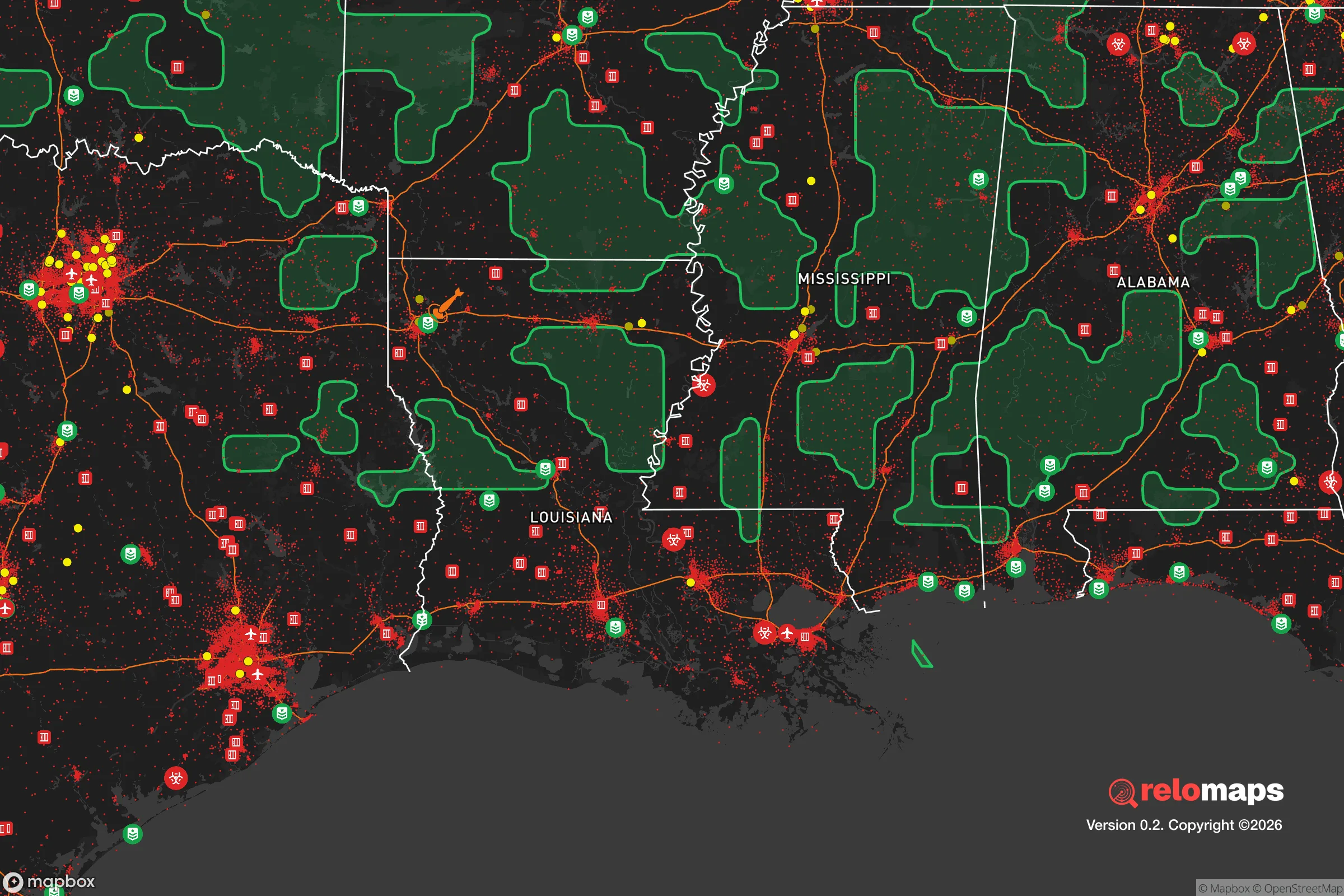


Important Note: For informational purposes only. This does not mean nothing bad ever happens in the green zones. Please use common sense. This is based on public data and modeled with AI. We tried to take a conservative approach but mistakes happen. We update this regularly as new information becomes available.
Solar Generator Recommendations
Backup power matters more here than in safer locations. We've picked three solar generators across budgets and capacity tiers — start with the budget unit if you only need a few essentials, or step up if you want to run a fridge and HVAC for days at a time.

Jackery Portable Power Station Explorer 300
Budget OptionPower on the Go: Weighing only 11 lbs, it's convenient to set up and store with book-sized foldable solar panels

BLUETTI Portable Power Station AC180
Designed for both indoor and outdoor scenarios, AC180 is highly capable as it has a robost capacity and continuous output power.

EF ECOFLOW DELTA Pro Ultra Power Station
Upgraded PickEcoFlow DELTA Pro Ultra is a whole-home energy system designed to grow with your family. Integrated with the Smart Home Panel 2, it scales to meet your evolving energy needs — keeping your home powered, intelligent, and secure through every stage of life.
We earn a commission, at no additional cost to you.
Strategic Assessment Analysis
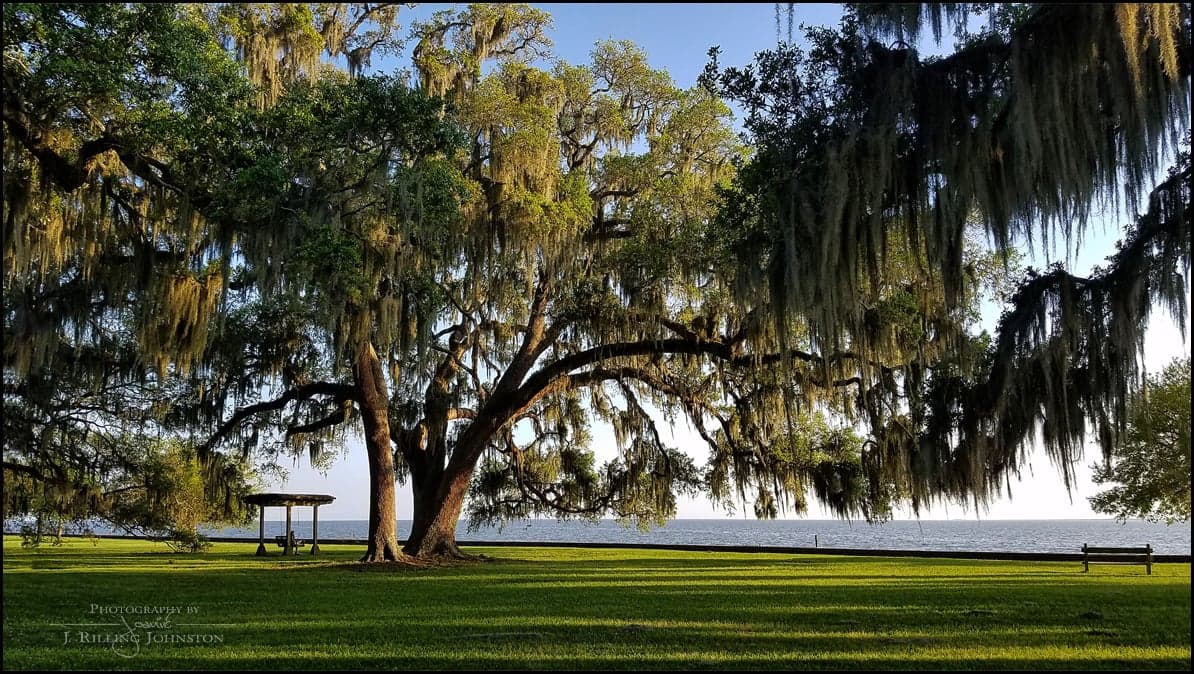
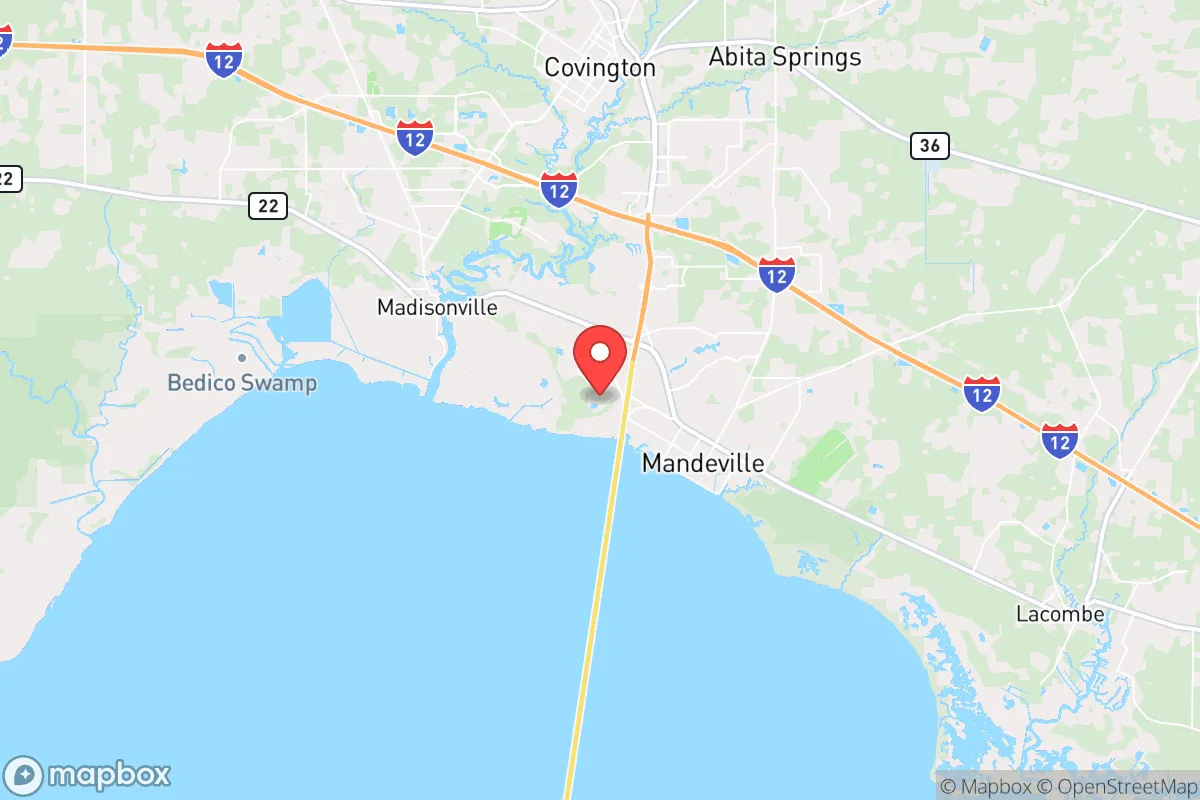
Mandeville, Louisiana, sits on the north shore of Lake Pontchartrain, offering a strategic blend of geographic isolation from New Orleans’ urban core while retaining access to its economic and logistical infrastructure. For a relocator with a survivalist mindset, this position provides a critical buffer against the immediate fallout of civic unrest, mass casualty events, or large-scale disasters that could destabilize the Gulf Coast. The city’s location on the “Northshore” places it roughly 30 miles from downtown New Orleans, far enough to avoid the worst of urban chaos but close enough to tap into regional resources, including major hospitals, ports, and interstate networks. This balance of proximity and separation is a key advantage for those prioritizing resilience without complete self-sufficiency.
Geographic position and natural advantages for long-term stability
Mandeville’s geography is defined by its position on the north shore of Lake Pontchartrain, a 630-square-mile brackish estuary that acts as a natural moat separating it from New Orleans and the more densely populated south shore. This water barrier is a double-edged sword: it complicates rapid evacuation but also slows the movement of unrest or disaster-related chaos from the south. The city sits on relatively higher ground compared to much of south Louisiana, with elevations averaging 10 to 20 feet above sea level, reducing flood risk from storm surge compared to areas like Slidell or New Orleans East. The surrounding St. Tammany Parish is heavily forested with pine and hardwood stands, offering natural cover, fuel sources, and building materials for those with land. The area’s proximity to the Pearl River and the Honey Island Swamp provides additional water resources and wildlife for foraging, though these areas are also prone to flooding during heavy rains. For a prepper, the key takeaway is that Mandeville’s natural defenses—water barriers, higher ground, and dense woodlands—create a defensible perimeter that is harder to breach than flat, open terrain. However, the same lake that protects from the south also limits escape routes to the north, making pre-planned secondary exits via Highway 21 or Interstate 12 critical.
Risks, exposures, and proximity to fallout-relevant landmarks
Mandeville’s primary risk exposure comes from its proximity to New Orleans, a major port city with a concentration of chemical plants, refineries, and the Mississippi River’s industrial corridor. The “Cancer Alley” stretch between Baton Rouge and New Orleans, roughly 40 miles west, contains over 150 petrochemical facilities that could become targets during civil unrest or sources of toxic releases during a natural disaster. A major hurricane or industrial accident could release hazardous materials that drift north across the lake, potentially contaminating water and air. Additionally, the Lake Pontchartrain Causeway—a 24-mile bridge connecting Mandeville to Metairie—is a single-point-of-failure vulnerability. In a crisis, this bridge could become a chokepoint for refugees fleeing New Orleans, bringing crime, disease, or hostile actors into the area. The city’s location near Interstate 12, a major east-west corridor linking Texas to Florida, also means it sits on a potential evacuation route that could become clogged or dangerous during a mass exodus. For a conservative-leaning relocator concerned with state-level stability, note that St. Tammany Parish is one of the most politically conservative areas in Louisiana, with a strong local law enforcement presence and a history of self-reliance. This cultural alignment reduces the likelihood of leftist-driven unrest but does not eliminate risks from external threats like hurricane-induced looting or supply chain disruptions.
Practical resilience for a relocator: food, water, energy, and defensibility
For a single individual or family looking to establish a resilient homestead, Mandeville offers several practical advantages. The city’s water supply comes from the Southern Louisiana Water Company, which draws from the Mississippi River via a pipeline—a centralized system vulnerable to contamination or disruption. A prepper should plan for at least two weeks of stored water or install a rainwater catchment system, as the area receives about 60 inches of rainfall annually. Local soil is sandy and acidic, making large-scale gardening challenging without raised beds or soil amendments, but the long growing season (March to November) allows for multiple crop cycles. Energy reliability is a concern: Entergy Louisiana’s grid is prone to outages during hurricanes, with some storms leaving parts of St. Tammany without power for weeks. Solar panels with battery storage are a wise investment, as the region averages over 200 sunny days per year. Defensibility is moderate: Mandeville’s suburban layout with cul-de-sacs and wooded lots provides natural chokepoints, but the lack of a unified community defense network means relocators should consider forming or joining a neighborhood watch or prepper group. The nearby Bogue Chitto State Park and the Pearl River Wildlife Management Area offer remote retreat options for those with off-grid land, though these areas are also popular with hunters and could attract attention during a crisis. For food security, the Gulf of Mexico’s fisheries are accessible via Lake Pontchartrain, but overfishing and red tide events can limit yields. Stockpiling non-perishable foods and learning to preserve game meat (deer, wild hog, and waterfowl are abundant) is recommended.
Overall, Mandeville presents a mixed strategic picture for the survivalist relocator. Its geographic isolation from New Orleans, conservative local culture, and natural resources make it a viable base for those willing to invest in off-grid infrastructure and community ties. However, the risks from industrial fallout, hurricane vulnerability, and single-point-of-failure infrastructure like the Causeway cannot be ignored. The city is best suited for individuals or families who can afford to build redundancy into their water, power, and food systems, and who are prepared to bug out north to Mississippi or east to Alabama if a major event overwhelms the area. For those seeking a balance between urban access and rural resilience, Mandeville is a defensible option—but only with deliberate planning and a clear-eyed understanding of its limitations. The Northshore’s relative stability in a volatile state makes it a strong candidate for a conservative-leaning relocator, provided they treat it as a launchpad rather than a final fortress.

* Values derived from national, state, county, city and local statistics and may differ in a specific area. Last updated: 2026-04-23T04:53:41.000Z
Narrative content on this page is AI-generated and may contain mistakes. Verify any details that matter before acting on them.
ReloMaps may earn a commission from affiliate links at no extra cost to you.

