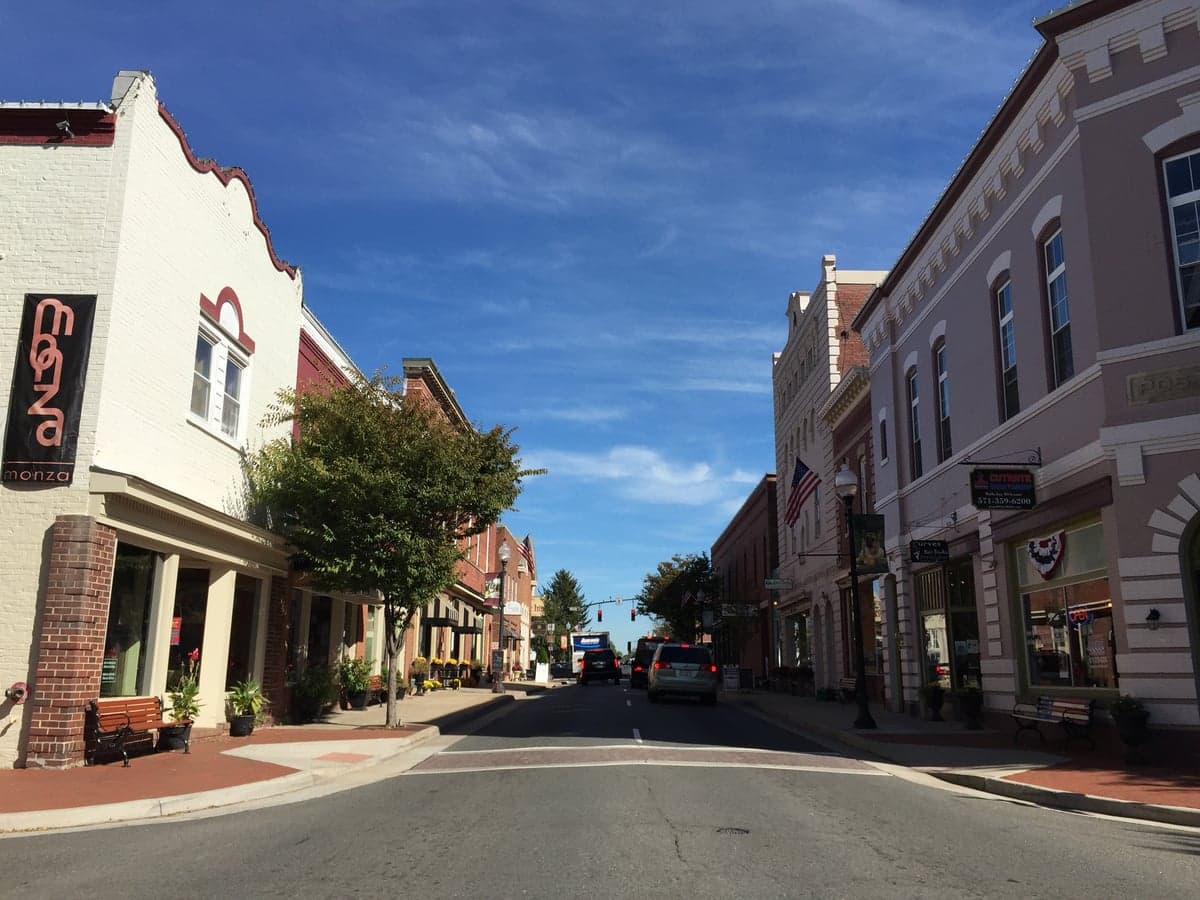


Photo: Wikipedia
Political ClimatePolitical Climate in Manassas, VA
District shown is the primary district for this city’s centroid. Cities may span multiple districts.
Local Political AnalysisPolitical Analysis of Manassas, VA
Manassas, Virginia, has a Cook PVI of D+6, meaning it leans about six points more Democratic than the national average, but that number doesn’t tell the whole story of how the city’s politics have shifted over the past decade. I’ve lived here long enough to remember when Manassas was a reliably conservative stronghold, with local elections often decided in Republican primaries and a general sense that government kept its nose out of your business. Now, you’ll see more yard signs for progressive candidates, and the city council has taken up issues like zoning changes and police oversight that would have been unthinkable 15 years ago. The trajectory is clear: Manassas is moving left, and it’s happening faster than many of us who value personal freedoms are comfortable with.
How it compares
If you drive just a few miles west or south, you’ll hit towns like Haymarket, Gainesville, or Nokesville, which still vote solidly Republican and have a more hands-off approach to local governance. Prince William County as a whole is a purple battleground, but Manassas itself is the most liberal pocket in the area, especially compared to the more rural communities that surround it. For example, while Manassas has embraced things like sanctuary city policies and higher density housing mandates, nearby Warrenton in Fauquier County has pushed back hard on similar measures. The contrast is stark: you can live in a place where the county board respects property rights and Second Amendment protections, or you can stay in Manassas and watch the city government get more involved in your daily life with each election cycle.
What this means for residents
For those of us who moved here for the affordable land and the sense of independence, the political shift means paying closer attention to local ordinances and school board decisions. The city has already passed stricter rental inspection programs and debated adding more affordable housing mandates, which some see as government overreach into private property rights. If you’re a small business owner or a gun owner, you’ve probably noticed the local climate becoming less friendly to traditional conservative values. The school board has also moved toward more progressive curriculum changes, which has led to more parents considering private or homeschool options. It’s not a crisis yet, but the trend is concerning if you believe that local government should stay out of your family’s choices.
One cultural distinction that stands out is how Manassas handles public events and public spaces. The city has put more emphasis on diversity and inclusion initiatives, which sounds nice on paper, but often translates to new committees and regulations that can feel like red tape. The annual Manassas Heritage Festival, for instance, now includes more political messaging than it used to, and some longtime residents feel the city’s character is being reshaped by outside influences. If you value a community where government is limited and personal responsibility is the norm, you might find yourself looking at the outskirts of town or even the neighboring counties for a better fit. Manassas isn’t what it was 20 years ago, and the next few elections will decide whether it becomes a fully progressive city or if there’s still room for the old-school independence that built this place.

State Political ClimatePolitical Climate in Virginia
State Political AnalysisPolitical Environment in the State
Virginia has shifted from a reliably purple swing state to a solidly blue one over the past two decades, driven by explosive growth in the Washington, D.C. suburbs. The state now leans Democratic by roughly 5-7 points in presidential elections, but that top-line number masks a deep and growing urban-rural chasm. For a conservative considering relocation, the real story is not the statewide vote but the starkly different political realities between Northern Virginia and the rest of the commonwealth.
Urban vs. rural divide
The political map of Virginia is essentially two states. The northern crescent—Arlington, Alexandria, Fairfax, Loudoun, and Prince William counties—now accounts for over half the state’s vote and delivers margins of 60-70% for Democrats. These jurisdictions are home to federal employees, defense contractors, and tech workers who have turned the region into a Democratic stronghold. Richmond and Norfolk/Virginia Beach add more blue votes, with Richmond proper voting over 80% Democratic in recent cycles. Meanwhile, the rest of the state—from the Shenandoah Valley to Southside and Southwest Virginia—votes heavily Republican. Roanoke and Lynchburg are conservative anchors, while Fredericksburg and Charlottesville have become battleground suburbs that are slowly trending left as D.C. exurbs expand. The rural-urban divide is so pronounced that a conservative living in Wise County (Trump +50) and one living in Arlington (Biden +45) might as well be in different countries.
Policy environment
Virginia’s policy environment has lurched leftward since Democrats took full control of state government in 2019. The state income tax is a flat 5.75%, but the sales tax is relatively low at 5.3% (plus local add-ons). Property taxes are set locally and vary widely—Loudoun County has some of the highest in the state, while Pittsylvania County is much lower. The regulatory posture is increasingly burdensome: Virginia adopted California-style emissions standards under the Clean Cars Act, and the 2021 Virginia Clean Economy Act mandates a 100% carbon-free grid by 2050, driving up energy costs. Education policy has been a flashpoint—the state eliminated its public school mask mandates in 2022, but school boards in blue counties like Fairfax and Arlington continue to push progressive curricula, including critical race theory and LGBTQ+ policies that have sparked parental rights battles. Election laws are relatively neutral—no-excuse absentee voting and same-day registration exist, but voter ID is still required. The state has no right-to-work law in the private sector, though it remains a right-to-work state for public employees.
Trajectory & freedom
On personal liberty, Virginia’s trajectory is mixed but concerning for conservatives. The 2020 General Assembly passed a sweeping gun control package—universal background checks, a red flag law, a one-handgun-per-month limit, and a ban on assault weapons (later struck down by a court). The red flag law remains in effect and has been used thousands of times. Parental rights took a hit with the 2020 repeal of the parental notification requirement for minors seeking abortions; the state now has no parental consent law for abortion. Medical freedom eroded with the 2021 vaccine mandate for state employees and the continued requirement for schoolchildren to receive HPV and other vaccines. On the positive side, Virginia has no income tax on military pensions and offers a modest property tax exemption for disabled veterans. The 2023 election gave Republicans control of the House of Delegates, which blocked further leftward movement on issues like rent control and energy mandates, but the Democratic Senate and Governor Youngkin’s veto pen have created a stalemate. The state is not becoming freer—it’s becoming a battleground where freedom is preserved only by divided government.
Civil unrest & political movements
Virginia has been a national epicenter of political conflict. The 2017 Unite the Right rally in Charlottesville and the subsequent removal of Confederate statues sparked years of protests and counter-protests. The 2020 George Floyd protests in Richmond and Norfolk led to the toppling of the Robert E. Lee statue and a broader push to remove Confederate monuments statewide. Immigration politics are heated: Prince William County and Arlington have declared themselves sanctuary jurisdictions, refusing to cooperate with ICE detainers. The 2021 gubernatorial race saw Glenn Youngkin win on a parental rights platform, but the 2023 legislative elections showed the issue has faded. Election integrity remains a live controversy—the 2020 election in Virginia was secure, but the 2021 switch to drop boxes and permanent absentee voting lists has raised concerns among conservatives. The most visible flashpoint for a new resident would be the school board meetings in Loudoun County, which became nationally famous for heated debates over transgender policies and critical race theory. These battles are ongoing and likely to intensify.
Projection
Over the next 5-10 years, Virginia will continue to drift leftward demographically. The D.C. suburbs are growing faster than the rest of the state, and the in-migration from blue states like New York and California is accelerating. The 2030 census will likely cost Virginia a congressional seat, and that seat will come from a rural district. The Republican Party’s only path to statewide power is to run a moderate like Youngkin who can peel off suburban women and independents, but the underlying trend is unfavorable. A conservative moving to Virginia today should expect that in a decade, the state will have a Democratic governor and legislature, higher taxes, stricter gun laws, and more progressive education policies. The only question is whether the pace of change will be slowed by divided government or accelerated by a Democratic trifecta. The best bet for a conservative is to settle in a red county like Augusta or Bedford, where local government remains conservative, but be prepared for state-level policies that will feel increasingly like those of Maryland or New Jersey.
For a new resident, the bottom line is this: Virginia offers beautiful landscapes, strong schools in some areas, and a relatively low cost of living outside the D.C. orbit, but the political climate is hostile to conservative values and trending worse. If you value gun rights, parental control over education, low taxes, and limited government, you will find yourself fighting an uphill battle against a state government that is increasingly aligned with progressive priorities. The best strategy is to choose your county carefully, get involved in local politics, and accept that statewide elections will be an ongoing defensive struggle. Virginia is not Texas or Florida—it’s a purple state that is slowly turning blue, and the only way to preserve your freedom is to stay engaged.
* Values derived from national, state, county, city and local statistics and may differ in a specific area. Last updated: 2026-04-19T08:36:36.000Z
Narrative content on this page is AI-generated and may contain mistakes. Verify any details that matter before acting on them.
ReloMaps may earn a commission from affiliate links at no extra cost to you.

