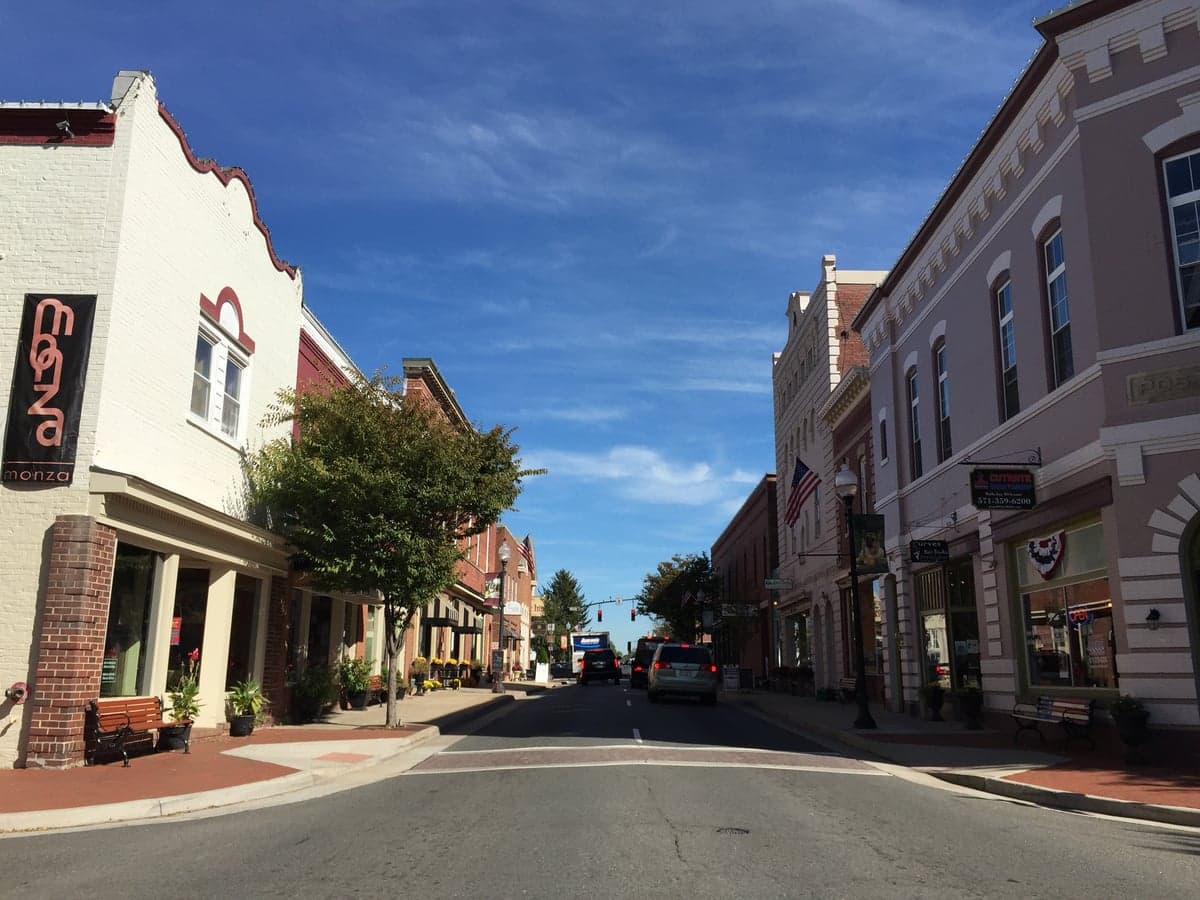
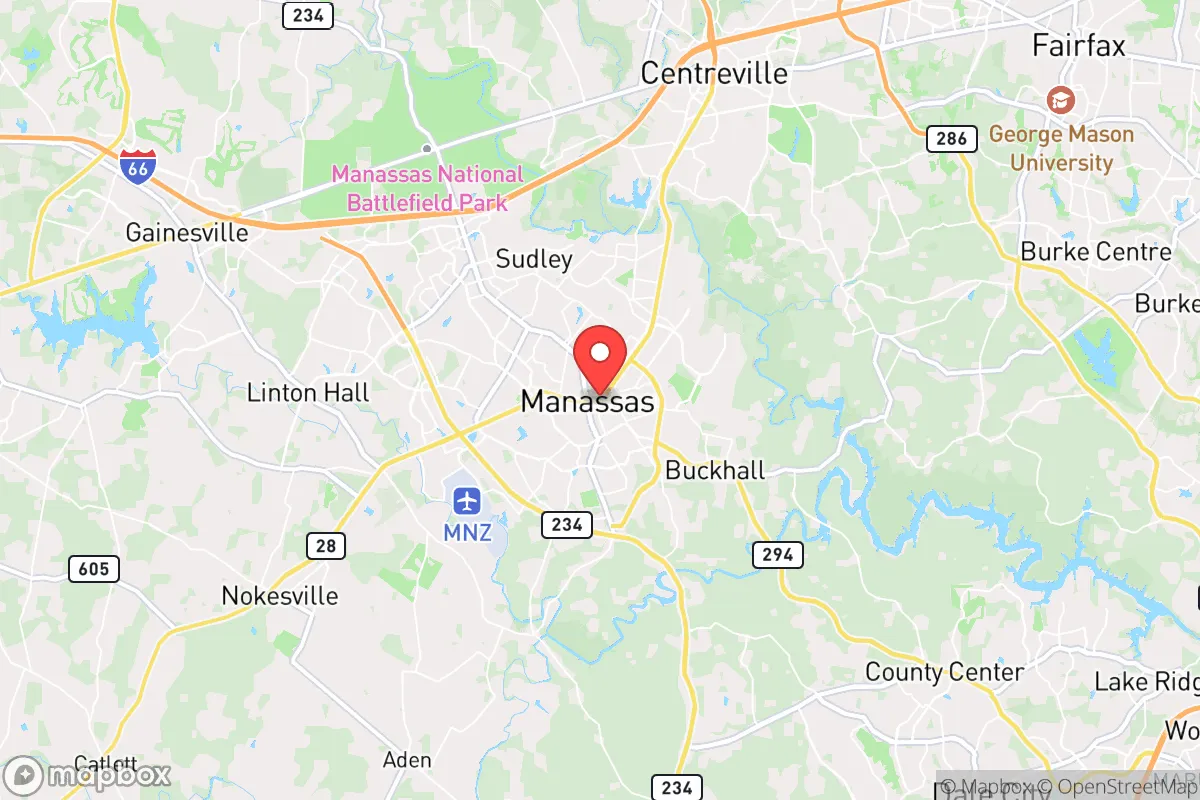
Photo: Wikipedia
Demographics of Manassas, VA
Affluence Level in Manassas, VA
An upper-middle-class area. Household wealth, education levels, and homeownership run ahead of national benchmarks.
People of Manassas, VA
Manassas, Virginia, is a compact, majority-minority city of 42,674 residents where no single ethnic group holds a numerical majority. The population is 43.0% Hispanic, 34.5% White, 12.4% Black, 4.2% East/Southeast Asian, and 1.4% Indian (subcontinent), with 17.8% foreign-born. This demographic profile reflects a city that has transformed from a small railroad depot town into a dense, diverse, and family-oriented suburb of Washington, D.C., where Spanish is heard as commonly as English in many neighborhoods and the median age is a relatively young 33.6 years.
How the city was settled and grew
Manassas was not a colonial settlement; its origin story begins with the railroad. The Manassas Gap Railroad reached the junction with the Orange & Alexandria Railroad in the 1850s, creating a small depot community called Manassas Junction. The original population was overwhelmingly white, Anglo-Saxon, and Protestant, drawn by the railroad economy and later by the region's agricultural trade. The Civil War brought two major battles to the area, but the town itself remained a small crossroads hamlet through the late 19th century. The first significant growth wave came after 1900, when the Manassas Industrial School for Colored Youth (founded in 1894) and the arrival of the Southern Railway spurred a modest Black population to settle in the Old Town Manassas area, particularly along Grant Avenue and West Street. By 1950, Manassas was still a small town of roughly 3,500 residents, nearly all white, with a small Black community concentrated in the Lomond neighborhood and the area around Liberia Avenue. The city's character remained rural and railroad-oriented until the post-World War II suburban boom began to reach it.
Modern era (post-1965)
The 1965 Hart-Cellar Immigration Act and the completion of Interstate 66 in the 1980s fundamentally reshaped Manassas. The city became a bedroom community for federal workers and defense contractors, drawing domestic in-migrants from across the United States. The first major non-white wave was Hispanic, beginning in the 1980s and accelerating through the 1990s and 2000s. Salvadoran, Guatemalan, and Mexican immigrants settled heavily in the Georgetown South neighborhood, a dense area of townhouses and apartments south of the railroad tracks, and in the Wellington area near the Prince William County line. By 2010, the Hispanic share of the population had surged past 35%, making Manassas one of the most heavily Hispanic cities in Virginia. A smaller but significant East/Southeast Asian wave—primarily Vietnamese and Korean families—arrived in the 1990s and 2000s, clustering in the Mayfield and West Manassas neighborhoods, drawn by affordable housing and proximity to the growing Asian commercial corridor along Route 28. The Indian (subcontinent) population, at 1.4%, is a more recent and smaller presence, concentrated in newer subdivisions near the Bull Run area on the city's northern edge. The white population, which was over 80% in 1980, has declined to 34.5% as of the latest data, with many white families moving to farther exurbs or remaining in the older Old Town historic district.
The future
Manassas is not homogenizing; it is becoming more distinctly tribalized by neighborhood and ethnicity. The Hispanic population, now the largest single group, is projected to continue growing slowly, driven by both immigration and natural increase, but the rate of new arrivals has plateaued since 2015. The white population is aging and declining, while the Black population has remained stable at roughly 12-13% for two decades. East/Southeast Asian and Indian populations are growing modestly, primarily through domestic migration from other D.C. suburbs rather than direct immigration. The city's foreign-born share of 17.8% is high for Virginia but has not increased significantly since 2010, suggesting that the immigrant-driven growth phase may be maturing. Over the next 10-20 years, Manassas is likely to see continued ethnic consolidation in its existing neighborhoods—Georgetown South remaining heavily Hispanic, Mayfield and West Manassas retaining their Asian character, and Old Town becoming more white and affluent as it gentrifies. The city's overall population is expected to grow slowly, constrained by land area and zoning, with density increasing through townhouse and apartment infill.
For a conservative-leaning individual or family moving to Manassas today, the city offers a dense, diverse, and family-oriented environment with strong schools and a stable job market tied to the federal government and defense sector. The population is becoming more settled and less transient, with second-generation Hispanic and Asian families putting down roots. The city is not a melting pot in the traditional sense, but a patchwork of distinct ethnic neighborhoods where community identity remains strong and property values have held steady. Manassas is a place where the railroad depot past has given way to a multi-ethnic, middle-class suburb that is still defining what it will become.

* Values derived from national, state, county, city and local statistics and may differ in a specific area. Last updated: 2026-04-19T08:36:36.000Z
Narrative content on this page is AI-generated and may contain mistakes. Verify any details that matter before acting on them.
ReloMaps may earn a commission from affiliate links at no extra cost to you.

