
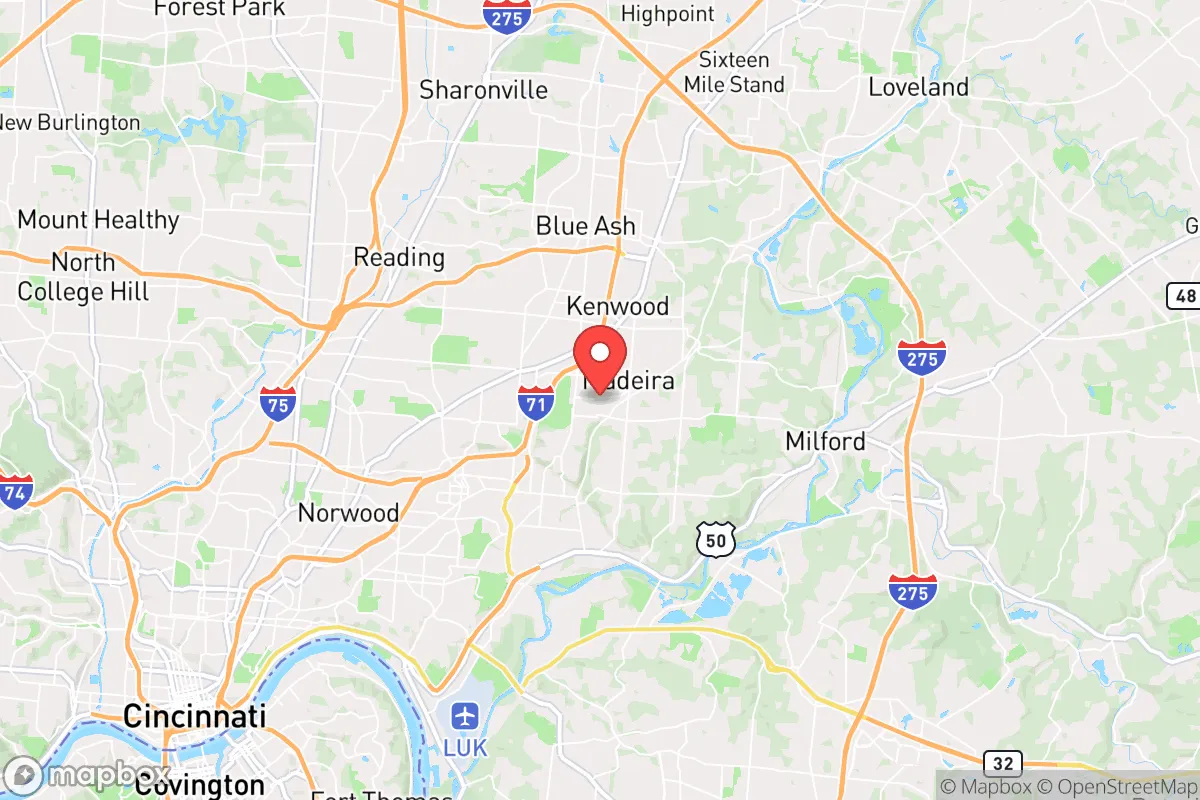
Photo by TopSphere Media on Unsplash
Demographics of Madeira, OH
Affluence Level in Madeira, OH
A wealthy area with high-earning, well-educated households. Incomes, home values, and educational attainment meaningfully outpace national averages.
People of Madeira, OH
The people of Madeira, Ohio, today form a notably homogeneous, highly educated community of 9,454 residents, where 88.0% of the population identifies as White and 71.8% hold a college degree. The city is characterized by its small-town feel within the Cincinnati metro area, with a strong emphasis on family life, local schools, and community events. Its distinctive identity is shaped by a deep-rooted sense of place, where many current residents are descendants of the families who built the city, creating a stable and tight-knit social fabric. This is a community where generational continuity is a defining feature, not a demographic transition.
How the city was settled and grew
Madeira’s human history begins not with a dramatic founding event, but with a slow, steady agricultural settlement. The area was originally part of the Symmes Purchase, a land grant that drew early American settlers of primarily German and English stock to the fertile Mill Creek Valley in the early 1800s. These first families—names like Madeira, Pfeffer, and Kennedy—established farms and small mills along the creek. The arrival of the Cincinnati, Lebanon & Northern Railway in the 1870s transformed the rural crossroads into a commuter suburb, attracting a second wave of German and Irish families who built homes in what is now the Historic District around Miami Avenue. These were skilled tradesmen, shopkeepers, and railroad workers who valued land ownership and self-reliance. The city incorporated in 1911, and through the mid-20th century, growth was organic and almost exclusively white, with new subdivisions like Kenwood Hills and Madeira Hills filling in with families moving from Cincinnati proper. The population remained overwhelmingly native-born and Protestant, with a small but established Catholic minority from the Irish and later Italian families who arrived in the 1920s and 1930s.
Modern era (post-1965)
The post-1965 era in Madeira was not defined by the large-scale immigration that reshaped other American suburbs. Instead, the city experienced a period of sustained domestic in-migration from other parts of Greater Cincinnati and the Midwest. The 1970s and 1980s saw the development of Ravenswood and Woods of Madeira, neighborhoods of larger single-family homes that attracted corporate professionals and executives from Procter & Gamble, Kroger, and other Cincinnati-based firms. These new residents were overwhelmingly white and college-educated, reinforcing the city’s existing demographic profile. The foreign-born population remained minimal—today it stands at just 1.0%—and the small Asian (2.1%) and Indian (1.1%) communities that have arrived since 2000 are largely concentrated in newer, higher-end developments like Summit Park and the Madeira Towne Centre area. These are typically families drawn by the Madeira City Schools reputation, not by ethnic enclaves. The Black population (0.8%) and Hispanic population (4.0%) remain very small, with no distinct neighborhood clustering. The city’s demographic story is one of stability, not transformation.
The future
Looking ahead, Madeira’s population is likely to continue its pattern of slow, selective growth, with the city approaching build-out. The primary demographic trend is aging in place, as the large cohort of families who moved in during the 1970s and 1980s now enter retirement. This will create a modest turnover of homes, but the high property values and strong school system will continue to attract a similar demographic profile: white, college-educated, and family-oriented. The small Asian and Indian communities are expected to grow incrementally as professional families from those backgrounds seek out the same school quality and safety that drew previous waves. However, there is no evidence of rapid diversification or the formation of distinct ethnic enclaves. The Hispanic population, while the fastest-growing minority group, is starting from a very low base and is unlikely to reach a critical mass that would alter the city’s character. The city is homogenizing in the sense that its population is becoming more uniformly affluent and educated, not more diverse.
For someone moving to Madeira now, the bottom line is clear: you are joining a community that values continuity, stability, and local institutions. This is not a city in demographic flux or cultural transition. It is a place where the past is present in the names on the streets and the families in the pews, and where the future looks very much like the present—a safe, well-educated, and predominantly white suburb that rewards those who seek a predictable and high-quality family environment.

* Values derived from national, state, county, city and local statistics and may differ in a specific area. Last updated: 2026-04-27T18:17:25.000Z
Narrative content on this page is AI-generated and may contain mistakes. Verify any details that matter before acting on them.
ReloMaps may earn a commission from affiliate links at no extra cost to you.

