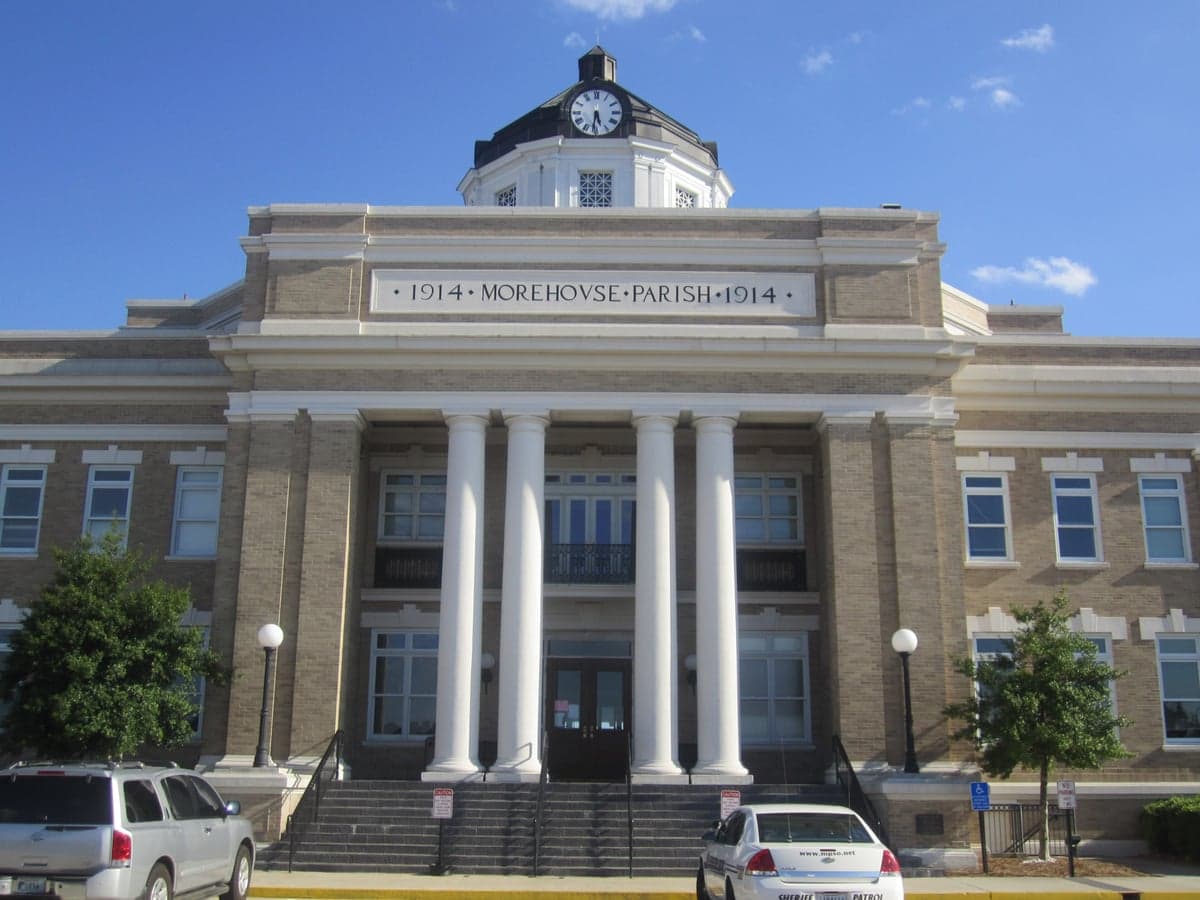
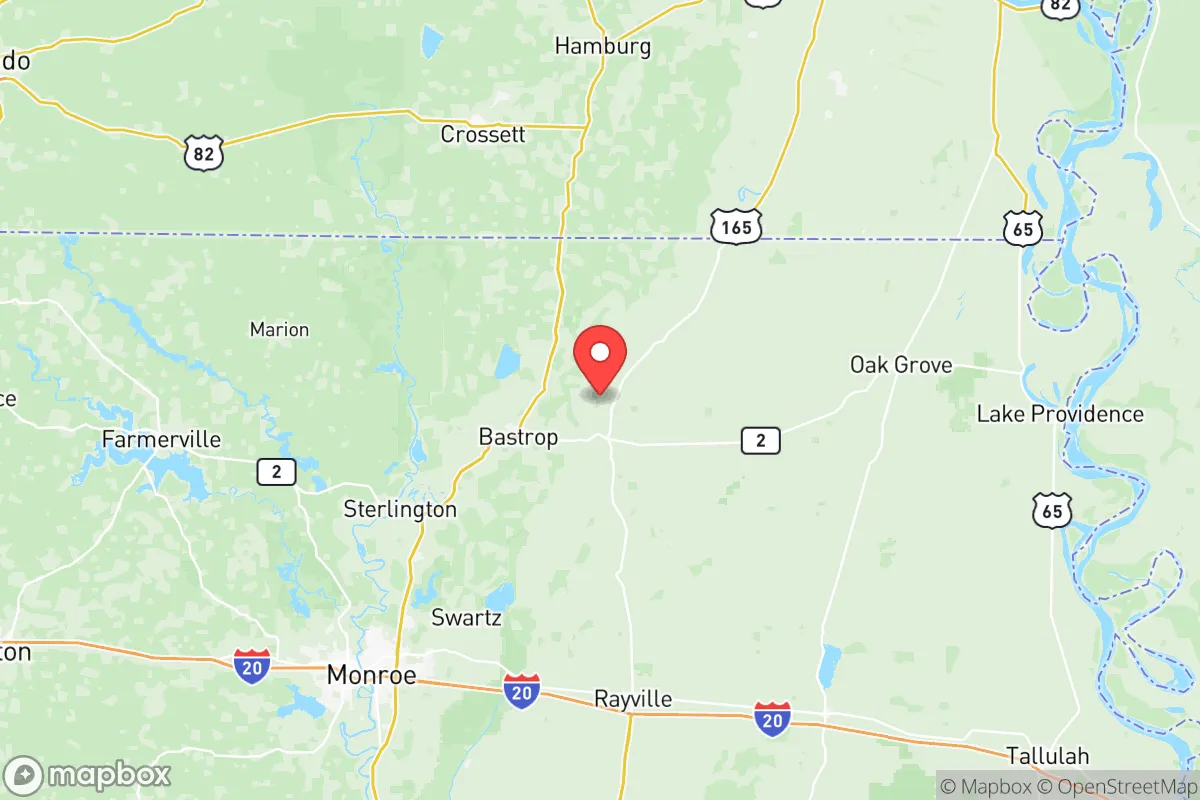
Photo: Wikipedia
Demographics of Morehouse County
Affluence Level in Morehouse County
A low-income area with significant economic hardship. Household wealth and educational attainment are well below national averages.
People of Morehouse County
The people of Morehouse Parish, Louisiana, today number just under 25,000, forming a nearly evenly split Black and white population in the state’s northeastern corner. With a foreign-born share of only 0.4%, this is one of the least ethnically diverse parishes in Louisiana, and its 12.7% college attainment rate reflects a rural, working-class character rooted in agriculture and resource extraction. The parish’s identity is shaped by its deep history as a cotton and timber powerhouse, a legacy that continues to influence settlement patterns around the towns of Bastrop, Mer Rouge, and Collinston.
Settlement & growth (pre-1960)
Before European contact, the area now known as Morehouse Parish was part of the hunting and trading grounds of the Caddo Confederacy, particularly the Kadohadacho and related bands. The Caddo had established a network of mound-building settlements along the Bayou Bartholomew and Ouachita River systems, but by the early 1800s, disease and displacement had drastically reduced their numbers. The United States acquired the region through the Louisiana Purchase in 1803, and the Caddo were forcibly removed to Oklahoma by treaties in the 1830s, opening the land to Anglo-American settlement.
The first major wave of settlers arrived in the 1820s and 1830s, primarily Scots-Irish and English families migrating from the Upper South states of Tennessee, Kentucky, and the Carolinas. They were drawn by cheap, fertile land along the Bayou Bartholomew floodplain, ideal for cotton cultivation. The parish was officially created in 1844, named after a local planter family, and the town of Bastrop was established as the parish seat on a high bluff overlooking the Ouachita River. By 1860, the population had reached roughly 8,000, with a large enslaved Black majority working the cotton plantations that lined the bayous. The Civil War and Reconstruction devastated the plantation economy, but cotton remained the backbone of the parish into the early 20th century.
After emancipation, freed Black families concentrated in rural settlements like Mer Rouge, Collinston, and the area around Oak Ridge, where they established independent farming communities and churches. The post-Reconstruction era saw the imposition of Jim Crow segregation, but Black landownership remained relatively high compared to other Deep South parishes. The arrival of the railroad in the 1880s spurred a second wave of growth, bringing a small number of Italian and Lebanese immigrant merchants to Bastrop, though their numbers remained tiny. The early 1900s saw the rise of the timber industry, with vast pine forests logged by both white and Black laborers, and the town of Bonita emerged as a sawmill hub. By 1930, the population had grown to 18,000, but the Great Depression and the mechanization of cotton farming triggered an outmigration of Black residents to northern cities during the Great Migration, a trend that continued through the 1950s.
Modern era (post-1965)
The Hart-Cellar Act of 1965 had almost no effect on Morehouse Parish. The foreign-born population today is 0.4%, and the parish saw no significant immigration from Asia, Latin America, or the Middle East. Instead, the demographic story of the modern era is one of domestic outmigration and racial rebalancing. Between 1960 and 2020, the parish lost roughly 10,000 residents, as young people left for job opportunities in Monroe, Shreveport, and out of state. The white population declined faster than the Black population, shifting the parish from roughly 60% white in 1960 to 47.5% white and 48.1% Black today.
Suburbanization within the parish has been minimal. Bastrop, the largest town with about 10,000 residents, remains the commercial and civic center, but its population has stagnated. The small communities of Mer Rouge, Collinston, and Bonita have seen steady population loss, with many homes abandoned or demolished. The decline of the timber industry in the 1980s and the closure of several cotton gins eliminated hundreds of jobs, accelerating the exodus. The prison system has become a notable employer, with the Morehouse Parish Detention Center and a state-run work release facility providing stable, if limited, jobs. The Hispanic population, at 1.6%, is a very recent arrival, consisting mostly of migrant laborers working in the remaining poultry and catfish operations, but no permanent enclave has formed.
The future
The population of Morehouse Parish is projected to continue its slow decline, falling below 22,000 by 2040 if current trends hold. The parish is becoming slightly more diverse in the sense that the white and Black shares are converging, but the overall population is aging and shrinking. The college attainment rate of 12.7% is among the lowest in Louisiana, and the lack of a four-year college or major employer outside of agriculture and corrections limits the parish’s ability to attract new residents. The small Hispanic population may grow modestly as the poultry industry expands, but it is unlikely to reach 5% in the next decade.
There are no signs of a reversal in the outmigration trend. The parish’s cultural identity remains deeply rooted in its rural, biracial Southern heritage, with strong church communities and a tradition of hunting and fishing. The annual Morehouse Parish Fair in Bastrop and the Mer Rouge Christmas parade are key social events. For a newcomer, the parish offers very low housing costs and a quiet, slow-paced lifestyle, but limited job opportunities, few amenities, and a population that is both aging and shrinking. The kind of person who moves here is likely someone with family ties, a remote work arrangement, or a job in the corrections or agricultural sector.
Morehouse Parish is becoming a quieter, older, and more economically fragile version of itself. For someone moving in now, it means joining a community where personal relationships and church networks matter deeply, but where the economic and demographic headwinds are strong. The parish is not diversifying in any meaningful way, and its future depends on whether it can retain its young people and attract any new industry beyond agriculture and incarceration.

* Values derived from national, state, county, city and local statistics and may differ in a specific area. Last updated: 2026-08-05T00:04:23.000Z
Narrative content on this page is AI-generated and may contain mistakes. Verify any details that matter before acting on them.
ReloMaps may earn a commission from affiliate links at no extra cost to you.

