Photo: Wikipedia
Demographics of Caddo County
Affluence Level in Caddo County
A below-average socioeconomic profile. Incomes, home values, and educational attainment trail the U.S., with higher poverty and unemployment.
People of Caddo County
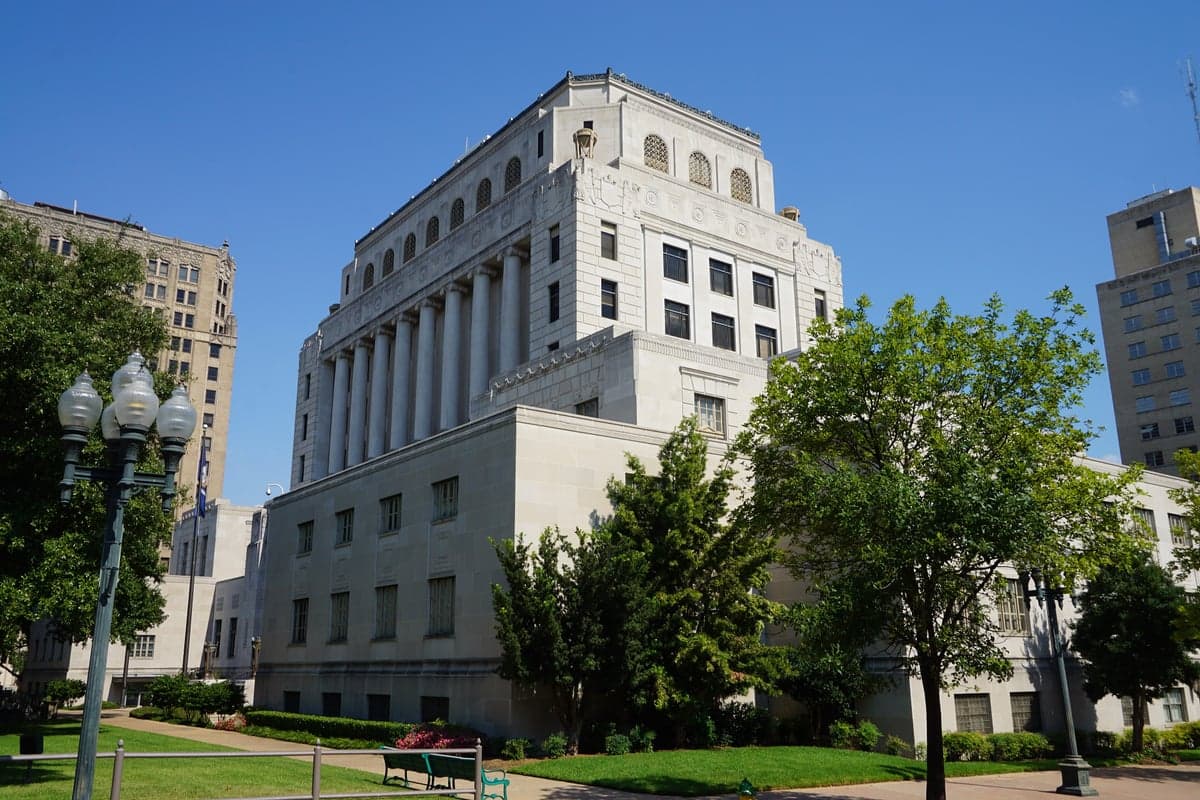
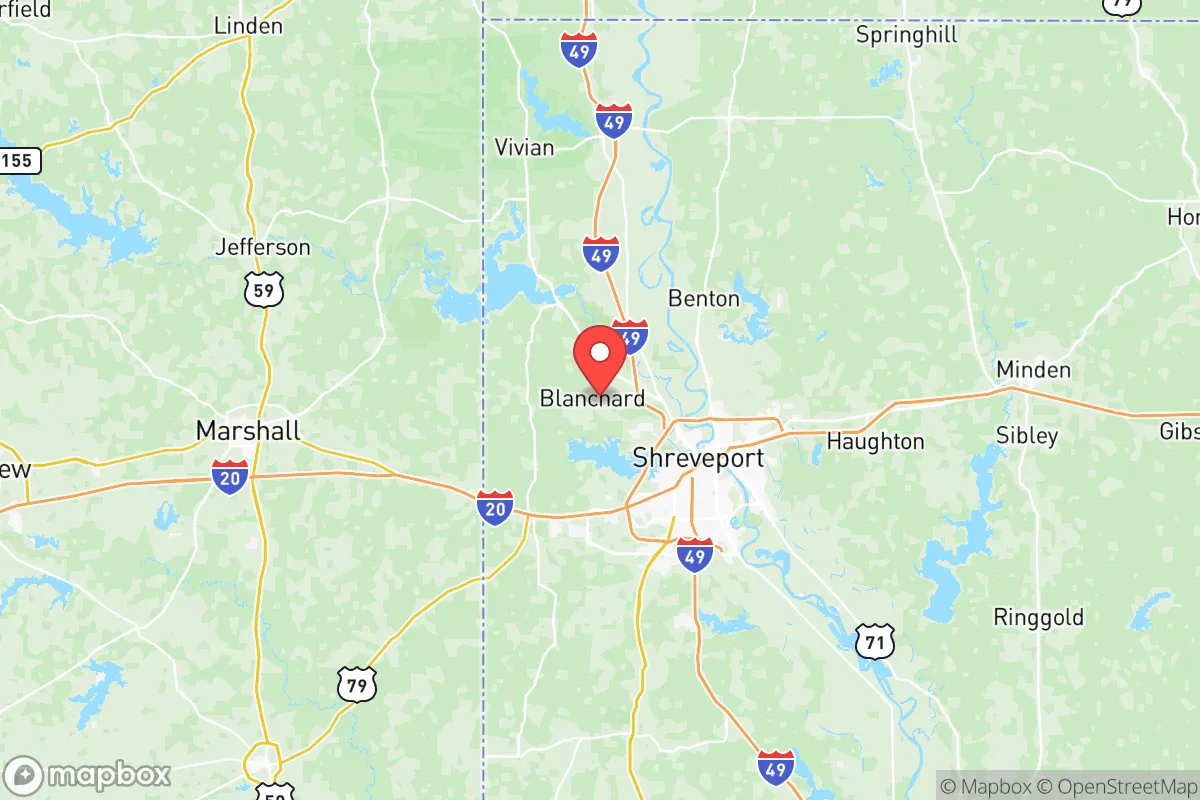
The people of Caddo Parish, Louisiana, today form a community shaped by deep historical roots and a clear demographic identity: a nearly evenly split Black and White population, with a very small foreign-born presence of just 1.2%. With 232,973 residents, the parish is anchored by the city of Shreveport, which serves as the cultural and economic heart, while smaller towns like Vivian, Blanchard, and Greenwood reflect its rural and suburban edges. Distinctive markers include a strong sense of place tied to the Red River, a legacy of oil and gas wealth, and a population that is notably less diverse than the national average, with Hispanic (3.7%) and East/Southeast Asian (0.9%) communities remaining small but present.
Settlement & growth (pre-1960)
Long before European contact, the area now known as Caddo Parish was the homeland of the Caddo Nation, a confederacy of agricultural tribes who lived in settled villages along the Red River. The Caddo people were forcibly removed to Indian Territory (present-day Oklahoma) in the 1830s, following the Louisiana Purchase and subsequent treaties. The parish itself was created in 1838, named for the Caddo tribe, and the first wave of American settlers—primarily Anglo-American planters from the Southeastern states—arrived in the 1830s and 1840s, drawn by fertile cotton lands along the river. These early settlers established plantations and the first towns, including Shreveport (founded 1836 by the Shreve Town Company) and Blanchard, which grew as a farming community.
The second major wave came after the Civil War, during Reconstruction and the late 19th century. Freed slaves, who made up a large portion of the parish's population, remained in the area as sharecroppers and tenant farmers, forming the foundation of the Black community that still constitutes nearly half the parish today. Many settled in Shreveport's Allendale and Lakeside neighborhoods, as well as in rural communities like Mooringsport and Oil City. The discovery of oil in the Caddo-Pine Island Oil Field in 1906 triggered a dramatic population boom. Thousands of white and Black workers from Texas, Arkansas, and Oklahoma flooded into the parish, transforming Shreveport into a bustling oil hub. Towns like Oil City and Vivian sprang up almost overnight to house oil-field workers, while Greenwood and Keithville grew as residential areas for those employed in the industry.
By the mid-20th century, the parish's population was overwhelmingly native-born, with a small number of European immigrants—mostly Italian and Lebanese merchants—who settled in Shreveport's downtown and Highland neighborhoods. The oil boom also attracted a modest number of Mexican laborers, but the foreign-born share remained minuscule. The Great Depression and World War II slowed growth, but the post-war era saw suburbanization begin, with families moving to areas like Bossier City (technically in Bossier Parish but closely tied to Caddo) and the southern parts of the parish around Stonewall.
Modern era (post-1965)
The 1965 Hart-Cellar Act, which reshaped U.S. immigration, had a limited impact on Caddo Parish compared to coastal or Sun Belt regions. The foreign-born population today stands at just 1.2%, far below the national average. The most notable post-1965 change has been domestic: the decline of the oil industry in the 1980s led to population stagnation and even loss, as many white and Black residents moved to Houston, Dallas, and other growing Sun Belt cities. This out-migration was partially offset by an influx of Black residents from rural areas of Louisiana and neighboring states, who moved to Shreveport for jobs in healthcare, education, and government.
The Hispanic population, while still small at 3.7%, has grown modestly since the 1990s, driven by Mexican and Central American immigrants who work in construction, agriculture, and the service industry. They are concentrated in Shreveport's West Shreveport and Queensborough neighborhoods, as well as in Vivian, where poultry processing plants employ many. The East/Southeast Asian community (0.9%) is primarily Vietnamese and Filipino, with a small enclave in Shreveport's Broadmoor area, many of whom arrived as refugees after the Vietnam War or as medical professionals. The Indian subcontinent population (0.3%) is even smaller, mostly professionals in healthcare and academia, living in Shreveport's South Highlands and Spring Lake neighborhoods.
Suburbanization has continued, with middle-class families—both Black and white—moving to newer developments in Blanchard, Greenwood, and Keithville. These areas have seen the most population growth since 2000, while Shreveport's urban core has lost residents. The parish's racial composition has remained remarkably stable: the Black share has hovered around 49% for decades, while the white share has declined slightly from 47% to 42.7%, largely due to out-migration of younger white residents. The college-educated rate of 25.3% is below the national average, reflecting the parish's industrial and service-based economy.
The future
The population of Caddo Parish is projected to continue its slow decline, with the U.S. Census Bureau estimating a loss of roughly 5-10% by 2040. The parish is becoming slightly more diverse, driven by modest Hispanic and Asian growth, but the foreign-born share will likely remain below 3%. The Black-white split will persist, with the Black share possibly edging past 50% as older white residents age out and younger ones leave. New communities are concentrating in the southern and western suburbs—Blanchard and Greenwood are expected to see the most new housing—while Shreveport's urban core will continue to lose population. The cultural identity is evolving from a historically biracial, oil-and-cotton economy toward a more service-oriented, healthcare-and-education-based one, anchored by LSU Health Shreveport and Barksdale Air Force Base (just across the Red River in Bossier Parish).
For someone moving in now, Caddo Parish offers a stable, affordable, and deeply rooted community with a clear sense of its past. The population is not becoming dramatically more diverse or cosmopolitan; instead, it is solidifying as a predominantly Black and white Southern parish with small but growing Hispanic and Asian enclaves. The future points toward a quieter, slower-paced region where family ties and local institutions—churches, schools, and civic clubs—remain central to daily life. New residents will find a place where the human history is written in the land, from the Caddo mounds to the oil derricks to the suburban cul-de-sacs of today.

* Values derived from national, state, county, city and local statistics and may differ in a specific area. Last updated: 2026-07-06T11:58:07.000Z
Narrative content on this page is AI-generated and may contain mistakes. Verify any details that matter before acting on them.
ReloMaps may earn a commission from affiliate links at no extra cost to you.

