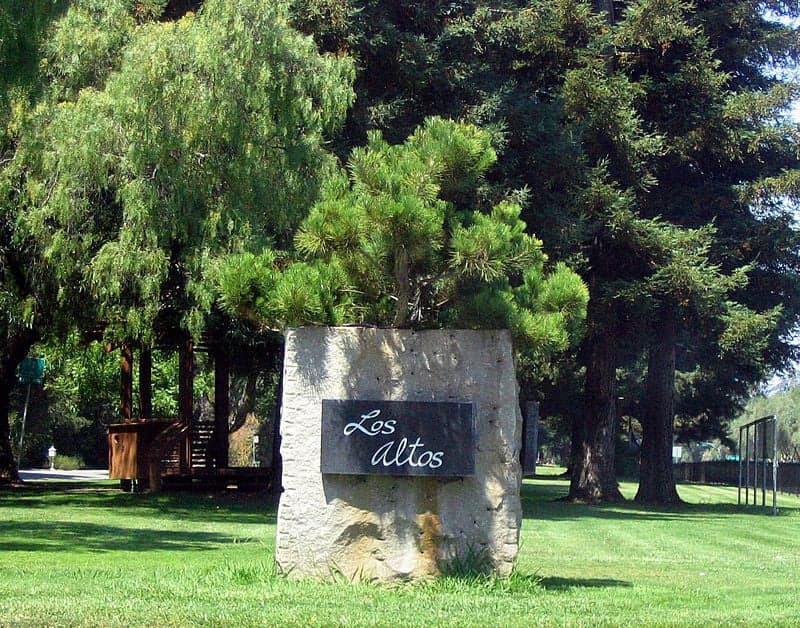
Photo: Wikipedia
Demographics of Los Altos, CA
Affluence Level in Los Altos, CA
An elite concentration of wealth — high incomes, strong home values, advanced degrees, and minimal poverty signal a top-tier socioeconomic profile.
Census doesn't track above $250K
People of Los Altos, CA
The people of Los Altos, California, today number roughly 30,736, forming a highly educated, affluent, and predominantly Asian-American and White community. The city is characterized by its concentration of tech-industry professionals, a foreign-born population of 11.0%, and an exceptionally high 87.2% college education rate. Distinctive identity markers include a strong culture of academic achievement, low-density suburban living with significant open space, and a demographic profile that has shifted dramatically from its historically White, Protestant roots to one where East/Southeast Asian (24.9%) and Indian (12.6%) communities together now outnumber the White population (50.5%).
How the city was settled and grew
Los Altos was not a 19th-century farming village but a planned 20th-century suburban development. The area was originally part of the vast Rancho San Antonio land grant, used for cattle grazing and later orchards. The city’s founding population arrived in the early 1900s, drawn by the 1906 earthquake’s displacement from San Francisco and the promise of a rural, temperate retreat. Developer Paul Shoup, a Southern Pacific Railroad executive, began selling lots in 1908, marketing Los Altos as a “country club” community for wealthy San Franciscans. The original settlers were almost entirely White, upper-middle-class professionals and business owners who built large homes on large lots. The historic Downtown Los Altos area, centered around Main Street and State Street, became the commercial and social hub for these early residents. The Loyola Corners neighborhood, near the intersection of Fremont Avenue and Magdalena Avenue, developed as a secondary commercial node serving the surrounding orchard estates. A second wave of White, middle-class families arrived during the post-World War II boom, filling new subdivisions like North Los Altos (north of El Camino Real) and South Los Altos (south of Foothill Expressway). These residents were largely engineers and managers drawn by the emerging defense and aerospace industries in nearby Sunnyvale and Palo Alto. The city incorporated in 1952, solidifying its identity as an exclusive, low-density suburb.
Modern era (post-1965)
The 1965 Hart-Cellar Immigration Act and the simultaneous rise of Silicon Valley transformed Los Altos’s population. The city’s proximity to Stanford University and major tech employers like Hewlett-Packard and Intel began attracting highly skilled immigrants, particularly from East and Southeast Asia. The Country Club neighborhood, with its larger homes and proximity to the Los Altos Golf & Country Club, saw an influx of Chinese and Taiwanese families in the 1980s and 1990s, drawn by the top-ranked Los Altos School District. The Rancho San Antonio area, near the open-space preserve, attracted a mix of White and Asian professionals. The most significant demographic shift occurred after 2000, as the Indian subcontinent community grew rapidly, now comprising 12.6% of the population. These families concentrated in newer, larger homes in neighborhoods like Grant Park and the Fremont Avenue corridor, where homes often exceed $3 million. The White population, while still a plurality at 50.5%, has declined from over 80% in 1980, as older residents have aged out and been replaced by younger, more diverse tech workers. The Hispanic population remains small at 5.5%, concentrated in service-industry roles and living primarily in the San Antonio Road area near the border with Mountain View. The Black population is minimal at 1.0%.
The future
The population of Los Altos is heading toward a continued, gradual homogenization by income and education level, even as it diversifies ethnically. The city is not tribalizing into distinct ethnic enclaves; rather, East/Southeast Asian and Indian families are integrating into the same neighborhoods and school communities as White families, driven by a shared focus on academic excellence and property values. The immigrant communities are plateauing in terms of growth, as the city is largely built out with no significant new housing development. The foreign-born share (11.0%) is lower than in neighboring Cupertino or Palo Alto, suggesting that second-generation and third-generation Asian-American families are now a significant portion of the population. Over the next 10-20 years, the White population is likely to continue its slow decline, while the East/Southeast Asian and Indian populations will likely stabilize or grow modestly as existing families age in place and a small number of new homes are built. The city’s high cost of entry—median home prices above $4 million—will continue to filter for only the highest-income households, reinforcing its character as an elite, academically-driven suburb.
For someone moving in now, Los Altos is becoming a place where traditional suburban values of safety, space, and top-tier public schools are paired with a distinctly global, tech-centric population. The city is not a melting pot in the classic sense but a high-achieving, high-cost enclave where ethnic diversity is real but stratified by income and education. New residents should expect a community that is politically moderate to liberal, intensely focused on children’s education, and increasingly shaped by the professional ambitions of its Asian and Indian majority.

* Values derived from national, state, county, city and local statistics and may differ in a specific area. Last updated: 2026-05-02T04:56:41.000Z
Narrative content on this page is AI-generated and may contain mistakes. Verify any details that matter before acting on them.
ReloMaps may earn a commission from affiliate links at no extra cost to you.

