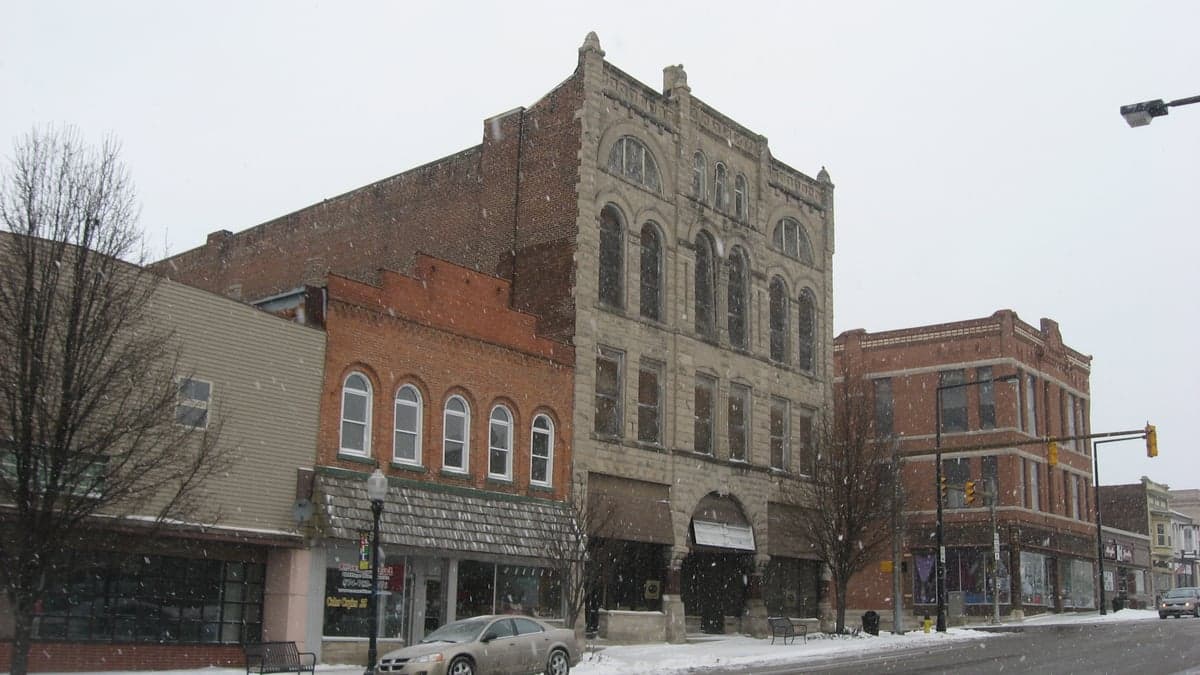
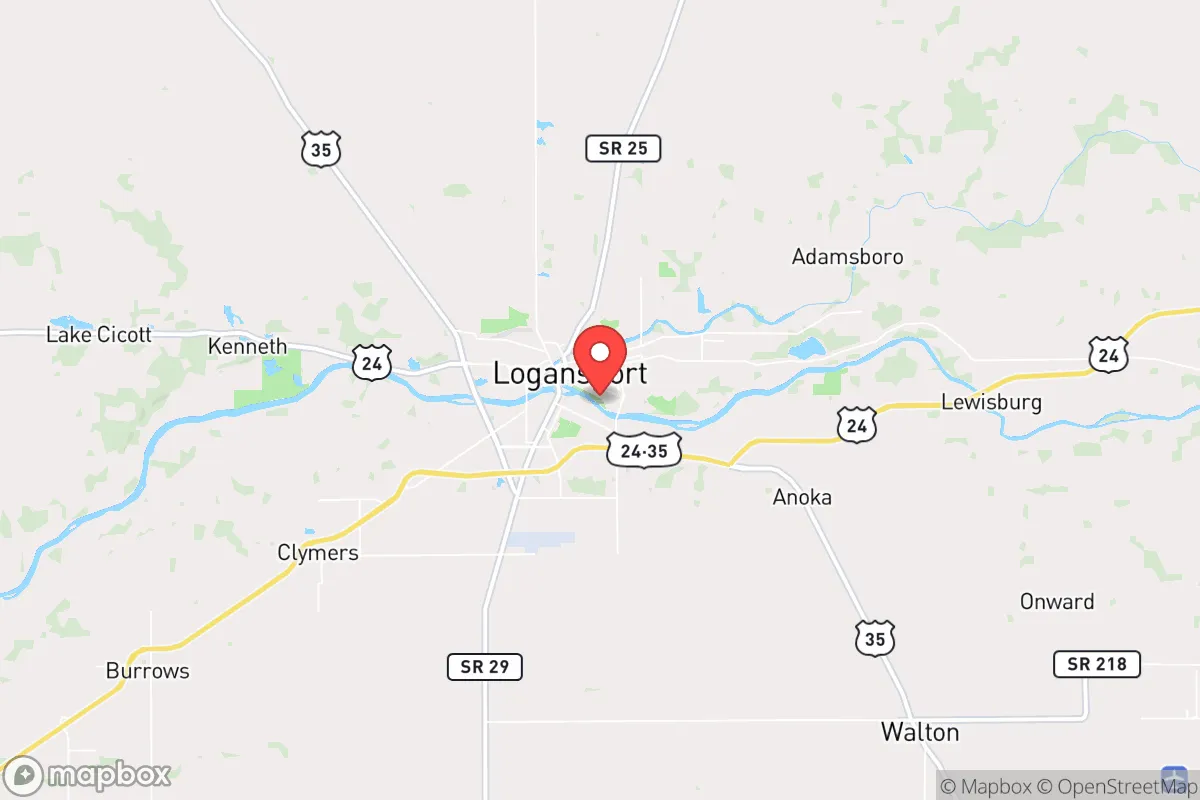
Photo: Wikipedia
Political ClimatePolitical Climate in Logansport, IN
District shown is the primary district for this city’s centroid. Cities may span multiple districts.
Inherited from parent county — no local data available.
* Lean and PVI are calculated from the surrounding county’s 2020 and 2024 presidential results, Cook-style — a finer measure here than its congressional district (IN-4).
Political rankings in Indiana
- Most Conservative Cities in Indiana
- Most Liberal Cities in Indiana
- Best Liberal-Leaning Towns in the Midwest
- Safest Liberal-Leaning Towns in the Midwest
- Safest Conservative-Leaning Towns in the Midwest
- Affordable Small Towns for Conservatives
- Most Affordable Liberal-Leaning Small Towns in the U.S.
- Safest Conservative-Leaning Cities in the U.S.
- Most Conservative Counties in Indiana
- Most Liberal Counties in Indiana
Local Political AnalysisPolitical Analysis of Logansport, IN
Logansport is a reliably conservative area, with a Cook Partisan Voting Index (PVI) of R+23, meaning it votes about 23 points more Republican than the national average. That’s a deep red lean, and it’s been consistent for decades. The surrounding state of Indiana, by contrast, has a PVI of R+9, so Cass County is significantly more Republican than the state as a whole. If you’re looking at the trajectory, it’s not shifting dramatically—Logansport has been a solid GOP stronghold for as long as anyone around here can remember, and the 2024 presidential results (Trump carried the county by roughly 30 points) just reinforced that pattern. The local Democratic Party still fields candidates, but they rarely win countywide races.
How it compares
Indiana as a whole is a reliably red state, but Logansport sits in a deeper shade of that red. The R+23 PVI puts Cass County in the same league as nearby rural counties like Miami (R+22) and Fulton (R+24), while the state’s R+9 reflects the moderating influence of places like Indianapolis (Marion County, D+19) and Lake County (D+10). If you drive 30 miles south to Kokomo (Howard County, R+18), you’ll find a slightly less conservative electorate, thanks to a stronger union presence and a more diverse industrial base. Head 45 miles west to Lafayette (Tippecanoe County, R+12), and you’ll see a purple-ish tilt driven by Purdue University’s student and faculty population. Logansport, by contrast, lacks a major university or a large urban core, so its politics are shaped by a mix of agriculture, manufacturing, and a stable, older population that tends to vote Republican. The city itself is a bit more moderate than the county—precincts near the downtown and the Hispanic neighborhoods (about 15% of the population) sometimes break for Democrats—but the rural precincts overwhelmingly cancel that out.
What this means for residents
For conservative residents, the political climate is comfortable and affirming. Local offices—county commissioners, sheriff, school board—are almost always held by Republicans, so policy tends to align with conservative priorities on taxes, gun rights, and development. The Cass County Republican Party is active, with regular meetings and a strong get-out-the-vote operation. For liberal residents, it can feel isolating. There’s no formal Democratic headquarters in the county, and progressive candidates often struggle to raise money or attract volunteers. That said, Logansport is not a place where political differences lead to open hostility—people tend to keep their views private in mixed company. The city council has had a few Democrats over the years, and local issues like road funding or the Wabash River levee project rarely split along party lines. The practical effect is that national debates (abortion, immigration, climate) don’t dominate local conversation as much as they might in a swing area; instead, people focus on jobs, schools, and the cost of living.
Culturally, Logansport stands out from the rest of Indiana in one notable way: its sizable Hispanic community, largely of Mexican descent, has been here for generations. That demographic reality softens some of the hard edges you’d find in whiter, more rural parts of the state. The annual Fiesta de Logansport, the presence of Spanish-language services at local churches, and the popularity of Mexican restaurants all signal a more diverse everyday life than the county’s voting record might suggest. Policy-wise, the city has been pragmatic—it’s a “sanctuary city” in name only, with a 2017 resolution that directed police not to ask about immigration status, but enforcement is low-key and hasn’t sparked the kind of backlash you’d see in more polarized places. If you’re moving here, expect a conservative baseline with a live-and-let-live attitude, where the biggest political fights are more likely to be about the local landfill or the high school’s budget than about national culture wars.

State Political ClimatePolitical Climate in Indiana
State Political AnalysisPolitical Environment in the State
Indiana is a reliably Republican state with a Cook PVI of R+9, meaning it votes about nine points more Republican than the national average in presidential elections. Over the past 20 years, the state has shifted from a competitive purple state—where Democrats could win statewide races like governor and senator—to a solid red stronghold, driven by the collapse of Democratic support in rural areas and the exurbs of Indianapolis. While the state hasn’t flipped to the same degree as neighboring Ohio or Kentucky, the trajectory is unmistakably conservative, with the GOP now controlling the governor’s office, both chambers of the legislature, and both U.S. Senate seats.
Urban vs. rural divide
The political map of Indiana is a classic urban-rural split, but with a few unique wrinkles. The Democratic base is concentrated in three main areas: Marion County (Indianapolis), Lake County (Gary and the Chicago suburbs), and Monroe County (Bloomington, home to Indiana University). Indianapolis itself is a blue island in a sea of red, but it’s not as deep blue as Chicago or Detroit—Marion County went for Biden by about 20 points in 2020, while Lake County was closer to 25 points. The rest of the state is overwhelmingly Republican, with the most conservative counties being in the rural north-central region (e.g., Kosciusko County, home to Warsaw) and the southern tier along the Ohio River (e.g., Dubois County, around Jasper). A notable exception is Tippecanoe County (Lafayette), which has been trending purple due to Purdue University’s growth and a tech-sector influx, flipping from red to blue in presidential races since 2016. Meanwhile, Hamilton County, the wealthy northern suburb of Indianapolis, is a GOP stronghold but has seen some suburban drift toward Democrats in recent cycles, though it still votes Republican by double digits.
Policy environment
Indiana’s policy environment is broadly conservative, with a low-tax, low-regulation posture that appeals to many relocators. The state has a flat income tax rate of 3.15% (as of 2025, with a scheduled phase-down to 2.9% by 2027), and the sales tax is 7% on most goods. Property taxes are relatively low, capped at 1% of assessed value for owner-occupied homes. The state is a right-to-work state, meaning union membership is voluntary, and it has a “business-friendly” reputation that has attracted logistics and manufacturing firms. Education policy leans toward school choice: Indiana has one of the largest voucher programs in the country, with over 60,000 students using vouchers in 2024, and charter schools are widely available. Healthcare is a mixed bag—the state expanded Medicaid under the Affordable Care Act via a conservative waiver program (HIP 2.0), but it has not expanded abortion access; in fact, Indiana passed one of the nation’s strictest abortion bans in 2022, banning the procedure at fertilization with narrow exceptions for rape, incest, and life of the mother. Election laws are moderately restrictive: voter ID is required, early voting is available for 28 days, and no-excuse absentee voting was expanded during COVID but remains less generous than in some states. The state does not have a “stand your ground” law, but it does have a “castle doctrine” and a permitless carry law (enacted in 2022), allowing most adults to carry a handgun without a license.
Recent policy direction
The last five years have seen Indiana move decisively to the right on several fronts. On gun rights, the 2022 permitless carry law (House Enrolled Act 1296) eliminated the requirement for a license to carry a handgun, though federal background checks still apply for purchases. On education, the state passed a “Parents’ Bill of Rights” in 2023 (Senate Enrolled Act 148), requiring schools to notify parents of any changes in a student’s health or well-being and prohibiting instruction on human sexuality in grades K-3. On medical freedom, Indiana banned gender-affirming care for minors in 2023 (Senate Enrolled Act 480), overriding a veto from Governor Eric Holcomb. On taxes, the legislature has been steadily cutting the income tax rate, with the goal of reaching 2.9% by 2027. On voting, the state passed a voter ID law in 2005 and has resisted efforts to expand mail-in voting, though it did allow no-excuse absentee voting during the pandemic. On property rights, Indiana is a “Dillon’s Rule” state, meaning local governments have limited authority unless explicitly granted by the state, which has been used to preempt local ordinances on issues like plastic bag bans and minimum wage increases. On privacy and surveillance, the state has no comprehensive data privacy law, though it does have a biometric privacy law (similar to Illinois’s BIPA) that has spurred class-action lawsuits. On bodily autonomy, the near-total abortion ban has been challenged in court but was upheld by the Indiana Supreme Court in 2023, making it one of the most restrictive in the Midwest.
Civil unrest & political movements
Indiana has seen its share of political flashpoints, though they tend to be less dramatic than in coastal states. The 2020 protests in Indianapolis over George Floyd’s death were large but mostly peaceful, with some property damage downtown. The state has a small but active “Second Amendment sanctuary” movement, with over 50 counties passing resolutions declaring they will not enforce certain gun laws. Immigration politics are relatively quiet—Indiana is not a border state, and the immigrant population is small (about 5% of the total). There are no sanctuary cities, though Bloomington and Indianapolis have “welcoming city” ordinances that limit cooperation with federal immigration enforcement. Election integrity has been a hot topic since 2020, with the state GOP pushing for stricter voter roll maintenance and a ban on ballot drop boxes (enacted in 2023). There have been no major secession or nullification movements, though some rural counties have flirted with “county sovereignty” resolutions. The most visible political movement in recent years has been the “school choice” and “parental rights” coalition, which has been highly effective at the statehouse, pushing through the Parents’ Bill of Rights and expanding the voucher program.
Projection
Over the next 5-10 years, Indiana is likely to remain solidly Republican, but the margins may tighten slightly in suburban areas like Hamilton County and Hendricks County as more white-collar professionals move in from blue states. The state’s population is growing slowly (about 0.5% per year), with most growth in the Indianapolis metro and the I-69 corridor toward Fort Wayne. The rural areas will continue to lose population and become even more Republican. The biggest wildcard is the state’s abortion ban—if it drives away young, college-educated women, it could accelerate the demographic shift toward an older, more conservative electorate. Conversely, if the ban is overturned or weakened by the courts, the state might retain more of its moderate suburbanites. The tax cuts are popular and likely to continue, which will keep the state attractive to businesses but may strain public services over time. For a new resident, the Indiana of 2035 will look much like the Indiana of 2025: reliably red, low-tax, and culturally conservative, but with a few blue islands in Indianapolis, Bloomington, and the Chicago suburbs.
For a relocator, the bottom line is that Indiana offers a stable, predictable political environment with low taxes and a conservative tilt on most issues. If you’re a conservative, you’ll find your values reflected in state law and local culture, especially outside the major cities. If you’re a liberal, you’ll find like-minded communities in Indianapolis, Bloomington, and parts of Lake County, but you’ll be living in a state where your vote carries less weight and where state policy will often run counter to your preferences. The state is not a political battleground—it’s a settled red state, and that stability is part of its appeal for many relocators.
* Values derived from national, state, county, city and local statistics and may differ in a specific area. Last updated: 2026-11-28T12:44:01.000Z
Narrative content on this page is AI-generated and may contain mistakes. Verify any details that matter before acting on them.
ReloMaps may earn a commission from affiliate links at no extra cost to you.

