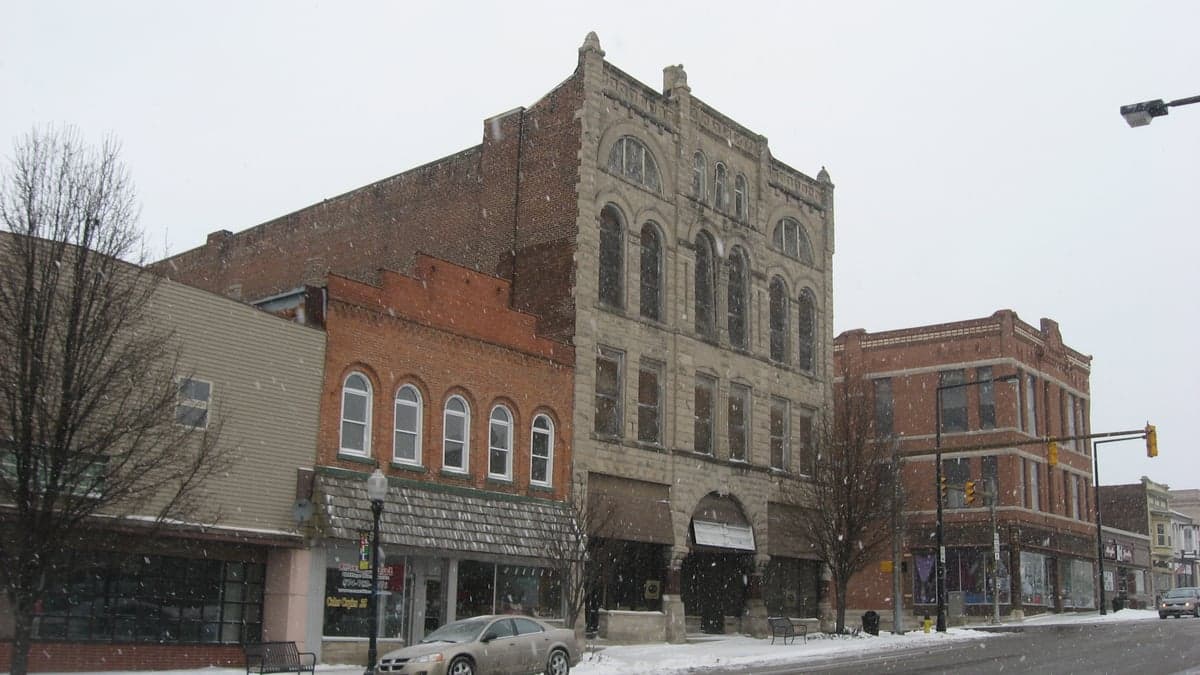
Photo: Wikipedia
Demographics of Logansport, IN
Affluence Level in Logansport, IN
A below-average socioeconomic profile. Incomes, home values, and educational attainment trail the U.S., with higher poverty and unemployment.
People of Logansport, IN
The people of Logansport, Indiana, today form a compact, working-class community of 17,766 residents, distinguished by a notably high foreign-born share of 10.9% — more than double the national average. The city is 61.2% White and 31.6% Hispanic, with small Black (1.9%) and East/Southeast Asian (1.0%) populations, and a college attainment rate of just 12.6%. This demographic profile reflects a city that has transformed from a predominantly White, native-born industrial hub into a Midwestern manufacturing town with a substantial and growing Hispanic community, concentrated in specific older neighborhoods near the Wabash and Eel rivers.
How the city was settled and grew
Logansport was founded in 1828 on the site of a former Miami and Potawatomi village, named after Captain John Logan, a War of 1812 officer. Its early growth was driven by its strategic location at the confluence of the Wabash and Eel rivers, which made it a natural transportation and milling center. The completion of the Wabash and Erie Canal in the 1840s and the arrival of railroads in the 1850s turned the town into a regional manufacturing and shipping hub. The original White settlers were largely of English, German, and Irish stock, with German immigrants forming a particularly strong community in the East End neighborhood, where they built churches, breweries, and social halls. The Irish settled heavily in the West End, near the riverfront and the railroad yards, where they found work as laborers and canal diggers. By the early 20th century, Logansport had become a classic Midwestern factory town, with industries like the Logansport Machine Company and the R. J. Reynolds Tobacco Company drawing a steady stream of domestic migrants from rural Indiana and the Ohio River valley. These workers filled the modest frame houses of South Side neighborhoods, which remain predominantly White and older in character today.
Modern era (post-1965)
The 1965 Hart-Cellar Act opened the door to new immigration, but Logansport's modern demographic shift began in earnest in the 1980s and 1990s, driven by labor demand in meatpacking and food processing. The North Side neighborhood, anchored by the large Tyson Foods plant (formerly IBP), became the primary landing zone for Mexican and Central American immigrants who arrived to fill shift work. Today, the North Side is the city's most Hispanic-concentrated area, with bodegas, Spanish-language churches, and multi-generational households. A smaller but notable wave of East/Southeast Asian immigrants — primarily Vietnamese and Filipino — settled in the East End near the hospital and industrial parks, though their numbers remain modest at 1.0% of the population. The White population, which was over 90% as recently as 1990, has declined both through out-migration to suburban Cass County and through natural decrease, as younger White families have left for larger cities or more affordable rural areas. The Black population has remained very small (1.9%), concentrated in a few blocks near the Downtown core, reflecting the city's limited history of African American in-migration compared to larger Indiana cities like Gary or Indianapolis. The Indian subcontinent population is effectively zero, distinguishing Logansport from many other Midwestern towns with growing South Asian communities.
The future
Logansport's population is becoming more Hispanic and more foreign-born, while the White share continues to shrink. The Hispanic population, already 31.6%, is projected to approach 40% within a decade, driven by both continued immigration and higher birth rates. This growth is dispersing beyond the North Side into the East End and South Side, where older White homeowners are aging out and selling to younger Hispanic families. The foreign-born share (10.9%) is among the highest in north-central Indiana, and the city's low housing costs — median home values around $80,000 — continue to attract immigrant families seeking entry-level homeownership. The college attainment rate (12.6%) remains very low, reflecting the city's reliance on manufacturing and processing jobs that do not require a degree. Over the next 10–20 years, Logansport is likely to become a majority-minority city, with a cultural identity that blends its historic Midwestern small-town character with a growing Latino influence visible in restaurants, festivals, and bilingual signage. The city's future depends on whether it can retain younger families and attract new employers to replace the declining manufacturing base.
For someone moving in now, Logansport offers a low-cost, family-oriented environment with a distinct working-class identity and a rapidly diversifying population. The city is becoming more Hispanic and more immigrant-driven, while the White population ages and shrinks. New residents should expect a community where the North Side feels like a different world from the older White neighborhoods of the South Side, and where the local economy is tied closely to the fortunes of a few large employers. It is a place in demographic transition, not yet fully defined by its new majority.

* Values derived from national, state, county, city and local statistics and may differ in a specific area. Last updated: 2026-11-28T12:44:01.000Z
Narrative content on this page is AI-generated and may contain mistakes. Verify any details that matter before acting on them.
ReloMaps may earn a commission from affiliate links at no extra cost to you.

