Photo: Wikipedia
Demographics of Locust Grove, GA
Affluence Level in Locust Grove, GA
A middle-class area roughly in line with national averages across income, home values, education, and employment.
People of Locust Grove, GA
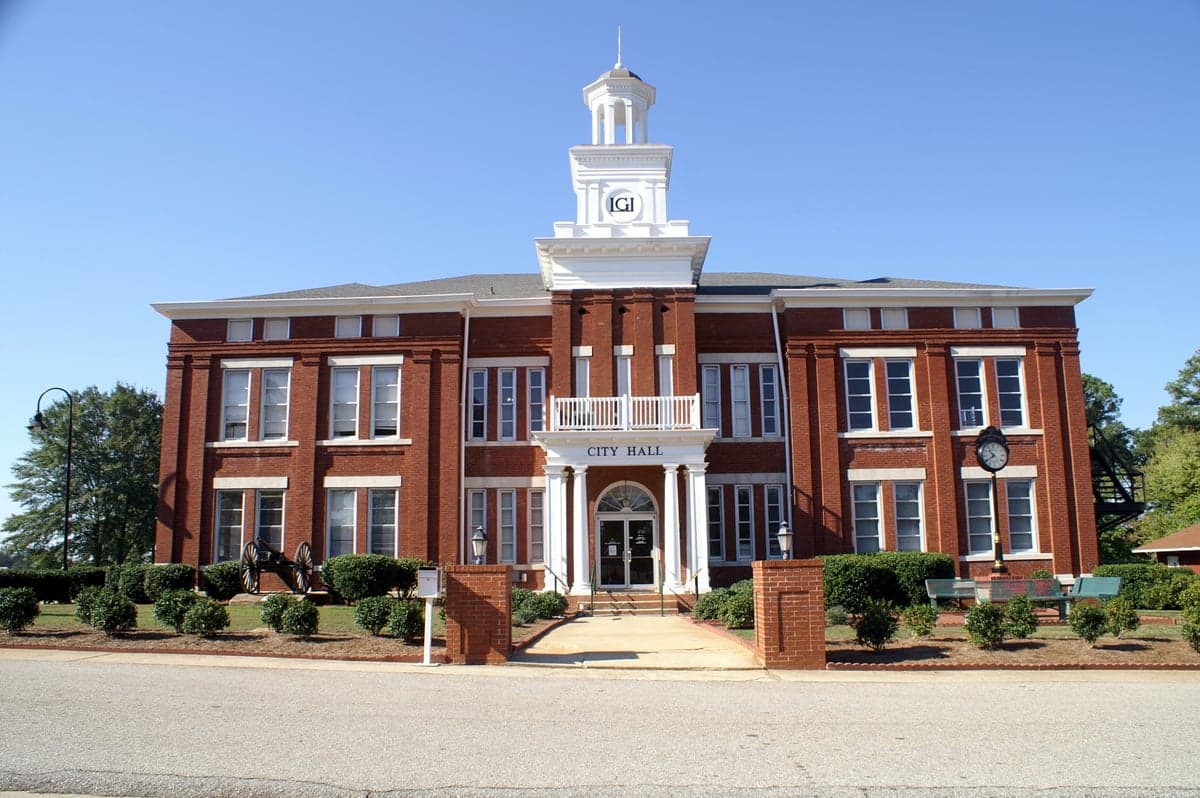
The people of Locust Grove, Georgia today form a predominantly Black and White community of nearly 10,000 residents, marked by a striking demographic shift over the past two decades. With a population that is 46.7% Black, 39.3% White, and 10.3% Hispanic, the city has become a majority-minority suburb with a distinctly family-oriented, conservative-leaning character. Despite its rapid growth, Locust Grove retains a small-town feel, anchored by its historic downtown and newer master-planned subdivisions that attract both first-time homebuyers and retirees seeking affordable housing within commuting distance of Atlanta.
How the city was settled and grew
Locust Grove was founded in the 1820s as a railroad stop along the Macon and Western Railroad, drawing its earliest settlers from the Piedmont region of Georgia and the Carolinas. These were primarily yeoman farmers of English and Scots-Irish descent who established small cotton plantations and subsistence farms. The original settlement clustered around what is now the Downtown Locust Grove Historic District, where the train depot and a handful of stores served as the commercial heart. By the late 19th century, a small but significant Black population had formed, many of whom were formerly enslaved people who stayed in the area as sharecroppers and tenant farmers. They settled in the Old Locust Grove area, along what is now Hampton Road and Bill Gardner Parkway, where several historic Black churches and cemeteries remain. The city remained a rural crossroads through the mid-20th century, with a population that hovered around 500 residents, almost entirely White and Black, with no significant foreign-born presence.
Modern era (post-1965)
The post-1965 era brought two major waves of change. The first, beginning in the 1970s and accelerating through the 1990s, was the suburbanization of Atlanta's southern exurbs. Interstate 75, completed through Henry County in the 1960s, made Locust Grove a viable commuter town. White families from Clayton County and south Atlanta moved into new subdivisions like Heritage Hills and Lake Dow Estates, drawn by larger lots and lower taxes. The second wave, starting around 2000, was a dramatic influx of Black families—many from the same southern Atlanta suburbs that were rapidly diversifying. They settled in newer developments such as Callaway Creek and Summerfield, which offered affordable new construction homes. This wave transformed the city's racial composition: the Black share of the population rose from roughly 20% in 1990 to 46.7% today, while the White share fell from over 75% to 39.3%. The Hispanic population, now 10.3%, began arriving in the 2000s, primarily working in construction, landscaping, and the logistics centers along I-75. They concentrated in the Fairview area near the Henry County line and in rental communities off Bill Gardner Parkway. The foreign-born share remains exceptionally low at 0.4%, meaning nearly all growth has come from domestic migration, not immigration.
The future
Locust Grove's population is projected to continue growing, driven by the expansion of the Atlanta metro area's southern edge and the development of the Locust Grove Towne Center mixed-use district. The city's demographic trajectory points toward increasing diversity, but primarily through further growth of the Black and Hispanic populations, with the White share likely continuing its gradual decline. The Asian and Indian populations remain negligible (0.2% and 0.5% respectively), and there is no indication of significant growth from these groups in the near term. Newer subdivisions such as Autumn Ridge and Woodland Creek are attracting a mix of Black and White families, while Hispanic households are dispersing across the city rather than clustering in a single enclave. The city's cultural identity is evolving from a historically White rural town to a Black-majority suburb with a growing Hispanic minority, but it remains overwhelmingly native-born and English-speaking. The political character is likely to remain conservative, as Henry County as a whole has shifted rightward in recent elections, and the city's population skews toward married couples with children—a demographic that tends to favor lower taxes and limited government.
For someone moving in now, Locust Grove offers a stable, family-oriented community with affordable housing and a strong sense of local identity, but with limited ethnic diversity beyond its Black-White-Hispanic mix. The city is becoming more diverse in terms of race and income, but remains culturally homogeneous in terms of nativity and language. The next decade will likely see continued growth in the Black and Hispanic populations, with the White share falling below 30% by 2035, while the city's small-town character and conservative values persist.

* Values derived from national, state, county, city and local statistics and may differ in a specific area. Last updated: 2026-08-26T02:26:25.000Z
Narrative content on this page is AI-generated and may contain mistakes. Verify any details that matter before acting on them.
ReloMaps may earn a commission from affiliate links at no extra cost to you.

