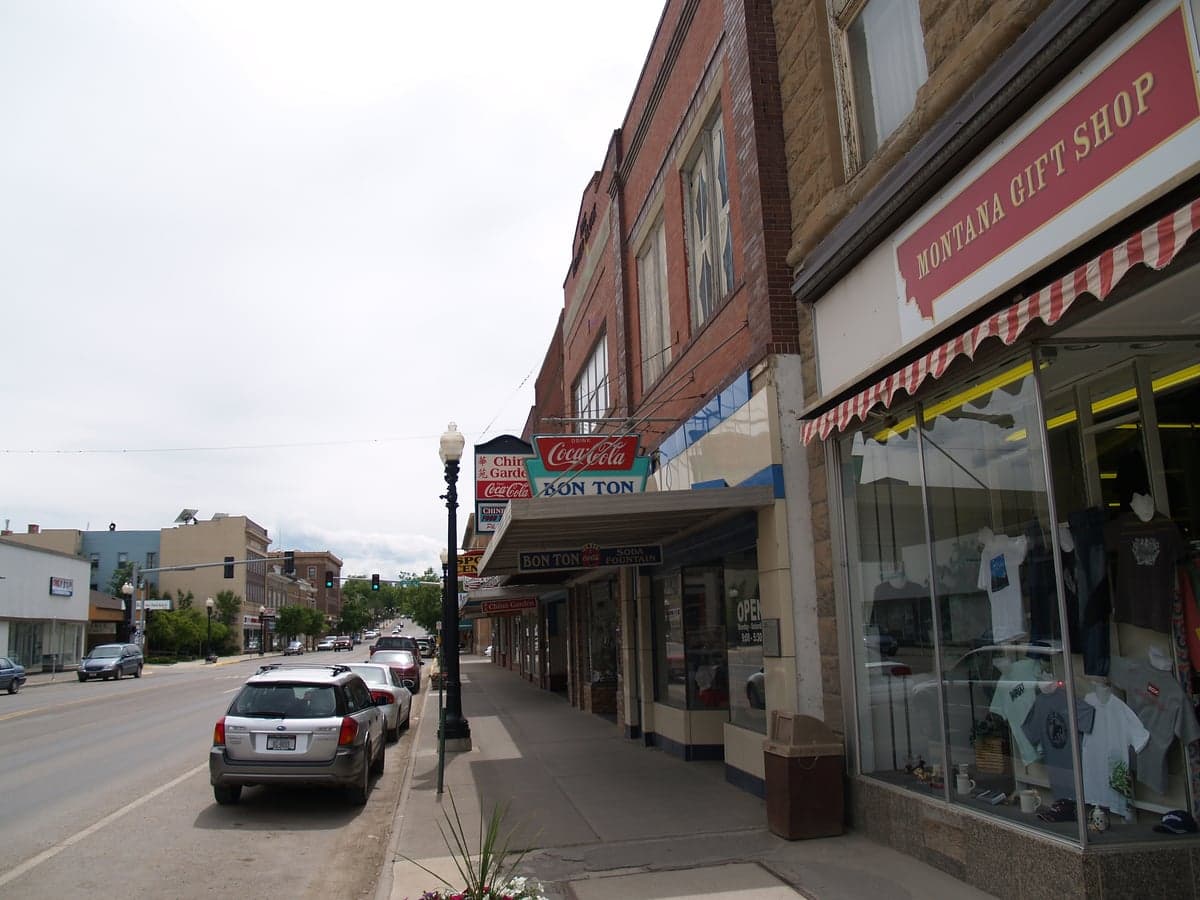
Photo: Wikipedia
Personal Sovereignty in Lewistown, MT
Viable for self-reliance. Generally workable, though some barriers may limit total independence.
What does Personal Sovereignty tell us?
Personal Sovereignty measures your capacity for self-reliance and independence with minimal government friction. Higher scores mean fewer barriers between you and the way you want to live... but it assumes you have the space you need and good neighbors.
What does this tell us?
Personal Sovereignty measures your capacity for self-reliance and independence with minimal government friction. Higher scores mean fewer barriers between you and the way you want to live... but it assumes you have the space you need and good neighbors.
State Policy
Energy independence: Net exporter (120% of energy produced in-state)
Personal Liberty
Homesteading

Personal Liberty Analysis
Lewistown, Montana offers one of the strongest environments for personal sovereignty in the lower 48, a fact that resonates deeply with those who view government overreach as the primary threat to liberty. Nestled in the geographic center of the state, this community of roughly 6,000 operates with a distinct frontier ethos—people here expect to be left alone to live their lives, raise their families, and prepare for whatever comes. The combination of Montana's constitutional protections, a local culture that values self-reliance, and the sheer distance from federal power centers creates a buffer against the creeping authoritarianism many see accelerating nationwide. For the strategic relocator—whether a single survivalist or a parent seeking to insulate their children from institutional indoctrination—Lewistown represents a rare pocket where personal autonomy isn't just tolerated but assumed.
Tax burden and regulatory posture: how Montana compares to high-control states
Montana's tax structure is a major draw for those fleeing states where government takes an ever-larger share of income and property. The state has no sales tax, which means every dollar earned stays in your pocket at the point of purchase—a significant advantage for preppers stockpiling supplies, ammunition, or equipment. Income tax is a flat 5.9% as of 2026, with no progressive brackets that penalize success. Property taxes in Fergus County, where Lewistown sits, average around 0.7% of assessed value, well below the national average and a fraction of what you'd pay in states like Illinois, New York, or California. More important than the raw numbers is the regulatory philosophy: Montana has no state-level gun registration, no red flag law, and no universal background check requirement for private sales. Business licensing is minimal, and zoning in unincorporated areas around Lewistown is virtually nonexistent. For someone who views every new regulation as a thumb on the scale of personal freedom, this is the opposite of the administrative state that chokes life out of high-tax jurisdictions. The state's constitutional provision—Article II, Section 3—explicitly guarantees the "right to pursue life's basic necessities, including the right to acquire, possess, and protect property," language that courts have interpreted broadly in favor of individual liberty.
Self-defense and gun law specifics: what the Second Amendment means here
Montana is a constitutional carry state, meaning no permit is required to carry a concealed firearm for anyone legally allowed to possess one. Lewistown's local sheriff's office is known for being pro-Second Amendment to the point of actively resisting any federal overreach—a stance that matters when considering how quickly a national crisis could trigger federal confiscation attempts. The state passed a Second Amendment Preservation Act in 2021 that prohibits state and local law enforcement from enforcing any federal gun laws deemed infringing on the right to keep and bear arms, including potential future bans on standard-capacity magazines or certain firearm types. Stand-your-ground laws are in full effect: there is no duty to retreat before using deadly force if you are lawfully present and reasonably believe force is necessary to prevent death or great bodily harm. Castle doctrine protections extend to your vehicle and place of business, not just your home. For the prepper mindset, this legal framework means you can train, carry, and store firearms without worrying about arbitrary storage laws or "safe storage" mandates that effectively disarm you in a home-defense scenario. The local gun culture is practical and non-judgmental—you'll see everything from hunting rifles to AR-platform builds at the local range, and nobody asks why you own what you own.
Self-reliance and homesteading viability: lot sizes, zoning, and off-grid feasibility
Lewistown's surrounding area offers some of the most accessible homesteading and off-grid opportunities in the Mountain West. Fergus County has minimal county-level zoning, and what exists is primarily focused on agricultural land use rather than dictating what you can build or how you can live. Outside city limits, you can purchase raw land in 5-to-40-acre parcels for $1,500 to $3,000 per acre—prices that haven't yet been inflated by the influx seen in Bozeman or Missoula. There are no county building codes in unincorporated areas, meaning you can construct a cabin, earthship, or shipping-container home without permit fees or inspections, as long as you meet basic septic and well requirements. Off-grid living is entirely legal: solar panels, wind turbines, rainwater catchment, and composting toilets are common. The local power cooperative, Central Montana Electric, will even net-meter your solar production without the bureaucratic hurdles seen in coastal states. Water rights are the primary legal consideration—Montana follows prior appropriation doctrine, so you'll need to secure a well permit and understand that surface water access is not guaranteed. But for someone willing to drill a well (typically $15,000–$25,000 for a domestic system), you can achieve genuine independence from municipal utilities. The growing season is short—about 100 days—but cold-hardy crops and greenhouse techniques make year-round food production possible. Lewistown's elevation (3,963 feet) and dry climate mean less mold and pest pressure than wetter regions, a practical advantage for long-term food storage.
Personal liberties: parental rights, medical autonomy, speech, and property protections
Montana has become a battleground for parental rights, and Lewistown's community leans heavily toward the view that parents—not the state—are the primary authority over children's education, healthcare, and upbringing. The state has no mask mandates, no vaccine mandates for school attendance, and no laws that allow minors to consent to gender-transition procedures without parental knowledge. Homeschooling is deregulated: you simply file a notification with the county superintendent, and there are no curriculum requirements, standardized testing mandates, or home visits. The local school district, Lewistown Public Schools, has resisted the ideological curricula that have driven parents out of districts in more progressive states. Medical autonomy is protected by Montana's constitutional right to privacy, which courts have interpreted to include the right to refuse any medical treatment—including vaccines—without penalty. During the COVID era, this meant Lewistown businesses and government entities largely did not enforce vaccine passports or mask mandates, respecting individual choice. Property rights are robust: Montana has no statewide rent control, no inclusionary zoning requirements, and no laws that restrict what you can do on your own land beyond basic health and safety. The Montana Environmental Policy Act (MEPA) has been reformed in recent years to prevent its use as a weapon by activists to block private development. Free speech is protected by the state constitution's explicit guarantee that "no law shall be passed impairing the freedom of speech," and local culture reinforces this—you can express unpopular opinions without fear of social or professional retaliation, a stark contrast to the cancel-culture dynamics in urban centers.
In the broader landscape of American sovereignty, Lewistown ranks among the top small towns for those who prioritize personal autonomy over the security of a nanny state. Compared to the Pacific Northwest, where red flag laws and magazine bans are the norm, or the Northeast, where property taxes can exceed 2% and homeschooling is heavily regulated, central Montana offers a genuine alternative. The trade-offs are real: harsh winters, limited healthcare access (the nearest Level 1 trauma center is in Great Falls, 110 miles away), and a thin social safety net. But for the strategic relocator who views those trade-offs as acceptable costs for freedom from government intrusion, Lewistown delivers what few places still can—the ability to live by your own rules, defend yourself without asking permission, and raise your children without the state looking over your shoulder. It's not a utopia, but in a country where personal sovereignty is increasingly under assault, it's a stronghold worth serious consideration.

* Values derived from national, state, county, city and local statistics and may differ in a specific area. Last updated: 2026-10-10T16:28:00.000Z
Narrative content on this page is AI-generated and may contain mistakes. Verify any details that matter before acting on them.
ReloMaps may earn a commission from affiliate links at no extra cost to you.

