Photo: Wikipedia
Demographics of Lebanon, TN
Affluence Level in Lebanon, TN
A middle-class area roughly in line with national averages across income, home values, education, and employment.
People of Lebanon, TN
The people of Lebanon, Tennessee today number 41,951, forming a community that is predominantly white (72.6%) with significant Black (10.8%) and Hispanic (8.9%) populations, and a notably low foreign-born share of 4.1%. The city’s character is shaped by its dual identity as a historic county seat with deep Southern roots and a fast-growing exurb of Nashville, attracting families and individuals seeking lower costs and a slower pace while remaining within commuting distance of a major metro. Distinctive markers include a strong sense of local tradition, a growing but still modest college-educated cohort at 30.0%, and a population that is less diverse than the national average but more diverse than much of rural Middle Tennessee.
How the city was settled and grew
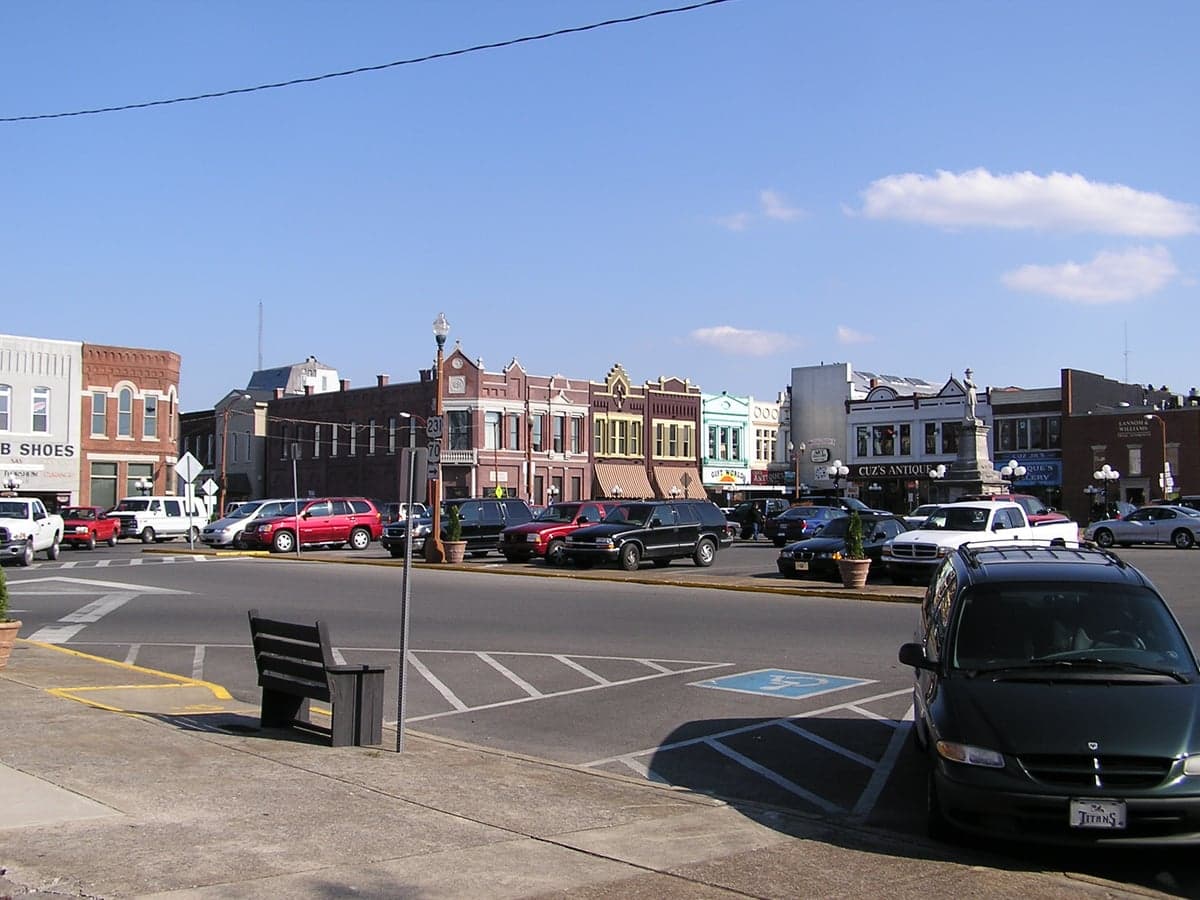
Lebanon was founded in 1801 as the seat of newly formed Wilson County, with the original population drawn by land grants offered to veterans of the American Revolution and the War of 1812. These early settlers were overwhelmingly of English, Scots-Irish, and German descent, establishing a rural agricultural economy centered on tobacco, corn, and livestock. The arrival of the railroad in the 1850s spurred a second wave, bringing merchants, craftsmen, and a small number of German and Irish immigrants who settled in the Historic Square district and along the rail corridor now known as West Main Street. After the Civil War, freedmen established a robust Black community concentrated in the Southside neighborhood, near the intersection of today’s South Maple Street and Baird Avenue, building churches, schools, and businesses that anchored the area for generations. The early 20th century saw modest industrial growth with the founding of the Lebanon Woolen Mills and a shirt factory, drawing rural white and Black workers into the Northside and Eastside neighborhoods, though the city remained a small town of under 5,000 residents until the post-World War II era.
Modern era (post-1965)
The 1965 Hart-Cellar Act had a minimal immediate effect on Lebanon, as the city’s foreign-born population remains low at 4.1% today. Instead, the major demographic shift after 1965 was domestic: the construction of Interstate 40 in the 1970s transformed Lebanon from an isolated county seat into a viable bedroom community for Nashville, 30 miles west. This triggered a wave of white middle-class out-migration from Davidson County, who settled in new subdivisions like Beckwith Place and Hunter’s Point on the city’s western and southern edges. The Black population share, which had been roughly 25% in 1970, declined to 10.8% by 2024 as many long-time Black families left for other parts of Wilson County or the broader Nashville region, while the historic Southside neighborhood saw disinvestment and population loss. The Hispanic population grew from near zero to 8.9% over the past three decades, driven by construction, landscaping, and service-sector jobs; these families concentrated in the West End area near the Walmart corridor and in mobile home parks along Highway 70. East and Southeast Asian communities (1.2%) and Indian-subcontinent residents (0.6%) are small but present, with families typically settling in newer subdivisions near the South Hartmann Drive area, drawn by professional jobs at the nearby Wilson County Medical Center and the Cracker Barrel headquarters.
The future
The population is heading toward continued growth and modest diversification, but not toward rapid ethnic transformation. Lebanon’s foreign-born share is likely to rise slowly from 4.1% as Hispanic families already in the area have children and as a trickle of Asian and Indian professionals arrive for healthcare and manufacturing jobs. The white share (72.6%) will probably decline gradually as the Hispanic and Black shares inch up, but the city is not on track to become a majority-minority community within the next 20 years. The most significant trend is economic sorting: newer subdivisions like Baird Farms and Colonial Hills are attracting affluent white and Asian families, while the historic Southside and West End remain more working-class and diverse. The city is not tribalizing into hostile enclaves, but distinct income and ethnic corridors are solidifying. For a conservative-leaning individual or family moving in now, Lebanon offers a population that is politically and culturally traditional, with a growing but still manageable diversity that is unlikely to disrupt the city’s fundamental character.
Lebanon is becoming a more economically stratified exurb where the historic Southern white and Black populations are being joined by a small but steady Hispanic and Asian presence, all while the city’s identity as a family-oriented, cost-conscious alternative to Nashville remains intact. For a new resident, this means a community that is changing slowly enough to preserve its traditions but diversifying enough to offer a broader range of neighbors and experiences than a generation ago.

* Values derived from national, state, county, city and local statistics and may differ in a specific area. Last updated: 2026-05-01T17:04:23.000Z
Narrative content on this page is AI-generated and may contain mistakes. Verify any details that matter before acting on them.
ReloMaps may earn a commission from affiliate links at no extra cost to you.

