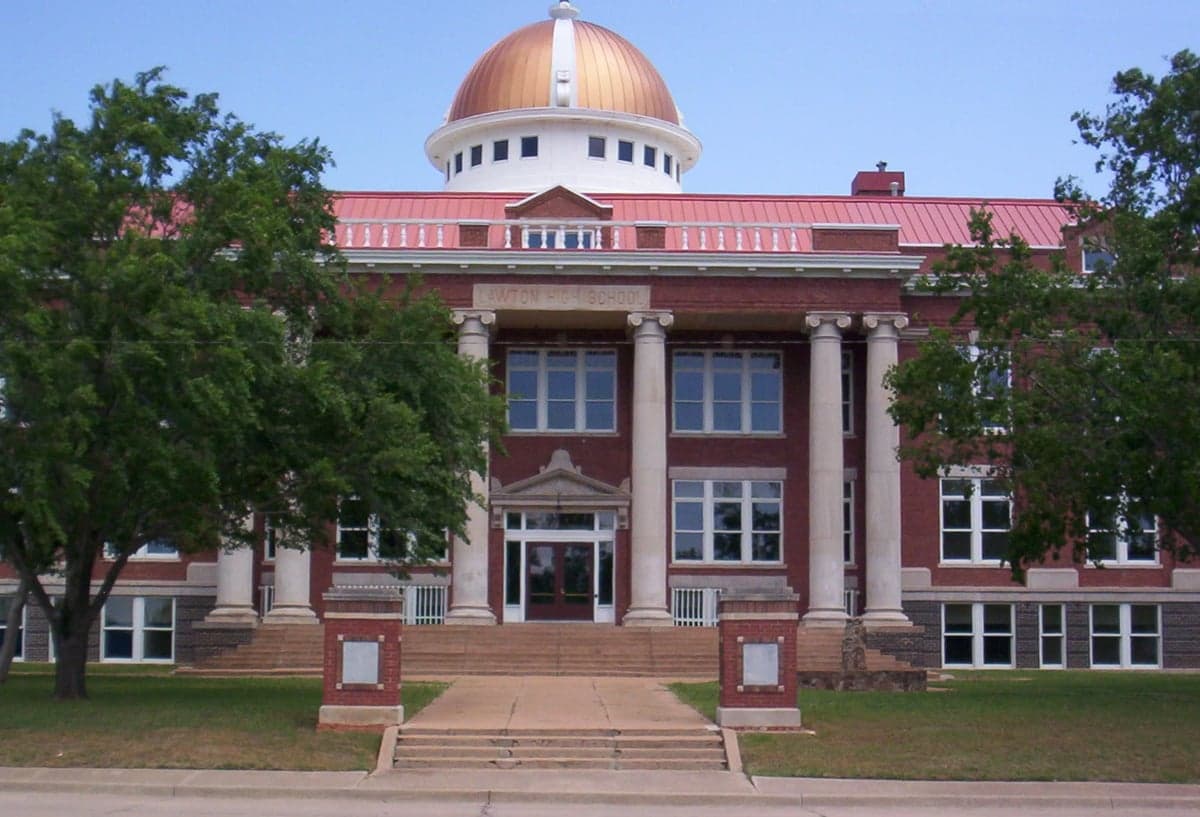
Photo: Wikipedia
Strategic Assessment of Lawton, OK
Workable tactical position. Some exposure to population density or targets, but generally defensible in a crisis.
What does the Strategic Assessment tell us?
Our Strategic Assessment grades tactical survivability of an area. Major population centers, military targets, fallout zones, natural disasters, and border exposure all drive risk — lower exposure means a more defensible position in a crisis.
This is heavily inspired by Joel Skousen's Strategic Relocation book. Highly recommended you checkout the book ($)What does this tell us?
Our Strategic Assessment grades tactical survivability of an area. Major population centers, military targets, fallout zones, natural disasters, and border exposure all drive risk — lower exposure means a more defensible position in a crisis.
This is heavily inspired by Joel Skousen's Strategic Relocation book. Highly recommended you checkout the book ($)Strategic Pillars

Key Distances
Regional Safe Places
Below is our recommended "safe zones" in Oklahoma and the surrounding area based on our strategic heuristics. For most people, it's unrealistic to live in a “safe zone” full-time due to work, family or other personal reasons. They tend to be more rural. However, many of these areas are perfect for second homes and retreat properties that double as a vacation home or even a short-term rental.
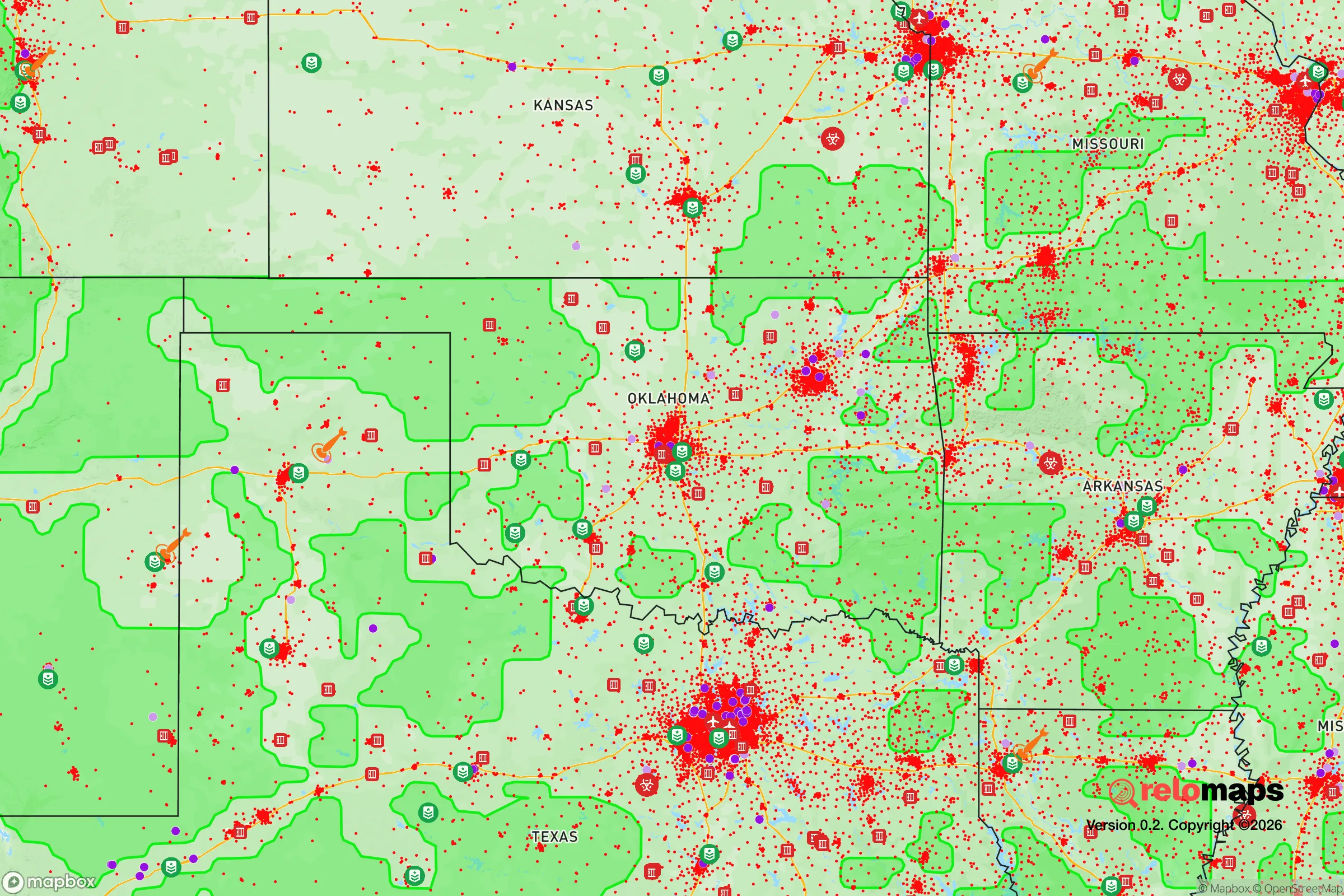
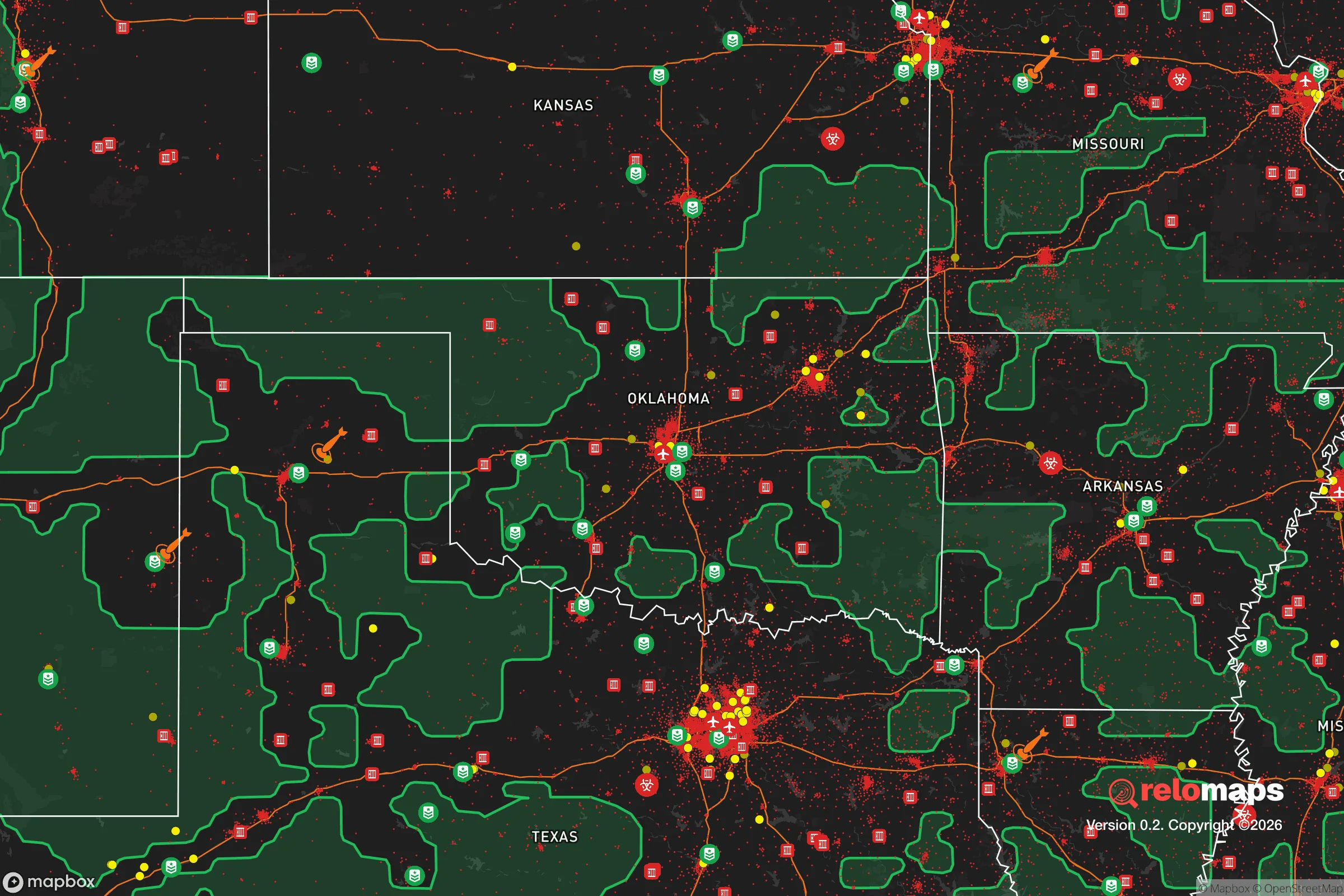


Important Note: For informational purposes only. This does not mean nothing bad ever happens in the green zones. Please use common sense. This is based on public data and modeled with AI. We tried to take a conservative approach but mistakes happen. We update this regularly as new information becomes available.
Solar Generator Recommendations
Backup power matters more here than in safer locations. We've picked three solar generators across budgets and capacity tiers — start with the budget unit if you only need a few essentials, or step up if you want to run a fridge and HVAC for days at a time.

Jackery Portable Power Station Explorer 300
Budget OptionPower on the Go: Weighing only 11 lbs, it's convenient to set up and store with book-sized foldable solar panels

BLUETTI Portable Power Station AC180
Designed for both indoor and outdoor scenarios, AC180 is highly capable as it has a robost capacity and continuous output power.

EF ECOFLOW DELTA Pro Ultra Power Station
Upgraded PickEcoFlow DELTA Pro Ultra is a whole-home energy system designed to grow with your family. Integrated with the Smart Home Panel 2, it scales to meet your evolving energy needs — keeping your home powered, intelligent, and secure through every stage of life.
We earn a commission, at no additional cost to you.
Strategic Assessment Analysis
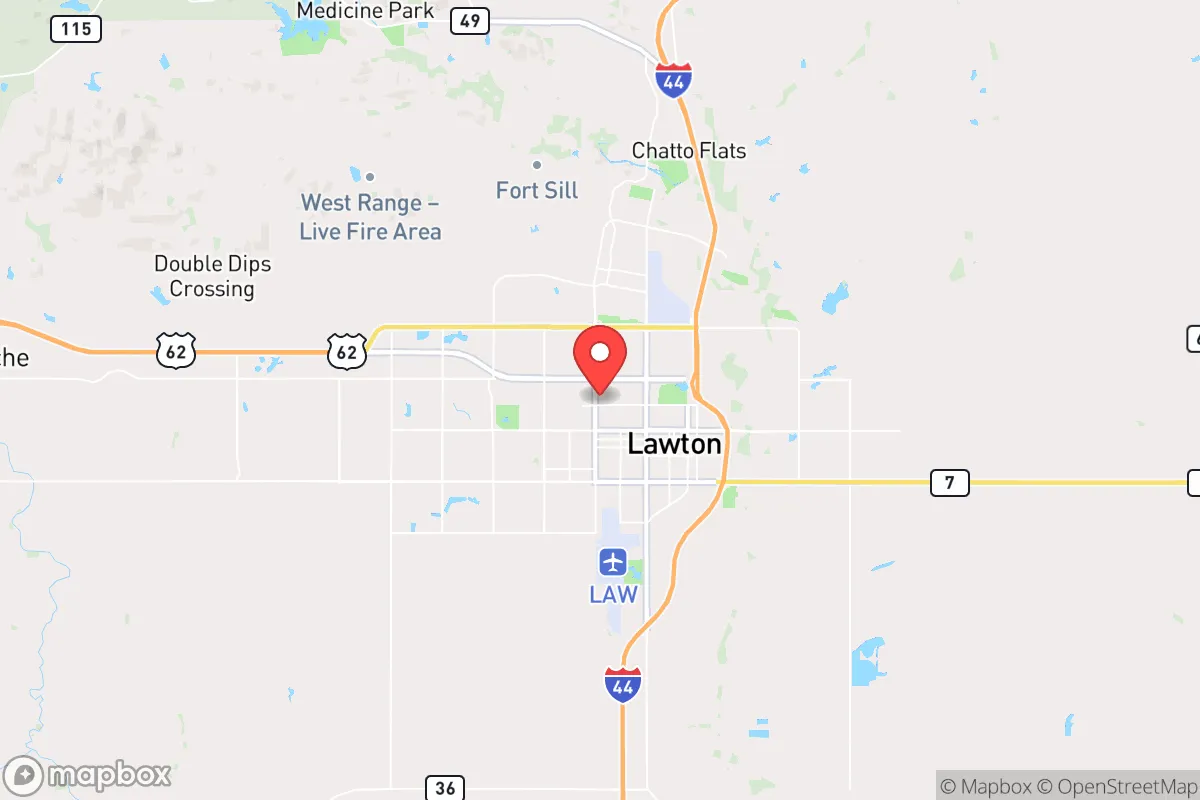
Lawton, Oklahoma, sits in a position that demands a hard look from anyone serious about long-term strategic relocation. It is not a flashy place, and that is precisely its strength. The city anchors the southwestern corner of Oklahoma, roughly 85 miles southwest of Oklahoma City and 150 miles northwest of Dallas-Fort Worth, placing it far enough from major population centers to avoid the immediate fallout of a major urban crisis, yet close enough to access those regions' resources if the situation stabilizes. The area's resilience is rooted in its low population density, its position within the relatively stable Southern Plains, and a local economy that is not entirely dependent on any single industry, with Fort Sill providing a steady, government-backed anchor. For the prepper or survivalist, Lawton offers a rare combination: genuine remoteness from the chaos of the megacity, without being so isolated that resupply or medical evacuation becomes impossible.
Geographic position and natural advantages for long-term security
Lawton's geography is a double-edged sword, but the edge cuts in your favor if you know how to use it. The city lies on the edge of the Wichita Mountains, a low but rugged range that provides natural defensible terrain, water catchment, and a surprising amount of cover. The surrounding landscape is a mix of rolling plains and rocky hills, offering multiple escape routes and observation points. The area is not prone to the catastrophic natural disasters that plague other regions—no hurricanes, no major earthquake faults, no wildfire corridors that threaten entire towns. Tornadoes are a real threat, but they are predictable in season and survivable with a proper storm shelter, which is standard in most homes. The climate is semi-arid, meaning you are not fighting constant humidity or flooding, and the growing season is long enough for a serious garden. The Wichita Mountains Wildlife Refuge, just north of town, is a massive, protected area that could serve as a fallback zone, with its own water sources and game populations. For a relocator, the key advantage is that you are not boxed in—you have room to maneuver, to cache supplies, and to establish a perimeter that a suburbanite in Dallas or Oklahoma City simply does not have.
Risks, exposures, and proximity to fallout-relevant landmarks
No strategic assessment is honest without naming the threats. Lawton's primary risk is its proximity to Fort Sill, a major U.S. Army base that trains artillery and missile crews. In a full-scale conflict or a major terrorist event, Fort Sill is a high-value target. The base is a legitimate military asset, and any adversary with a long-range missile or a drone would have it on their list. That said, the base is not a nuclear reactor or a chemical plant—it is a training facility, not a weapons storage depot. The real danger is not a direct strike on Lawton itself, but the secondary effects: a base lockdown, a massive influx of military personnel and their families fleeing the base, or a disruption of the local economy if the base is temporarily evacuated. The other risk is the proximity to the Interstate 44 corridor, which connects Lawton to Oklahoma City and Wichita Falls. In a mass evacuation scenario, that highway becomes a chokepoint and a target for looters or hostile groups. The city's water supply comes from Lake Lawtonka and the nearby reservoirs, which are vulnerable to contamination or sabotage, though the watershed is relatively small and manageable. The biggest exposure is the lack of a major medical trauma center—the nearest Level 1 trauma center is in Oklahoma City, a 90-minute drive under normal conditions. In a mass casualty event, that distance becomes a death sentence for anyone with serious injuries.
Practical resilience for a relocator: food, water, energy, and defensibility
For someone looking to live off the grid or at least significantly reduce their dependence on fragile supply chains, Lawton has real advantages. The water situation is solid: the city's municipal supply is reliable, but the real prize is the abundance of groundwater in the surrounding area. The Arbuckle-Simpson aquifer runs beneath much of southern Oklahoma, and private wells are common and affordable. Rainwater catchment is also viable, given the region's average 30 inches of annual rainfall. Food production is straightforward—the growing season runs from April to October, and the soil, while rocky in places, is workable with raised beds or contour farming. Local farmers' markets and co-ops exist, but the serious prepper will want to establish their own garden and possibly a small livestock operation; chickens and goats are common in the rural areas outside city limits. Energy independence is achievable: solar irradiance in southwestern Oklahoma is among the best in the Plains, and wind is consistent enough for small-scale turbines. The local power grid is not particularly robust—outages during ice storms or summer heat waves are common—but that only reinforces the need for a backup system. Defensibility is where Lawton shines for the prepared individual. The terrain around the Wichita Mountains offers natural chokepoints, high ground, and cover. A well-chosen property on the outskirts, with a clear line of sight to approach roads and a water source on-site, is as close to a fortress as you can get without building walls. The local gun culture is strong, and the county sheriff's office is generally supportive of Second Amendment rights. In a collapse scenario, you are not fighting for space with millions of people; you are dealing with a population of roughly 90,000, most of whom are not preppers.
The overall strategic picture for Lawton is one of calculated risk. It is not a perfect sanctuary—no place is. The proximity to Fort Sill is a genuine liability in a war scenario, and the lack of a major hospital is a weakness that cannot be fully mitigated. But for the relocator who is serious about being prepared for civic unrest, economic collapse, or a major disaster, Lawton offers a combination of factors that are hard to find elsewhere: low population density, defensible terrain, reliable water, a long growing season, and a culture that does not look sideways at someone with a rifle and a stockpile of canned goods. The city itself is not a prepper paradise—it has crime, poverty, and the usual problems of a small American city—but the surrounding region is a blank canvas for someone willing to put in the work. If you are looking to get out of the blast radius of a major city, establish a sustainable homestead, and have a reasonable chance of riding out the storm, Lawton deserves a serious look. It is not the end of the world, but you can see it from there—and that is exactly the point.

* Values derived from national, state, county, city and local statistics and may differ in a specific area. Last updated: 2026-10-10T16:27:58.000Z
Narrative content on this page is AI-generated and may contain mistakes. Verify any details that matter before acting on them.
ReloMaps may earn a commission from affiliate links at no extra cost to you.

