 Popular
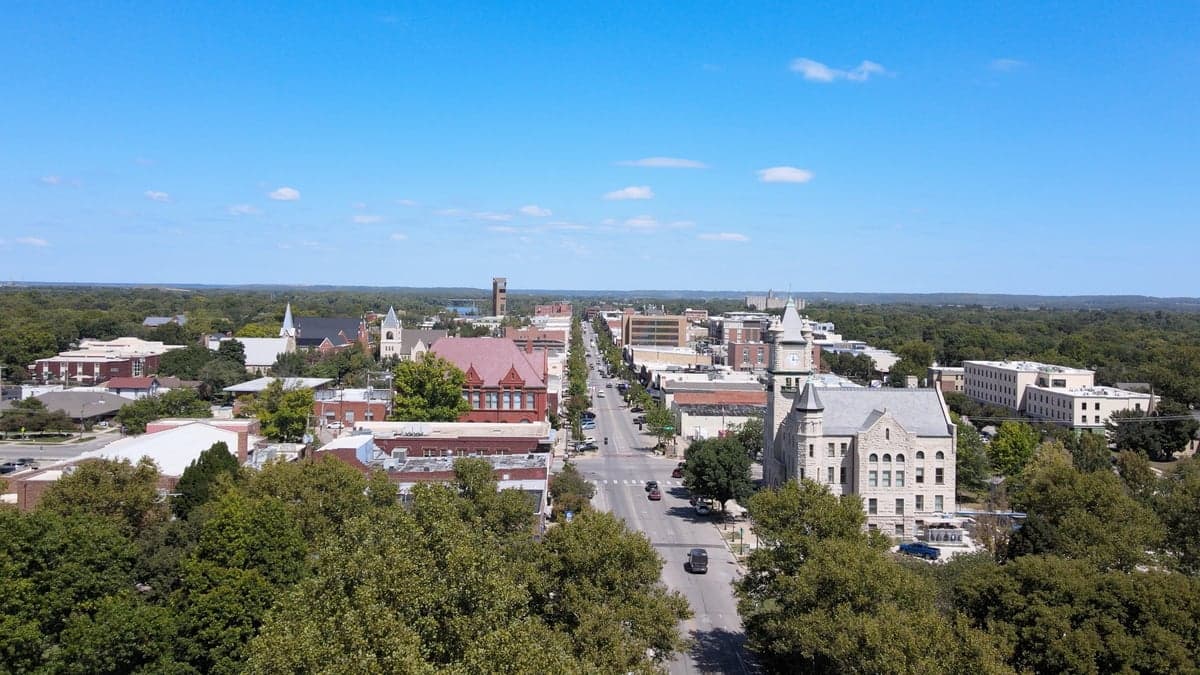
Photo: Wikipedia
Demographics of Lawrence, KS
Affluence Level in Lawrence, KS
A middle-class area roughly in line with national averages across income, home values, education, and employment.
People of Lawrence, KS
The people of Lawrence, Kansas, today number roughly 95,500, forming a distinctly college-educated and politically liberal enclave within a conservative state. With 55.1% of adults holding a bachelor’s degree or higher, the city’s identity is overwhelmingly shaped by the University of Kansas, which anchors a population that is 73.7% white, 7.8% Hispanic, 4.5% Black, 4.2% East/Southeast Asian, and 1.2% Indian (subcontinent). Only 4.9% of residents are foreign-born, giving Lawrence a native-born, Midwestern character that is simultaneously progressive, youthful, and increasingly diverse by neighborhood.
How the city was settled and grew
Lawrence was founded in 1854 by anti-slavery settlers from New England, organized by the New England Emigrant Aid Company, who sought to make Kansas a free state. These abolitionist pioneers—largely white, educated, and Protestant—established the city as a political and military flashpoint during “Bleeding Kansas,” with the sacking of Lawrence by pro-slavery forces in 1856 and Quantrill’s Raid in 1863 cementing its identity as a free-state stronghold. The original settlement clustered around what is now Old West Lawrence, a historic district of Victorian homes built by the city’s early merchant and professional class. After the Civil War, the railroad arrived, and Lawrence grew as a regional trading center and the home of the University of Kansas (chartered 1864). The university drew faculty and students from across the Midwest, while German and Irish immigrants settled in working-class areas like East Lawrence, where modest cottages and a grid of small lots housed railroad workers and tradesmen. By 1900, the city’s population was nearly entirely white and native-born, with a small Black community concentrated around Pinckney (now part of central Lawrence), a historically African American neighborhood that emerged from the post-Reconstruction Great Migration.
Modern era (post-1965)
The 1965 Hart-Cellar Act had a modest effect on Lawrence compared to coastal cities, but it did open the door for a small but steady stream of international students and faculty at KU. The most visible post-1965 shift has been the growth of the Hispanic population, which rose from under 2% in 1980 to 7.8% today, driven by Mexican and Central American immigrants working in construction, food service, and agriculture. These families have concentrated in North Lawrence, a working-class area across the Kansas River, and in parts of East Lawrence, where older housing stock and lower rents attract new arrivals. The East/Southeast Asian population (4.2%) is largely composed of Chinese, Korean, and Vietnamese students and professionals tied to KU’s engineering and science programs, living near campus in the Oread neighborhood and in newer apartment complexes along 23rd Street. The Indian subcontinent population (1.2%) is similarly university-linked, with many families settling in the West Hills area near the KU West Campus. The Black population, at 4.5%, has remained stable since the 1970s, with a historic concentration in Pinckney and newer subdivisions in southern Lawrence. Suburbanization after 1990 pushed white, middle-class families into southwest Lawrence (around Clinton Parkway and Wakarusa Drive), creating a socio-economic divide: the university-adjacent core remains young and transient, while the southwest is more family-oriented and owner-occupied.
The future
Lawrence’s population is projected to grow slowly, reaching roughly 105,000 by 2040, driven by university enrollment and spillover from the Kansas City metro area, 40 miles east. The city is not homogenizing; instead, it is tribalizing into distinct enclaves. The Hispanic share is likely to rise to 10-12% as families in North Lawrence and East Lawrence grow and as new immigrants arrive for service-sector jobs. The East/Southeast Asian and Indian populations will probably plateau or grow only modestly, as they remain tied to KU’s graduate programs, which face flat domestic enrollment. The white share will continue to decline gradually, but Lawrence will remain a majority-white, highly educated city. The most significant trend is the deepening divide between the liberal, transient student-and-faculty core (Old West Lawrence, Oread, downtown) and the more conservative, family-oriented periphery (southwest Lawrence, rural Douglas County). For a conservative-leaning newcomer, this means the city’s political and cultural center of gravity will remain firmly progressive, but the outer neighborhoods offer a quieter, more traditional lifestyle with good schools and lower crime rates than the core.
Lawrence is becoming a bifurcated city: a dense, university-driven liberal hub surrounded by a growing suburban ring that is more moderate and family-focused. For someone moving in now, the choice of neighborhood will largely determine daily experience—whether that means walkable, politically active streets in Old West Lawrence or a quieter, car-dependent life in southwest Lawrence with access to the same schools and parks.

* Values derived from national, state, county, city and local statistics and may differ in a specific area. Last updated: 2026-04-30T04:46:20.000Z
Narrative content on this page is AI-generated and may contain mistakes. Verify any details that matter before acting on them.
ReloMaps may earn a commission from affiliate links at no extra cost to you.

