Photo: Wikipedia
Political ClimatePolitical Climate in Kyle, TX
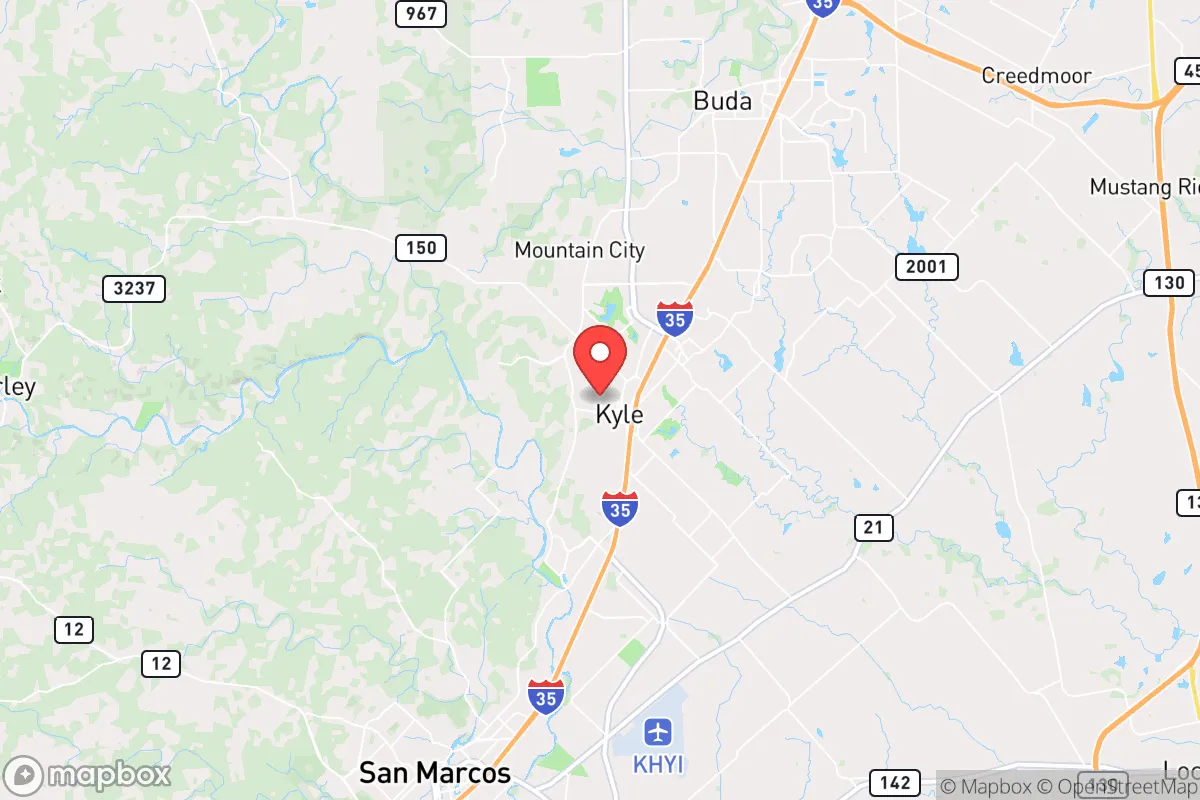
District shown is the primary district for this city’s centroid. Cities may span multiple districts.
Local Political AnalysisPolitical Analysis of Kyle, TX
Kyle's political lean is solidly blue, with a Cook PVI of D+19, which puts it way out of step with the rest of Texas (R+4). I've watched this town shift over the years, and it's getting more progressive by the cycle. What used to be a quiet, conservative-leaning bedroom community is now a fast-growing suburb that's importing Austin's politics along with its commuters. The trajectory is concerning if you value limited government and personal freedoms—each new development seems to bring another layer of city ordinances and progressive priorities.
How it compares
Kyle sits in Hays County, which as a whole leans left thanks to San Marcos and the southern Austin spillover, but the contrast with the rest of Texas is stark. The state's R+4 rating reflects a broad conservative majority that still values individual liberty and local control. Kyle, by contrast, votes like a deep-blue urban enclave. Drive ten miles north to Buda and you'll find a more balanced mix—Buda's city council still has a conservative voice. Head east toward the rural parts of Hays County, or south toward San Antonio's exurbs, and the political landscape flips hard red. Kyle's D+19 rating is more than double the Democratic lean of Travis County's outer suburbs, meaning it's an outlier even by Central Texas standards. The city council and school board races here increasingly reflect that shift, with candidates pushing policies that feel imported from downtown Austin—density mandates, equity initiatives, and stricter land-use rules.
What this means for residents
If you're someone who believes government should stay out of your business, Kyle's trajectory is a red flag. Property taxes have climbed as the city expands its services and takes on more debt for infrastructure projects tied to progressive planning goals. The school district has adopted curriculum changes that prioritize social-emotional learning over core academics, and there's been talk of inclusionary zoning that could dictate what kind of housing you're allowed to build on your own lot. Local elections here have real consequences for your wallet and your rights—a city council that sees itself as a social engineer will happily regulate everything from short-term rentals to the size of your garage. For now, the county sheriff's office and the state legislature still provide a check on the worst overreach, but as Kyle grows, the pressure to align with Austin's regulatory model only intensifies.
Culturally, Kyle is losing its small-town character fast. The old feed store and the family-run diners are being replaced by chain restaurants and apartment complexes with "luxury" in the name. Policy-wise, the city has embraced sustainability resolutions and "complete streets" designs that prioritize bike lanes over parking—fine if you're a planner, frustrating if you just want to get to work without navigating a roundabout. The real distinction is that Kyle's local government is actively trying to reshape how people live, rather than simply letting them live how they choose. If you value personal freedom and low taxes, you'll find more breathing room in the unincorporated parts of Hays County or in towns like Wimberley and Dripping Springs, where conservative common sense still holds sway. Kyle isn't there yet, but the direction is clear—and it's worth watching closely if you're thinking of putting down roots.

State Political ClimatePolitical Climate in Texas
State Political AnalysisPolitical Environment in the State
Texas is a solidly Republican state with a Cook PVI of R+4, meaning it leans about four points more conservative than the national average. The dominant coalition is a mix of rural conservatives, suburban moderates, and a growing number of Hispanic voters who often break for the GOP on economic and social issues. Over the last 10-20 years, Texas has actually trended slightly redder in its rural and exurban areas, even as major metros like Austin and Houston have become more liberal. The result is a state that remains reliably red at the statewide level, but with a widening urban-rural chasm that creates very different political realities depending on where you live.
Urban vs. rural divide
The political map of Texas is stark. The big blue islands are Austin (Travis County), El Paso, and to a lesser extent San Antonio and Houston (Harris County). These cities vote heavily Democratic, with Austin often hitting 70%+ for the Democratic presidential candidate. Meanwhile, the vast rural and exurban areas—places like Lubbock, Midland, Odessa, and the Panhandle—are deep red, often voting 80%+ Republican. The suburbs around Dallas-Fort Worth are a battleground: Collin County and Denton County have shifted left in recent cycles, but still lean Republican overall. The key is that rural Texas has more political weight per square mile because of low population density and state legislative districts that favor non-urban areas. That’s why the state legislature remains firmly in GOP hands even as the big cities grow bluer.
Policy environment
Texas’s policy environment is a dream for conservatives who want limited government. There is no state income tax, though property taxes are high to compensate. The regulatory posture is famously business-friendly: few zoning restrictions, fast permitting, and a right-to-work law that keeps unions weak. On education, the state has been pushing school choice and voucher programs, though rural Republicans have sometimes blocked full-scale adoption. The curriculum battles are real—Texas recently passed laws requiring the display of the Ten Commandments in public schools and banning certain books deemed sexually explicit (HB 900). Healthcare is a mixed bag: no Medicaid expansion, a near-total abortion ban after SB 8 (the heartbeat bill), and limited telehealth options. Election laws tightened with SB 1 in 2021, adding voter ID requirements and restricting mail-in ballots. For a conservative, this is largely a positive environment—low taxes, strong parental rights, and election integrity measures. But the heavy hand of government is still present in areas like property taxes and school curriculum mandates.
Trajectory & freedom
On balance, Texas has become more free in several key areas over the last decade. The biggest win for personal liberty was HB 1927 (permitless carry), which allows law-abiding adults to carry a handgun without a license. That’s a clear expansion of Second Amendment rights. Parental rights also got a boost with laws that let parents challenge school library materials and opt their kids out of certain instruction. Property rights were strengthened with eminent domain reforms. However, there are concerning trends. The state’s aggressive border security operation, Operation Lone Star, has involved deploying National Guard troops and state police in a way that some see as federal overreach by the state itself. The abortion ban (SB 8) and the subsequent trigger law have eliminated nearly all abortion access, which is a freedom issue depending on your perspective. And the recent drag ban (SB 12) and book rating system (HB 900) represent government stepping into cultural matters that many conservatives would rather leave to families and local communities. So the trajectory is mixed: more freedom on guns and school choice, but more government involvement in social issues and border enforcement.
Civil unrest & political movements
Texas has seen its share of political flashpoints. The 2020 Black Lives Matter protests in Austin, Houston, and Dallas were large and sometimes violent, leading to property damage and a lasting sense of insecurity in those downtown areas. Immigration politics are a constant: the state has bused thousands of migrants to New York, Chicago, and other sanctuary cities, and local sheriffs in border counties like El Paso and Val Verde are caught between federal and state directives. The Texas Nationalist Movement, which advocates for secession, has a small but vocal following, though it’s mostly a fringe group. Election integrity remains a hot topic—the 2020 audit in Harris County and ongoing voter fraud investigations keep the issue alive. A new resident would notice the heavy police presence at the border, the political signs in rural areas, and the occasional protest in city centers. The overall vibe is that Texas is a state where political passions run high, but the conservative majority keeps things stable outside the blue cities.
Projection
Over the next 5-10 years, Texas will likely remain Republican at the state level, but the margins will tighten. In-migration from California, New York, and Illinois is bringing more moderate and liberal voters to the suburbs of Dallas, Houston, and Austin. However, many of those newcomers are actually conservatives fleeing blue states, so the net effect isn’t a simple blue shift. The Hispanic population is growing, but Hispanic voters in Texas are not monolithic—many in the Rio Grande Valley and rural areas vote Republican on social issues. The state legislature will probably stay GOP-controlled due to gerrymandering, but the governor’s race could become competitive if a moderate Democrat emerges. Expect more preemption laws from Austin to override liberal city ordinances on things like paid leave, plastic bag bans, and sanctuary policies. For a conservative moving in now, the next decade will feel like a holding action: the state will remain free in most respects, but the cultural and political battles will intensify, especially in the suburbs. If you want the full Texas freedom experience, you’ll want to live in a rural or exurban county, not inside the loop of a blue city.
Bottom line for a new resident: Texas offers low taxes, strong gun rights, and a business-friendly climate that aligns with conservative values. But don’t assume the whole state is the same. If you move to Austin or Houston, you’ll face high property taxes, progressive local government, and the same kind of overreach you might have left behind. Stick to the suburbs or rural areas—places like Lubbock, Midland, or the exurbs of Fort Worth—and you’ll find the Texas that still values personal freedom and limited government. Just keep an eye on the legislature: the same people who gave you permitless carry might also decide what books your kids can read.
* Values derived from national, state, county, city and local statistics and may differ in a specific area. Last updated: 2026-05-14T18:36:39.000Z
Narrative content on this page is AI-generated and may contain mistakes. Verify any details that matter before acting on them.
ReloMaps may earn a commission from affiliate links at no extra cost to you.

