 Popular
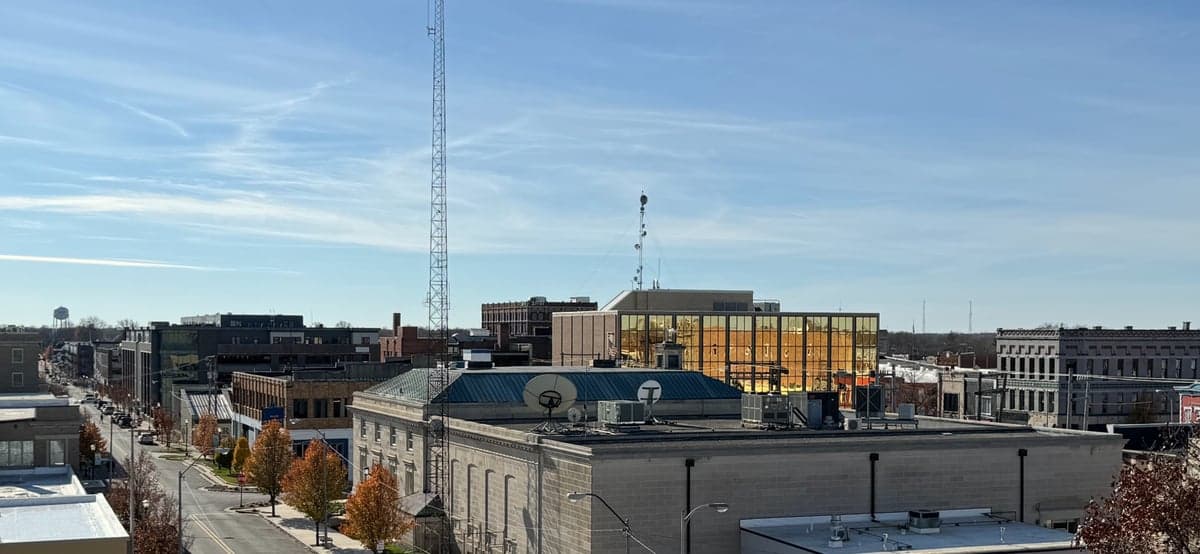
Photo: Wikipedia
Demographics of Kokomo, IN
Affluence Level in Kokomo, IN
A below-average socioeconomic profile. Incomes, home values, and educational attainment trail the U.S., with higher poverty and unemployment.
People of Kokomo, IN
The people of Kokomo, Indiana today number roughly 59,375, forming a predominantly white (79.4%) and working-class city with a notably low foreign-born share of just 0.9%. The city’s identity is rooted in its industrial past—auto manufacturing and metal fabrication—giving it a blue-collar, Midwestern character where family ties run deep and neighborhoods are often defined by which factory employed the previous generation. With only 17.2% of adults holding a college degree, Kokomo remains a place where skilled trades and high school diplomas have historically been the ticket to a stable middle-class life, though that economic model is under pressure.
How the city was settled and grew
Kokomo’s population story begins with the Miami and Potawatomi peoples, who occupied the region before forced removal in the 1830s. The city itself was platted in 1844 on land donated by David Foster, a local merchant, and named after a Miami chief. The first major wave of white settlers were farmers and tradesmen from Ohio, Kentucky, and the Upper South, drawn by cheap land and the promise of the Michigan Road, which passed through the area. The real population boom came after the discovery of natural gas in the 1880s, which sparked an industrial rush. By 1900, Kokomo had become a manufacturing hub, attracting European immigrants—primarily German, Irish, and Polish—who settled in working-class neighborhoods like Apperson Way and East Side, near the Haynes-Apperson auto plant and the Continental Steel mill. These neighborhoods were built around company housing and ethnic churches, creating tight-knit enclaves that persisted for generations. A smaller wave of Italian and Hungarian immigrants arrived in the 1910s and 1920s, clustering in the South Side near the Pittsburgh Plate Glass plant.
Modern era (post-1965)
The post-1965 era brought significant demographic change, though Kokomo’s foreign-born population remained negligible compared to national trends. The most notable shift was the Great Migration of Black Americans from the rural South, who arrived between the 1940s and 1970s seeking industrial jobs at Chrysler, Delco Electronics, and Continental Steel. This community settled primarily in the Northside and Westside neighborhoods, near the factories and along the railroad corridors. Today, Black residents make up 10.5% of the population, a share that has held relatively steady since the 1990s. The Hispanic population, now 4.0%, began growing in the 1990s and 2000s, driven by Mexican and Central American migrants who found work in construction, meatpacking, and light manufacturing. They concentrated in the Eastside and parts of South Kokomo, where affordable housing and proximity to industrial parks made settlement practical. East and Southeast Asian communities (1.7%) arrived in two smaller waves: first, Vietnamese refugees in the late 1970s and 1980s, and later, Filipino and Korean professionals in the 2000s, many tied to the local hospital system and Indiana University Kokomo. They are scattered across the city but have a visible presence near the Markland Avenue corridor. The Indian subcontinent population (0.3%) is tiny and largely composed of professionals working in engineering and healthcare, with no distinct ethnic neighborhood.
The future
Kokomo’s population is aging and slowly shrinking, down from a peak of roughly 47,000 in the 1970s to 59,375 today (the city limits expanded in the 1990s). The white population is declining in absolute numbers, while the Hispanic and Black shares are growing modestly. The foreign-born share remains extremely low at 0.9%, suggesting that Kokomo is not a destination for new international migration. Instead, the city is likely to become more homogenized in terms of nativity, with any future diversity coming from domestic in-migration—particularly from nearby rural areas and smaller towns. The Hispanic population is the fastest-growing segment, projected to reach 6-7% by 2035, and will likely continue concentrating in the Eastside and South Kokomo neighborhoods. The Black population is stable but aging, with younger Black residents often leaving for larger cities like Indianapolis or Chicago. The East and Southeast Asian communities are small and plateauing, as the hospital and university that anchor them face budget pressures. Kokomo is not tribalizing into distinct ethnic enclaves; rather, it is becoming a more uniformly white, working-class city with a growing Hispanic minority and a shrinking Black population. For someone moving in now, the city offers a low-cost, low-diversity environment where community ties are strong but economic opportunity is narrowing.
Kokomo is becoming a quieter, older, and more insular version of its industrial self—a place where the past is still visible in the neighborhoods and the people, but where the future depends on whether it can attract new residents and jobs to reverse the demographic drift. For a conservative-leaning mover seeking a stable, affordable, and culturally familiar Midwestern town, Kokomo fits the bill, but the economic and demographic trends suggest it will require deliberate effort to avoid stagnation.

* Values derived from national, state, county, city and local statistics and may differ in a specific area. Last updated: 2026-04-22T09:59:26.000Z
Narrative content on this page is AI-generated and may contain mistakes. Verify any details that matter before acting on them.
ReloMaps may earn a commission from affiliate links at no extra cost to you.

