
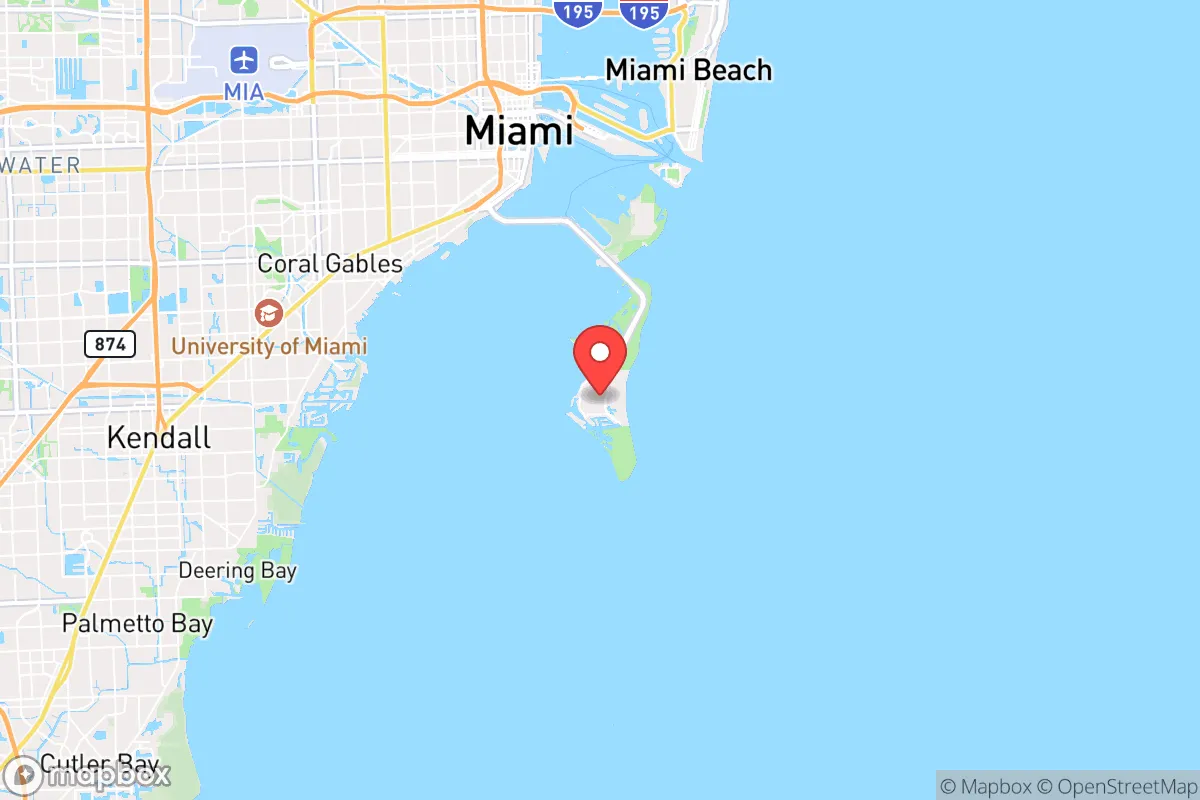
Photo: Wikipedia
Political ClimatePolitical Climate in Key Biscayne, FL
District shown is the primary district for this city’s centroid. Cities may span multiple districts.
Local Political AnalysisPolitical Analysis of Key Biscayne, FL
Key Biscayne has long been a conservative stronghold in an increasingly liberal Miami-Dade County, with a Cook PVI of R+6 that reflects its reliably Republican voting patterns. The village has historically leaned red even as surrounding areas like downtown Miami and Coral Gables have shifted leftward, but I’ve watched with growing concern over the last decade as progressive influences have started creeping into local governance and community discourse. If you’re looking for a place where traditional values and limited government still hold sway, Key Biscayne is one of the last bastions in South Florida—but it’s not immune to the pressures of the broader political climate.
How it compares
When you stack Key Biscayne against nearby cities, the contrast is stark. Just across the Rickenbacker Causeway, Miami proper has swung hard toward progressive policies, with city commissions pushing rent control measures and sanctuary city ordinances that prioritize illegal immigration over public safety. Head north to Miami Beach, and you’ll find a local government that’s embraced defunding police rhetoric and imposed strict COVID-era mandates that many residents felt were heavy-handed. Meanwhile, Key Biscayne has held the line on property rights, kept its police force well-funded, and resisted the kind of overreaching public health orders that shut down small businesses elsewhere. Even in neighboring Coral Gables, which used to be reliably conservative, you’re seeing more zoning battles over density and affordable housing mandates that feel like government overreach. Key Biscayne’s R+6 rating isn’t just a number—it’s a reflection of a community that still believes in personal responsibility and local control, even as the region around it drifts left.
What this means for residents
For those of us who live here, the political climate translates directly into daily life. You won’t find the same level of bureaucratic meddling that plagues other parts of Miami-Dade—our village council tends to take a hands-off approach to business regulations and property taxes, which keeps the cost of living manageable for a barrier island. But I’ve noticed a troubling trend in recent years: a vocal minority pushing for more “equity” initiatives in local schools and zoning changes that would bring high-density development to our quiet streets. The 2020 election cycle saw a surge in progressive activism here, with some candidates running on platforms that sounded more like Miami Beach than Key Biscayne. If that momentum continues, we could see the kind of government overreach that’s already damaged other communities—like mandatory affordable housing set-asides that strip property owners of their rights, or environmental regulations that go beyond sensible conservation into punitive territory. Long-term, I’m worried that the village’s conservative identity is at risk if we don’t stay vigilant at the ballot box.
Culturally, Key Biscayne still feels like a throwback to a more sensible era. There’s no push for defunding the police here, and our town hall meetings don’t devolve into the kind of ideological shouting matches you see in Miami. But the policy distinctions are worth noting: we’ve resisted the county’s push for inclusionary zoning and kept our school board focused on academics rather than social engineering. That said, the pressure is mounting. If you’re considering a move here, know that you’re buying into a community that’s fighting to preserve its conservative character—but it’s a fight that’s getting harder every election cycle.

State Political ClimatePolitical Climate in Florida
State Political AnalysisPolitical Environment in the State
Florida has been a reliably Republican state in presidential elections since 1952, with only two exceptions (1996 and 2008), but its internal politics are far more volatile than that record suggests. The state’s overall partisan lean is roughly R+3 to R+5 in statewide races, driven by a coalition of conservative retirees, rural and exurban voters, and a growing Hispanic population in the southern part of the state that is increasingly breaking toward the GOP. Over the last 10-20 years, Florida has shifted from a classic swing state to a solidly red one, with Republicans now holding supermajorities in both legislative chambers and the governor’s mansion since 2019. This trajectory accelerated after 2020, when the state’s handling of COVID—keeping businesses open and schools running—cemented its reputation as a haven for those fleeing lockdowns and mandates in blue states.
Urban vs. rural divide
The political map of Florida is a textbook study in urban-rural polarization, but with a few twists. The major metros—Miami-Dade, Broward (Fort Lauderdale), and Palm Beach County—are the Democratic strongholds, though Miami-Dade has been trending rightward. In 2020, Donald Trump improved his margin in Miami-Dade by 8 points compared to 2016, and in 2024, he actually won the county outright, a stunning flip for a place that voted for Hillary Clinton by 30 points. The Tampa Bay area (Hillsborough and Pinellas counties) is a perennial battleground, with St. Petersburg leaning blue and the suburbs of Tampa trending red. The I-4 corridor, stretching from Daytona Beach through Orlando to Lakeland, is the state’s political heartland—Orlando itself is blue, but the surrounding counties like Lake, Sumter, and Polk are deep red. The Panhandle, from Pensacola to Tallahassee, is reliably conservative, with the exception of Leon County (Tallahassee), which is a Democratic island thanks to the state capital and two major universities. The rural interior—places like Ocala, Gainesville’s outskirts, and the Everglades region—votes overwhelmingly Republican, often by 70-80% margins. The key takeaway: Florida’s red shift is being driven by Hispanic voters in Miami-Dade and by transplants from blue states settling in exurban counties like St. Johns (St. Augustine) and Collier (Naples), which are now among the most Republican in the nation.
Policy environment
Florida’s policy environment is a deliberate counterweight to states like California and New York. There is no state income tax, which is the single biggest draw for high-earners and retirees. Property taxes are moderate, with a 3% annual cap on assessed value increases for homesteaded properties (Save Our Homes amendment). Sales tax is 6%, but local options can push it to 7.5-8.5% in some counties. The regulatory posture is aggressively pro-business: Florida is a right-to-work state, has minimal occupational licensing burdens compared to the Northeast, and has no state-level minimum wage above the federal floor (though a 2020 ballot initiative is phasing in a $15 minimum by 2026). Education policy has been a flashpoint: Governor Ron DeSantis signed the Parental Rights in Education Act (HB 1557, dubbed “Don’t Say Gay” by critics) in 2022, which restricts classroom instruction on sexual orientation and gender identity in grades K-3, and expanded it to all grades in 2023. School choice is robust, with the Family Empowerment Scholarship program allowing state funds to follow students to private or charter schools. Healthcare is a mixed bag: Florida did not expand Medicaid under the ACA, leaving roughly 800,000 low-income adults uninsured, but the state has a competitive private insurance market. Election laws were tightened after 2020: SB 90 (2021) added voter ID requirements, limited drop boxes, and restricted third-party ballot collection. The state also banned ranked-choice voting and requires all ballots to be counted within a week of Election Day. On criminal justice, Florida is tough: it has a “stand your ground” law, no parole for violent felonies, and a three-strikes law for serious offenses. The overall message: Florida’s government is designed to stay out of your wallet, your child’s education, and your personal safety decisions, but it will enforce the law aggressively.
Trajectory & freedom
Florida is arguably the most “free” state in the country by the Cato Institute’s personal and economic freedom rankings, and recent legislation has only expanded that. On gun rights, Florida became a permitless carry state in 2023 (HB 543), allowing any law-abiding adult to carry a concealed firearm without a license. On parental rights, the aforementioned HB 1557 and its expansion (HB 1069 in 2023) give parents explicit authority over their children’s medical and educational decisions, including banning transgender surgeries for minors and restricting puberty blockers. On speech, the state passed the “Stop WOKE Act” (HB 7) in 2022, which prohibits mandatory diversity training that promotes certain racial or gender-based narratives in workplaces and schools—though parts of it have been blocked by federal courts. On medical autonomy, Florida banned COVID-19 vaccine mandates for private employers and government entities (SB 252, 2023) and prohibited mask mandates in schools. Property rights were strengthened by the “Live Local Act” (2023), which preempts local zoning to allow affordable housing development on commercial land, and by a 2024 law that limits homeowners’ association fines and restrictions on solar panels and clotheslines. The only area where freedom has arguably contracted is in immigration: SB 1718 (2023) requires hospitals to ask patients about immigration status, bans local governments from issuing ID cards to undocumented immigrants, and makes it a felony to transport them into the state. For a conservative, this is a net positive—the state is actively pushing back against federal overreach on border policy. The trajectory is clear: Florida is doubling down on individual liberty in education, health, and self-defense, while tightening the screws on illegal immigration.
Civil unrest & political movements
Florida has seen less civil unrest than many blue states, but it hasn’t been immune. The 2020 George Floyd protests were relatively muted compared to Portland or Seattle, with the most significant clashes in Miami and Orlando, but no widespread looting or arson. The state’s political movements are highly organized on both sides. On the right, the “Moms for Liberty” group, founded in Florida in 2021, has become a national force in school board elections, advocating for parental rights and against critical race theory. The “Florida Freedom Fund” and “Americans for Prosperity” are active in pushing tax cuts and deregulation. On the left, the “Florida Rising” coalition and “Dream Defenders” organize around criminal justice reform and immigrant rights, but they have little legislative success. Immigration politics are a constant flashpoint: Governor DeSantis has flown migrants to Martha’s Vineyard and California, and the state has a “sanctuary city” ban that threatens to remove local officials who refuse to cooperate with ICE. There is no serious secession or nullification movement in Florida—unlike Texas, the state’s identity is more about being a destination than a breakaway republic. Election integrity controversies have been minimal since 2020, largely because the state’s laws are already tight. The most visible flashpoint for a new resident would be the culture war in schools: you’ll see “parental rights” signs in yards and “protect trans kids” signs in others, and school board meetings can get heated. But overall, the political temperature is lower than in states like California or New York—people here are more focused on enjoying the weather and the low taxes than on street protests.
Projection
Over the next 5-10 years, Florida will likely become even more Republican, but not uniformly. The in-migration from blue states—roughly 1,000 people per day—is disproportionately conservative or libertarian-leaning, as people flee high taxes and COVID restrictions. This is already flipping counties like St. Johns (St. Augustine) and Collier (Naples) from purple to deep red, and it’s pushing Miami-Dade toward the GOP. The Hispanic vote, particularly among Cuban-Americans and Venezuelan-Americans in Miami, is trending right due to socialism fears, while Puerto Ricans in Orlando remain more Democratic but are not monolithic. The biggest wild card is climate change: rising sea levels and hurricane intensity could eventually drive out coastal residents, but that’s a slow-moving threat. Demographically, Florida is aging faster than the nation, which favors Republicans (older voters lean right), but the state is also attracting young families from the Northeast, who tend to be more moderate. The most realistic projection: Florida will remain a red state with a 55-45 Republican lean in statewide races, with the GOP holding supermajorities in the legislature. The policy direction will continue toward lower taxes, school choice, and gun rights, with occasional fights over property insurance reform (a growing crisis) and water quality (algae blooms in the Gulf). A new resident moving in now should expect to find a state that is culturally conservative, economically dynamic, and politically stable—but with a simmering culture war over education and immigration that will occasionally boil over in the legislature.
For a conservative single person or parent considering relocation, Florida offers a rare combination: no state income tax, strong parental rights in education, permitless carry, and a government that actively resists federal overreach. The trade-offs are real—hurricane risk, high property insurance costs, and a summer heat that can be oppressive—but the political climate is as close to a “live and let live” ethos as you’ll find in the Lower 48. If you’re coming from a blue state, you’ll notice the difference immediately: fewer mandates, more freedom in your daily choices, and a sense that the state government has your back on the issues that matter most. Just be prepared for the humidity.
* Values derived from national, state, county, city and local statistics and may differ in a specific area. Last updated: 2026-04-27T14:35:59.000Z
Narrative content on this page is AI-generated and may contain mistakes. Verify any details that matter before acting on them.
ReloMaps may earn a commission from affiliate links at no extra cost to you.

