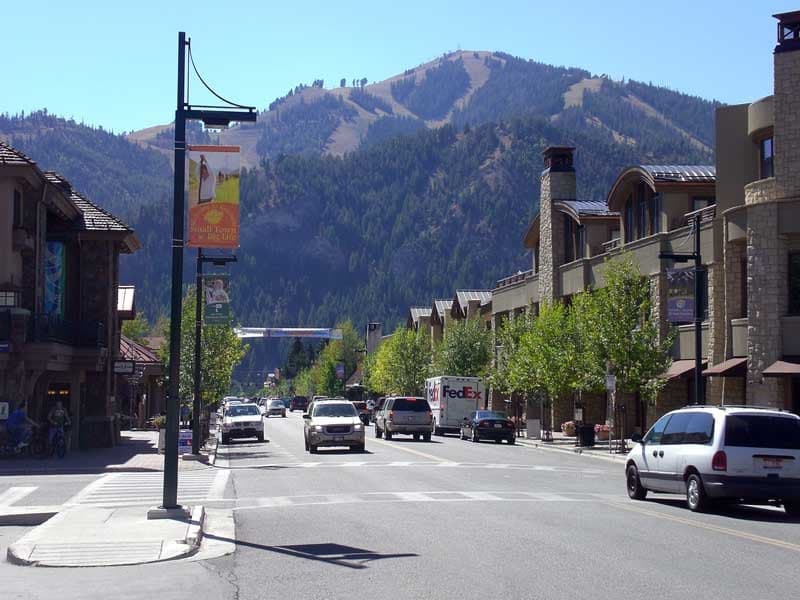
Photo: Wikipedia
Political ClimatePolitical Climate in Ketchum, ID
District shown is the primary district for this city’s centroid. Cities may span multiple districts.
Inherited from parent county — no local data available.
* Lean and PVI are calculated from Ketchum, ID’s own 2020 presidential results (precinct returns summed to the city), with 2024 estimated from the surrounding county’s 2020–2024 shift, Cook-style. Sources: state election offices; VEST 2020 precinct results (CC BY 4.0).
Political rankings in Idaho
- Most Conservative Cities in Idaho
- Most Liberal Cities in Idaho
- Best Liberal-Leaning Towns in the Mountain West
- Safest Liberal-Leaning Towns in the Mountain West
- Safest Conservative-Leaning Cities in the Mountain West
- Affordable Small Towns for Conservatives
- Most Affordable Liberal-Leaning Small Towns in the U.S.
- Safest Conservative-Leaning Cities in the U.S.
- Most Conservative Counties in Idaho
- Most Liberal Counties in Idaho
Local Political AnalysisPolitical Analysis of Ketchum, ID
Ketchum is a deep blue island in a deep red state. With a Cook Partisan Voting Index of D+17, it’s one of the most reliably Democratic towns in Idaho, which as a whole carries an R+18 rating. That 35-point gap between town and state isn’t just a statistic—it defines daily life here. Locals will tell you that Ketchum has voted blue in every presidential election since at least 2000, and the margin has only widened with each cycle. The surrounding Wood River Valley towns—Hailey and Bellevue—lean left too, but Ketchum is the epicenter, with its ski-resort economy, second-home owners from California and the Pacific Northwest, and a year-round population that skews older, wealthier, and more environmentally conscious.
How it compares
Drive 20 minutes south to Hailey and you’ll find a similar vibe, but push another 30 minutes to the Magic Valley towns like Twin Falls or Jerome, and the political landscape flips hard. Those areas vote R+25 or more, and the cultural divide is palpable. In Ketchum, you’ll see Biden-Harris yard signs next to Subarus with “Protect Public Lands” bumper stickers; in Twin Falls, it’s Trump flags and diesel trucks. The contrast isn’t just partisan—it’s about what people prioritize. Ketchum residents tend to rank climate action, public land preservation, and LGBTQ+ inclusion high on their list, while the rest of Idaho focuses on property rights, gun access, and low taxes. The state legislature in Boise, dominated by Republicans, often passes laws—like the 2023 ban on gender-affirming care for minors—that feel alien to many in Ketchum. Yet the town’s economic clout (think Sun Valley Resort and high-end tourism) gives it a louder voice than its 2,700 year-round residents might suggest.
What this means for residents
For liberal residents, Ketchum is a refuge. You can live openly, attend a Pride parade in Hailey, and not feel outnumbered at the grocery store. But you’ll also feel the weight of state politics: property taxes are set by a conservative legislature, and local initiatives on things like renewable energy can get preempted by state law. For conservative residents, life here is more nuanced. You’re in the minority, but not an oppressed one—most people are polite, and the town’s libertarian streak means live-and-let-live attitudes prevail. The real friction comes on land-use issues: conservatives often push for more housing development and fewer regulations, while the liberal majority fights to preserve open space and limit growth. Both sides agree on one thing: the cost of living is brutal. The median home price in Ketchum hovers around $1.2 million, which prices out many locals, regardless of party.
Culturally, Ketchum feels more like a liberal mountain town in Colorado or Vermont than the rest of Idaho. The local paper, the Idaho Mountain Express, covers city council meetings with a progressive lens, and the city’s sustainability goals—like aiming for 100% renewable electricity by 2030—are taken seriously. But don’t mistake the blue lean for uniformity. The valley has a strong ranching and outfitting history, and many older families vote Republican. The trajectory, though, is clear: as second-home buyers and remote workers continue to move in from blue states, Ketchum will only get bluer. The state will stay red, but the gap between town and state will keep widening, making Ketchum an ever more distinct political outlier in Idaho.

State Political ClimatePolitical Climate in Idaho
State Political AnalysisPolitical Environment in the State
Idaho is one of the most reliably Republican states in the nation, with a Cook PVI of R+18, meaning it votes about 18 points more Republican than the national average. The state hasn't voted for a Democratic presidential candidate since 1964, and the GOP holds every statewide office, supermajorities in both legislative chambers, and both U.S. Senate seats. Over the past 20 years, the shift has been toward an even more conservative, libertarian-leaning Republicanism, driven by rapid in-migration from California, Washington, and Oregon — people who often moved here specifically for lower taxes, less regulation, and a culture they see as more aligned with traditional values.
Urban vs. rural divide
The political map of Idaho is starkly divided between a handful of growing urban centers and vast, deeply conservative rural expanses. The Treasure Valley — anchored by Boise, Meridian, and Nampa — is the state's population and economic engine, and it's where the political action is. Ada County (Boise) has been trending purple for a decade; in 2020, Trump won it by just 3 points, down from 12 points in 2016. The city of Boise itself is increasingly liberal, with a Democratic mayor and city council, while the sprawling suburbs of Meridian and Eagle remain solidly red. Canyon County (Nampa, Caldwell) is still reliably Republican but growing fast with conservative-leaning transplants. Outside the Treasure Valley, the picture is simpler: Idaho Falls and Rexburg in the east are among the most conservative small cities in the nation, heavily influenced by the LDS Church and Brigham Young University-Idaho. Moscow, home to the University of Idaho, is a blue dot in a sea of red — the only county (Latah) that voted for Biden in 2020. Kootenai County (Coeur d'Alene) has become a flashpoint, with rapid growth from out-of-state conservatives turning it into a reliably red stronghold, though the city of Coeur d'Alene itself has a more moderate, business-friendly vibe.
Policy environment
Idaho's policy environment is defined by low taxes, minimal regulation, and a strong emphasis on local control. There is no state income tax on corporate or personal income — the state relies heavily on sales tax (6%) and property taxes, which are relatively low by national standards. The regulatory posture is business-friendly: no statewide building codes in most rural areas, minimal zoning restrictions, and a "right-to-work" law that weakens union power. Education policy is a hot-button issue: the state has one of the lowest per-pupil spending levels in the nation, and the legislature has passed multiple school choice bills, including a 2023 law creating education savings accounts (ESAs) that can be used for private school tuition or homeschooling expenses. Healthcare is a mixed bag: Idaho expanded Medicaid under the Affordable Care Act via a 2018 ballot initiative, but the legislature has since added work requirements and other restrictions. Election laws are moderately restrictive: voter ID is required, same-day registration is not available, and mail-in voting is allowed but requires an excuse. The state has no statewide sanctuary policies; in fact, the legislature passed a law in 2024 requiring local law enforcement to cooperate with federal immigration authorities.
Recent policy direction
The last five years have seen Idaho move decisively toward a more assertive, culturally conservative policy agenda. On gun and self-defense law, Idaho is a constitutional carry state (no permit needed to carry concealed), and in 2023 it passed a "Second Amendment Preservation Act" that purports to nullify federal gun laws — a direct challenge to federal authority. On parental and education rights, the 2023 "Parents' Bill of Rights" law requires schools to notify parents of any curriculum changes and gives them the right to opt their children out of any instruction they find objectionable; a 2024 law banned "critical race theory" and "social-emotional learning" in public schools. On speech and privacy, the state passed a law in 2023 prohibiting government officials from requiring masks or vaccines, and a 2024 law restricts the collection of biometric data by private companies. On medical and bodily autonomy, Idaho has one of the most restrictive abortion bans in the nation — a near-total ban with no exceptions for rape or incest, only for the life of the mother — and in 2023 it passed a law making it a crime for an adult to help a minor travel out of state for an abortion. On property rights, the state has strong eminent domain protections and a "right to farm" law that shields agricultural operations from nuisance lawsuits. On taxation, the legislature has cut income taxes repeatedly, with the top rate dropping from 6.9% to 5.8% in 2024, and there is a growing push to eliminate the corporate income tax entirely. On voting and ballot access, a 2024 law tightened voter ID requirements and banned the use of ballot drop boxes, while a separate law made it harder for third parties to get on the ballot.
Civil unrest & political movements
Idaho has a long history of anti-government and militia movements, dating back to the 1990s Ruby Ridge standoff in nearby Boundary County. Today, the most visible organized movement is the Idaho Freedom Foundation, a conservative think tank that has successfully pushed for tax cuts, school choice, and anti-vaccine legislation. On the left, the Idaho Democratic Party is weak but has seen a surge in grassroots activism in Boise, particularly around abortion rights and public school funding. Immigration politics are tense: in 2023, the legislature passed a bill allowing local police to enforce federal immigration law, and there have been protests both for and against the policy. Election integrity controversies flared after 2020, with the state GOP passing a resolution in 2021 questioning the legitimacy of the presidential election, though no evidence of widespread fraud was found. A new resident would notice the prevalence of "Don't Tread on Me" flags and "Let's Go Brandon" stickers, especially in rural areas, but also a growing number of "Black Lives Matter" signs in Boise neighborhoods. The most visible flashpoint is the annual Idaho Day rally at the state capitol, where armed protesters have demonstrated against COVID restrictions and federal overreach.
Projection
Over the next 5-10 years, Idaho's political trajectory is likely to remain deeply conservative, but with increasing internal tension between the libertarian-leaning "leave us alone" faction and the more culturally conservative "family values" wing. The biggest wild card is demographic change: the state is growing faster than almost any other, with most new arrivals coming from blue states. If the current trend continues, the Treasure Valley could become a swing region within a decade, potentially flipping Ada County to Democratic in presidential elections. However, the rural and eastern parts of the state are growing more conservative, not less, as they attract like-minded transplants. The net effect is likely a state that remains R+15 to R+20 for the foreseeable future, but with a more polarized and contentious political culture. A new resident moving in now should expect to see continued fights over education funding, abortion access, and the role of local government, with the legislature likely to pass even more preemptive laws to lock in conservative policies before the demographics shift too far.
For a new resident, the bottom line is this: Idaho offers a political environment that is overwhelmingly conservative, with low taxes, minimal regulation, and a strong emphasis on individual liberty — but that liberty comes with trade-offs. Public services, especially schools and healthcare, are underfunded by national standards. The political culture is intense and often confrontational, especially in the legislature. If you're a conservative who values low taxes, gun rights, and local control, you'll find a lot to like. If you're a liberal, you'll find a small but growing community in Boise and Moscow, but you'll be living under laws that are actively hostile to many of your values. Either way, the state is changing fast, and the politics will only get more interesting — and more contentious — in the years ahead.
* Values derived from national, state, county, city and local statistics and may differ in a specific area. Last updated: 2026-11-16T17:45:59.000Z
Narrative content on this page is AI-generated and may contain mistakes. Verify any details that matter before acting on them.
ReloMaps may earn a commission from affiliate links at no extra cost to you.

