Political ClimatePolitical Climate in Mccracken County
Showing district-level results — no local-only data available.
Local Political AnalysisPolitical Analysis of Mccracken County
McCracken County is one of the most reliably Republican corners of Kentucky, with a Cook Partisan Voting Index (PVI) of R+23 that puts it eight points to the right of the state as a whole (R+15). That gap has been widening over the past decade, driven largely by the shift of working-class voters in Paducah and the surrounding unincorporated areas away from the Democratic Party. In the 2024 presidential race, Donald Trump carried the county by roughly 30 points, outperforming his statewide margin by about eight points. The trajectory is clear: McCracken has been moving right faster than Kentucky as a whole, and there’s no sign of that slowing down.
How it compares
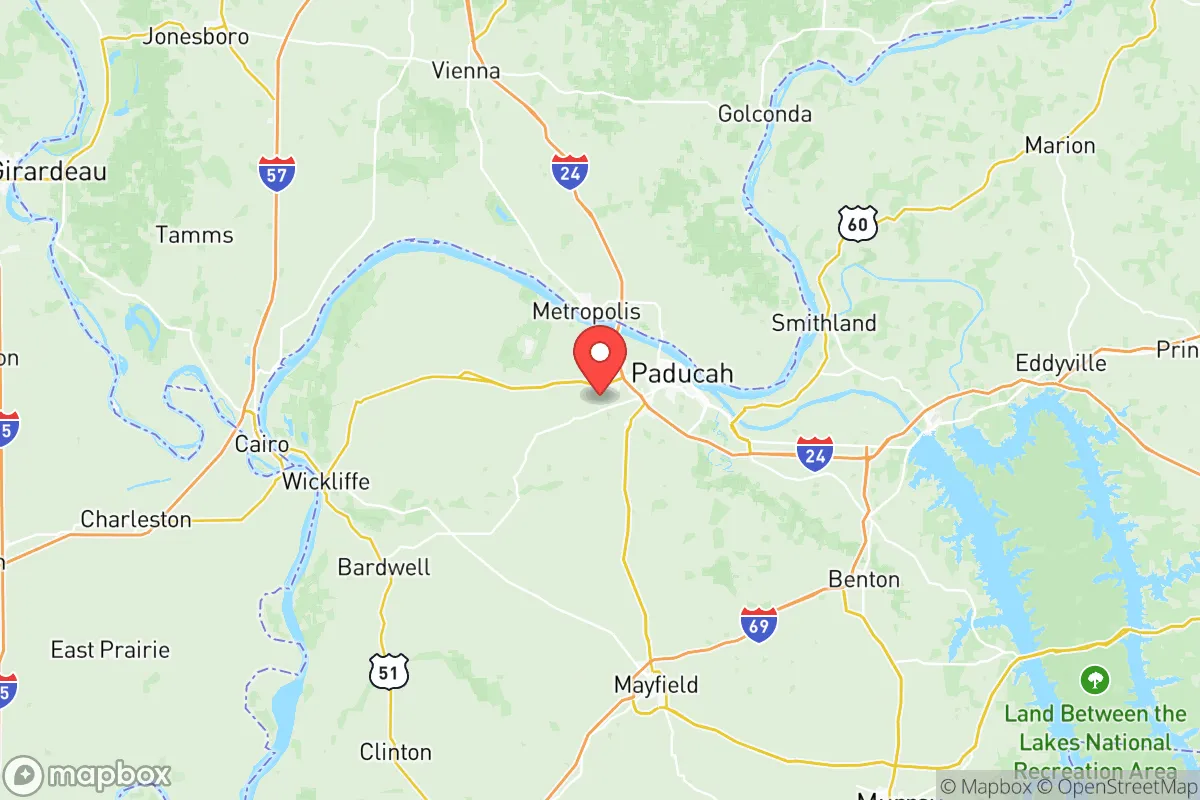
Kentucky’s R+15 PVI already makes it a solid red state, but McCracken County is in a different league. The county’s R+23 rating puts it in the same company as places like Texas’s Tarrant County (Fort Worth) or Indiana’s Hamilton County (suburban Indianapolis). The biggest difference between McCracken and the rest of Kentucky is the absence of any real blue stronghold. While Louisville’s Jefferson County (D+15) and Lexington’s Fayette County (D+8) pull the state’s average leftward, McCracken has no comparable urban anchor. Paducah, the county seat and largest city, is a mixed bag politically. The downtown core and the historic neighborhoods around Broadway and the riverfront lean slightly Democratic, but the suburban precincts in the city’s western and southern edges—think Lone Oak and the area around Reidland—are deeply red. The rural precincts in the county’s northern and eastern reaches, like those around the tiny community of Melber, are among the most conservative in the state, often voting 80% Republican or higher. The swing precincts are almost nonexistent; the closest thing to a battleground is the area around Paducah’s midtown, where a mix of older homeowners and younger renters can produce 55-45 splits in either direction, but even those are trending red.
What this means for residents
For conservative residents, McCracken County is about as comfortable as it gets. Local offices—county judge-executive, sheriff, school board—are overwhelmingly held by Republicans, and the county commission has been all-Republican for years. Tax policy reflects that: property taxes are low, and the county has resisted adopting a local option sales tax. For liberal residents, the reality is more isolating. There’s no real progressive infrastructure outside of a few advocacy groups in Paducah, and Democratic candidates often struggle to find volunteers or donors. That said, the county’s politics are not uniformly hostile. The city of Paducah itself has a more moderate streak, and local issues like riverfront development, flood control, and the future of the Paducah Gaseous Diffusion Plant site tend to be handled pragmatically, with less partisan edge than national politics. The county’s strong Republican lean does mean that social issues—abortion, gun rights, religious liberty—are front and center in local discourse, and the school board has been a flashpoint over curriculum and library books.
Culturally, McCracken County is more Southern than the rest of Kentucky in some ways—the drawl is thicker, the barbecue is more prominent, and the local identity is tied more to the Tennessee Valley than to the Bluegrass region. The county’s politics reflect that: it’s a place where the Second Amendment is a given, where church attendance is high, and where the term “moderate” usually means a Republican who doesn’t talk about politics at dinner. The Paducah Gaseous Diffusion Plant, once the county’s largest employer, has left a legacy of environmental concern and economic anxiety that cuts across party lines, but even that hasn’t loosened the GOP’s grip. Looking ahead, the county’s political trajectory seems locked in. As long as Paducah’s population continues to age and the rural precincts remain dominant, McCracken will stay deep red—and likely get redder.

State Political ClimatePolitical Climate in Kentucky
State Political AnalysisPolitical Environment in the State
Kentucky is a deeply red state with a Cook PVI of R+15, meaning it votes about 15 points more Republican than the national average in presidential elections. Over the past 20 years, the state has shifted from a competitive purple state—where Democrats held a majority of state legislative seats and the governorship was regularly contested—to a solidly Republican stronghold. The last Democrat to win Kentucky in a presidential election was Bill Clinton in 1996, and since 2000, the GOP margin has grown from roughly 15 points to over 25 points in 2024. The dominant coalition is a mix of rural, socially conservative voters, working-class whites in the eastern coalfields, and suburbanites in the Louisville and Lexington metros who have drifted rightward on cultural issues.
Urban vs. rural divide
The political map of Kentucky is a textbook example of the urban-rural split. The two major metros—Louisville (Jefferson County) and Lexington (Fayette County)—are the only reliably Democratic strongholds, each voting for Joe Biden by roughly 15-20 points in 2020. However, these cities are surrounded by deep-red suburbs and exurbs. For instance, Oldham County, just northeast of Louisville, voted for Trump by over 40 points, while Scott County (Georgetown) and Boone County (part of the Cincinnati metro) are reliably Republican. The state’s third-largest city, Bowling Green, is a conservative hub in Warren County, voting for Trump by about 30 points. The eastern coalfields—places like Pikeville and Hazard—are among the most Republican areas in the nation, often voting 80%+ for the GOP. The western part of the state, including Paducah and Owensboro, is also solidly red, though historically had a stronger Democratic tradition that has faded. The only notable blue-leaning rural area is the Bluegrass region around Lexington, where some horse-farm counties like Woodford and Bourbon are competitive but still lean Republican.
Policy environment
Kentucky’s policy environment is shaped by a Republican supermajority in the state legislature and a GOP governor (Andy Beshear is a Democrat, but the legislature routinely overrides his vetoes). The state has a flat income tax rate of 4.5% (down from 6% in 2018, with a path to elimination), and no state-level property tax on real estate—local governments handle that. Sales tax is 6%, with no exemptions for groceries. The regulatory posture is business-friendly, with a right-to-work law (passed in 2017) and a low corporate income tax rate of 5%. Education policy is a flashpoint: the state has a school choice program (the "Education Opportunity Account" program, passed in 2022 but struck down by the state Supreme Court in 2023), and the legislature is pushing for a constitutional amendment to allow public funds for private schools. Healthcare is dominated by the expansion of Medicaid under the Affordable Care Act (which Governor Beshear expanded in 2014), but the legislature has imposed work requirements and premiums for able-bodied adults. Election laws are moderately restrictive: Kentucky requires a photo ID to vote, has no-excuse absentee voting (expanded during COVID but made permanent), and has a 28-day early voting period. The state does not have automatic voter registration.
Recent policy direction
Over the past five years, Kentucky has moved decisively rightward on a range of issues. On gun and self-defense law, the state passed constitutional carry (permitless carry) in 2019, and in 2024, it enacted a "stand your ground" law, removing the duty to retreat in public spaces. On parental and education rights, the legislature passed a ban on teaching "divisive concepts" (like critical race theory) in public schools in 2022, and in 2023, it passed a law requiring schools to notify parents of any changes to a student’s "services or monitoring" related to gender identity. On speech and privacy, Kentucky has no broad shield law for journalists, but it does have a strong anti-SLAPP statute protecting free speech from frivolous lawsuits. On medical and bodily autonomy, the state has a near-total abortion ban (triggered after Dobbs), with exceptions only to save the mother’s life or prevent serious injury—no exceptions for rape or incest. In 2024, the legislature passed a law restricting gender-affirming care for minors, banning puberty blockers and hormone therapy. On property rights, Kentucky is a "Dillon’s Rule" state, meaning local governments have only powers explicitly granted by the state, which limits local zoning and land-use control. On taxation, the legislature is on a path to eliminate the state income tax entirely, with automatic cuts triggered by revenue growth. On voting and ballot access, the state has tightened voter ID requirements and purged inactive voters from rolls, but it has also expanded early voting and made absentee voting easier.
Civil unrest & political movements
Kentucky has seen its share of political flashpoints. The 2020 protests in Louisville over the death of Breonna Taylor were among the largest in the nation, with weeks of demonstrations, clashes with police, and a heavy National Guard presence. The state also saw a significant right-wing activist movement, including the "Kentucky Freedom Coalition" and local chapters of the "Moms for Liberty" group, which have been active in school board meetings and local elections. Immigration politics are less visible here than in border states, but there is a small but vocal movement against sanctuary policies—none of Kentucky’s cities have declared themselves sanctuaries, though Louisville has a "welcoming city" ordinance that limits cooperation with federal immigration enforcement. There is no serious secession or nullification rhetoric, though some rural counties have passed symbolic "Second Amendment sanctuary" resolutions. Election integrity controversies flared after 2020, with some Republican legislators pushing for an audit of the state’s election systems, but no major fraud was found. The most visible flashpoint for a new resident would be the cultural divide between the urban centers and the rest of the state, particularly around LGBTQ+ rights and abortion.
Projection
Over the next 5-10 years, Kentucky is likely to become even more Republican, driven by two trends: the continued out-migration of younger, more liberal residents from rural areas to cities outside the state, and the in-migration of conservative-leaning retirees and remote workers from higher-tax states like California and Illinois. The Louisville and Lexington metros will remain blue, but their influence will be diluted as the state legislature continues to preempt local ordinances (e.g., banning local minimum wage increases or anti-discrimination laws). The state’s income tax is likely to be eliminated entirely by 2030, which will further attract conservative migrants but could strain funding for public services. The abortion ban and restrictions on gender-affirming care are unlikely to be reversed unless the state Supreme Court or federal courts intervene. A new resident moving in now should expect a state that is culturally and politically conservative, with a strong emphasis on gun rights, school choice, and low taxes, but with a persistent urban-rural tension that plays out in state-level policy battles.
For a new resident, the bottom line is straightforward: if you align with conservative values on taxes, gun rights, and cultural issues, Kentucky offers a low-cost, low-regulation environment with a strong sense of community in its small towns and suburbs. If you lean liberal, you’ll find a welcoming community in Louisville or Lexington, but you’ll be living under a state government that is actively hostile to many of your policy preferences—from abortion access to LGBTQ+ protections to public school funding. The state is not a place of political moderation; it’s a place where the red majority governs decisively, and the blue minority has limited power to push back. Plan accordingly.
* Values derived from national, state, county, city and local statistics and may differ in a specific area. Last updated: 2026-10-03T07:12:06.000Z
Narrative content on this page is AI-generated and may contain mistakes. Verify any details that matter before acting on them.
ReloMaps may earn a commission from affiliate links at no extra cost to you.

