Demographics of Mccracken County
Affluence Level in Mccracken County
A middle-class area roughly in line with national averages across income, home values, education, and employment.
People of Mccracken County
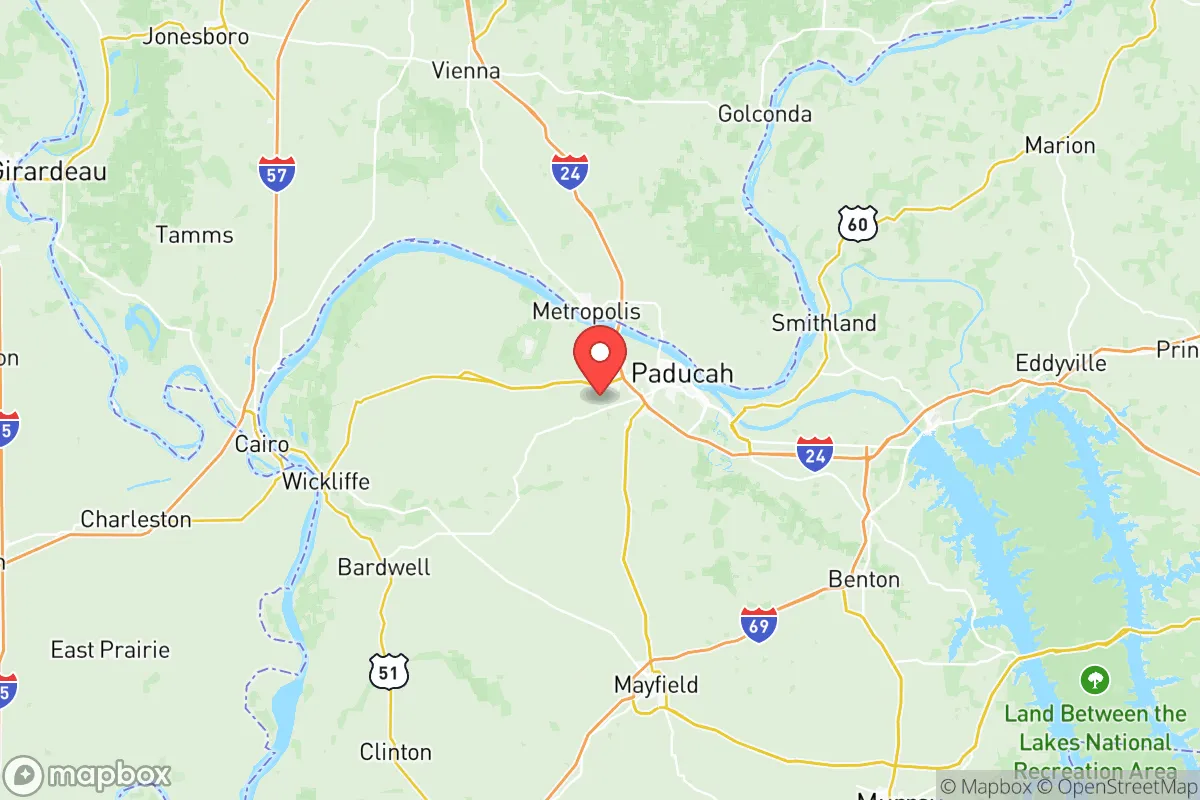
Today, McCracken County, Kentucky, is home to 67,584 residents, a population that is 81.5% White, 10.0% Black, and 3.3% Hispanic, with a notably low foreign-born share of just 0.8%. The county’s character is defined by its historic role as a Ohio River transportation hub, anchored by the city of Paducah, which concentrates the vast majority of the population and serves as the region’s commercial and cultural center. Despite its small size, the county has a distinctive identity shaped by a blend of Appalachian migration, African American heritage from the post-Civil War era, and a steady, modest influx of professionals tied to the U.S. Coast Guard and the Paducah Gaseous Diffusion Plant. The population is older than the national median (median age 42.3), and the county remains predominantly native-born, with a cultural conservatism that reflects its deep Southern and Midwestern roots.
Settlement & growth (pre-1960)
The land that became McCracken County was originally inhabited by the Chickasaw and Cherokee peoples, who used the Ohio River corridor for trade and seasonal hunting. European contact came via French explorers and traders in the 17th and 18th centuries, but no permanent European settlement occurred until after the American Revolution. The county was formally established in 1825 from parts of Hickman County, named for a Kentucky legislator, and its first permanent settlers were primarily of English and Scots-Irish stock, moving west from Virginia and North Carolina along the Wilderness Road and down the Ohio River. These early arrivals were drawn by the promise of fertile bottomlands and river access, establishing small farms and river landings at what would become Paducah, the county seat founded in 1827 by William Clark (of Lewis and Clark fame).
The defining population wave of the 19th century was the arrival of enslaved African Americans, who were brought to work on tobacco and cotton plantations along the river. By 1860, enslaved people made up roughly 25% of McCracken County’s population. After the Civil War, many freedmen remained in the area, forming the foundation of Paducah’s historic African American neighborhoods, particularly the Southside and the area around 13th and Washington streets. The post-Reconstruction era also saw a small but notable influx of German and Irish immigrants, who found work on the riverboats, in the growing railroad yards, and in Paducah’s emerging industries, such as the Illinois Central Railroad shops and the city’s thriving tobacco and lumber markets. These European immigrants concentrated in Paducah’s near-downtown neighborhoods, like the Lower Town district, which still retains some of its 19th-century architecture.
The 20th century brought two major shifts. First, the Great Migration (roughly 1910–1970) saw thousands of Black residents leave McCracken County for industrial jobs in Chicago, Detroit, and St. Louis, reducing the county’s Black population share from a peak of around 30% in 1900 to about 12% by 1970. Second, the construction of the Paducah Gaseous Diffusion Plant in 1952, part of the Manhattan Project’s legacy, drew a wave of engineers, scientists, and skilled workers from across the country, many of them White and college-educated. This plant, located in the western part of the county near the town of West Paducah, became the county’s largest employer and a magnet for a new, more transient professional class. Suburbanization also began in earnest after World War II, with families moving from Paducah’s urban core to new developments in Lone Oak and Reidland, which remain primarily White, middle-class bedroom communities today.
Modern era (post-1965)
The 1965 Hart-Cellar Act had a minimal direct impact on McCracken County, as the region never attracted the large-scale immigration seen in coastal or Sun Belt metros. The foreign-born population today is just 0.8%, one of the lowest rates in Kentucky. The modest post-1965 immigration that did occur has been almost entirely driven by two groups: a small number of East/Southeast Asian professionals (0.7% of the population), many connected to the engineering and technical fields at the Paducah Gaseous Diffusion Plant and the nearby U.S. Coast Guard base, and an even smaller Indian subcontinent population (0.2%), primarily physicians and IT workers at local hospitals and firms. These groups have not formed distinct ethnic enclaves; instead, they are dispersed across Paducah and its suburbs, particularly in the newer subdivisions of Hendron and Massac.
The most significant demographic shift since 1965 has been domestic: the slow but steady outmigration of younger, college-educated residents to larger metros like Nashville, Louisville, and St. Louis, coupled with the in-migration of retirees and remote workers seeking a lower cost of living. The county’s population peaked at around 65,000 in 1980 and has since fluctuated, declining slightly in the 1990s before stabilizing around 67,000 in the 2020s. The Hispanic population, while still small at 3.3%, has grown from near-zero in 1990, driven by labor demand in agriculture (tobacco and corn) and the construction trades. These Hispanic residents are concentrated in Paducah’s working-class neighborhoods and in the rural areas around Heath and Kevil, where they work on farms and in landscaping. The Black population has remained steady at around 10%, with the historic Southside neighborhood of Paducah still serving as the cultural and institutional heart of the African American community, anchored by churches like Washington Street Baptist Church and the annual Paducah African American Heritage Festival.
Suburbanization has continued to reshape the county. The unincorporated communities of Lone Oak and Reidland have grown as family-oriented, predominantly White suburbs, while Paducah’s urban core has seen modest reinvestment, particularly in the Lower Town Arts District, which has attracted a small but visible creative class. The county’s college-educated share is 27.9%, below the national average of 33%, reflecting the limited number of white-collar jobs outside the plant and the healthcare sector.
The future
McCracken County’s population is projected to remain relatively flat over the next 10–20 years, with slight growth driven by in-migration of retirees and remote workers from higher-cost states, particularly Illinois and California. The county is becoming slightly more diverse, but at a glacial pace: the Hispanic share is expected to rise to 5–6% by 2040, while the White share will likely decline to around 78–79%. The Black population is expected to remain stable at 9–10%, as outmigration of younger Black residents to larger cities continues to offset natural increase. The East/Southeast Asian and Indian populations will likely grow modestly, tied to any expansion of the Paducah Gaseous Diffusion Plant or the Coast Guard base, but will remain below 2% combined.
The most notable trend is the aging of the population. With a median age already above 42, and limited in-migration of young families, the county will continue to gray. This will strain local services, particularly healthcare and housing, as older residents age in place. New residential development is concentrated in the western part of the county, near the plant and the Interstate 24 corridor, in areas like West Paducah and Massac, while Paducah’s urban core struggles to attract young professionals. The cultural identity of the county is likely to remain conservative and rooted in its river-town heritage, with the arts district and the National Quilt Museum providing a small counterbalance of progressive influence.
For someone moving in now, McCracken County offers a stable, low-cost, and safe environment with a strong sense of place, but it is not a region of rapid demographic change or economic dynamism. The population is overwhelmingly native-born, culturally traditional, and aging, with limited diversity beyond the historic Black community and a small but growing Hispanic presence. New arrivals will find a community that values neighborliness, local institutions, and a slower pace of life, but should expect little of the ethnic variety or youthful energy found in larger metros.

* Values derived from national, state, county, city and local statistics and may differ in a specific area. Last updated: 2026-10-03T07:12:06.000Z
Narrative content on this page is AI-generated and may contain mistakes. Verify any details that matter before acting on them.
ReloMaps may earn a commission from affiliate links at no extra cost to you.

