
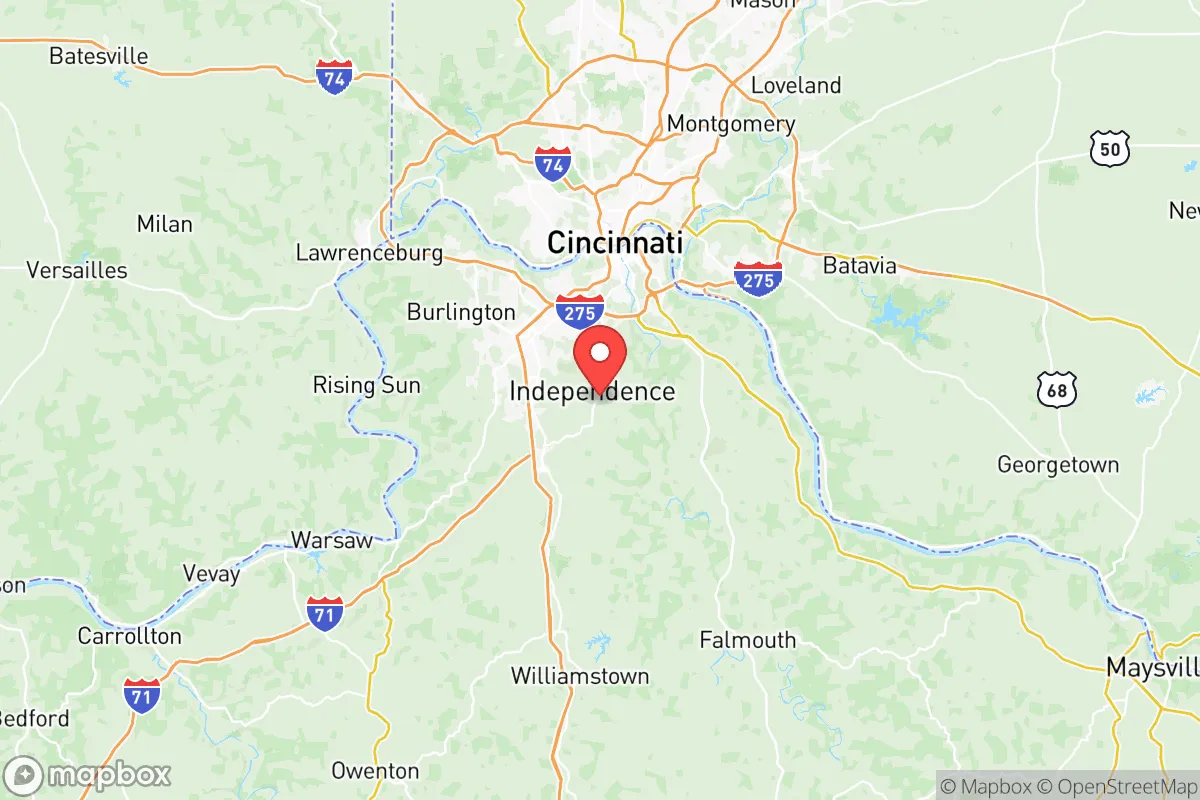

Photo: Wikipedia
Political ClimatePolitical Climate in Kenton County
Showing district-level results — no local-only data available.
Local Political AnalysisPolitical Analysis of Kenton County
Kenton County has long been a solid Republican stronghold, and honestly, it still is, but you can feel the ground shifting under your feet if you've been here a while. The Cook PVI sits at R+18, which is a bit redder than the state's R+15, but that margin has been shrinking in recent cycles. Back in 2016, Trump won the county by nearly 20 points; by 2024, that lead had slimmed to about 14 points. The real story isn't the county as a whole, though—it's the growing divide between the northern river cities and the southern suburbs.
How it compares
Compared to Kentucky as a whole, Kenton County is still a reliable Republican vote, but it's not the deep-red fortress it used to be. The state's R+15 PVI is driven by massive rural margins in places like Eastern Kentucky and the Purchase area, while Kenton's R+18 is being pulled down by its urban core. Covington and Newport are the blue dots on the map—both have voted Democratic in every presidential election since 2008, with Covington's 4th Ward precinct going +18 for Biden in 2020. Meanwhile, Independence and Taylor Mill are as red as they come, with precincts routinely hitting +30 to +40 for Republican candidates. The swing areas are in Fort Mitchell and Edgewood, where educated suburbanites have started splitting tickets—voting for local Republicans but drifting left on national races. That's a trend you don't see much in the rest of Kentucky, where straight-ticket voting is still the norm.
What this means for residents
For folks who value limited government and personal freedoms, the trend here is a bit concerning. The county commission is still solidly Republican, but the city councils in Covington and Newport have been pushing progressive policies—things like sanctuary city resolutions and higher local taxes for social programs. In 2023, Covington's council voted to create a "racial equity" task force with subpoena power over local businesses, which felt like a step toward government overreach to a lot of us. On the flip side, the county-wide government has held the line on property taxes and zoning regulations, keeping Kenton County a relatively low-regulation place to live compared to Louisville or Lexington. The school boards are another battleground—Kenton County Schools (the county district) has kept its curriculum focused on traditional academics, while Covington Independent Schools have introduced DEI initiatives that have some parents worried about ideological capture.
Culturally, you still see a lot of "live and let live" attitude in the southern parts of the county. People in Villa Hills and Crestview Hills tend to mind their own business and expect the same from government. But the northern river cities are becoming more like Cincinnati's urban core—more regulations, more ordinances, more government involvement in daily life. The long-term trajectory depends on whether the suburban swing voters in Fort Mitchell and Edgewood keep moving left. If they do, Kenton County could look a lot more like Hamilton County, Ohio (Cincinnati) in a decade—and that's a future where personal freedoms might not be as protected as they are today. For now, though, the county is still a good place for anyone who wants less government and more freedom, especially if you stick to the southern towns.

State Political ClimatePolitical Climate in Kentucky
State Political AnalysisPolitical Environment in the State
Kentucky is a deeply red state with a Cook PVI of R+15, meaning it consistently votes Republican by a 15-point margin above the national average. Over the past 20 years, the state has shifted hard right, driven by the collapse of the old Blue Dog Democrat coalition in rural areas and the rapid growth of the Louisville and Lexington suburbs. While Kentucky was once a competitive swing state that voted for Bill Clinton twice, it hasn’t backed a Democrat for president since 1996, and the GOP now holds supermajorities in both chambers of the state legislature. The dominant coalition is a mix of evangelical conservatives, rural populists, and increasingly, suburban families fleeing progressive policies in neighboring states like Illinois and Ohio.
Urban vs. rural divide
The political map of Kentucky is a textbook case of the urban-rural split. The two major metros — Louisville (Jefferson County) and Lexington (Fayette County) — are the only reliably blue islands in a sea of red. Louisville votes Democratic by about 20 points, driven by its diverse population, university presence, and union-heavy manufacturing base. Lexington is more moderate but still leans blue, powered by the University of Kentucky and a growing tech and healthcare sector. The real action is in the suburbs. Counties like Boone, Kenton, and Campbell in Northern Kentucky (Cincinnati suburbs) have shifted from purple to solid red over the last decade, as families move across the Ohio River to escape Ohio’s tax hikes and urban crime. Meanwhile, rural counties like Pike, Harlan, and Letcher in eastern Kentucky — once Democratic strongholds — now vote Republican by 50-point margins, fueled by coal country resentment of environmental regulations and cultural conservatism. The only real exception is the city of Bowling Green, which is a purple-ish college town in an otherwise deep red region.
Policy environment
Kentucky’s policy environment is aggressively conservative, with a strong emphasis on low taxes, limited regulation, and cultural traditionalism. The state has a flat income tax that is being phased down from 5% to 4% by 2026, with a goal of elimination entirely. Property taxes are among the lowest in the nation, and there is no estate or inheritance tax. The regulatory climate is business-friendly, with right-to-work laws and a tort reform system that caps non-economic damages. On education, Kentucky has a robust school choice movement — the state passed a charter school law in 2017 and expanded education opportunity accounts in 2022, though litigation has slowed implementation. Healthcare is a mixed bag: the state expanded Medicaid under the Affordable Care Act, but the legislature has imposed work requirements and premiums for able-bodied adults. Election laws are strict: Kentucky requires a photo ID to vote, has no-excuse absentee voting only for limited groups, and bans ballot harvesting. The state also passed a constitutional amendment in 2022 affirming that there is no right to abortion, and a near-total ban is in effect with exceptions only for life of the mother, rape, and incest.
Trajectory & freedom
Kentucky is trending toward more freedom in most areas, but with some concerning caveats. On the positive side, the state has become a national leader in Second Amendment rights. In 2019, Kentucky passed constitutional carry (permitless carry), and in 2023, it passed a law prohibiting local governments from enforcing federal gun regulations that conflict with state law — a direct rebuke to potential federal overreach. Parental rights have also expanded: the 2022 “Parents’ Bill of Rights” gives parents the right to review curriculum and opt their children out of any instruction they find objectionable, including sexual education and critical race theory. Medical freedom took a hit during COVID — Governor Andy Beshear (a Democrat) imposed mask mandates and business closures, but the Republican legislature quickly stripped his emergency powers in 2021 and passed a law banning vaccine mandates for state employees and contractors. Property rights are strong, with no statewide zoning and a low property tax burden. The biggest red flag is the state’s reliance on federal Medicaid funding — if the federal government tightens eligibility, Kentucky’s budget could take a hit. Also, the state’s tax structure is regressive, meaning lower-income residents pay a higher percentage of their income in sales and excise taxes than the wealthy.
Civil unrest & political movements
Kentucky has seen its share of political flashpoints, but they are more localized than in many states. The most notable was the 2020 Breonna Taylor protests in Louisville, which turned into weeks of demonstrations, property damage, and a heavy police response. That event radicalized a segment of the Louisville population and led to the election of a progressive prosecutor, but the backlash in the rest of the state was even stronger — rural and suburban voters turned out in record numbers to reject any talk of defunding the police. The state also has a small but vocal secessionist movement in eastern Kentucky, where some residents have floated the idea of joining West Virginia due to cultural and economic ties. Immigration politics are relatively quiet — Kentucky has a small foreign-born population, and there are no sanctuary cities. Election integrity has been a hot topic: the 2020 election saw no major fraud in Kentucky, but the legislature passed a series of bills tightening voter ID laws and banning private funding of election administration. The most visible political movement right now is the school choice coalition, which has been fighting the teachers’ unions in court and at the ballot box. In 2022, voters rejected a constitutional amendment that would have allowed public funds to go to private schools, but the legislature is expected to try again.
Projection
Over the next 5-10 years, Kentucky is likely to become even more conservative, driven by two demographic trends. First, the state is seeing a steady influx of retirees and remote workers from blue states like California, Illinois, and New York, who are drawn by low housing costs, low taxes, and a slower pace of life. These newcomers tend to be culturally conservative or libertarian, reinforcing the existing political lean. Second, the urban cores of Louisville and Lexington are losing population to the suburbs and exurbs, which are voting more Republican with each cycle. The only countervailing force is the growing Hispanic population in the Louisville area and the increasing number of college-educated professionals in Lexington, but these groups are not large enough to flip the state. Expect the flat income tax to be fully eliminated by 2030, further gun rights expansions (including permitless carry for non-residents), and continued battles over school choice. The biggest wildcard is the opioid crisis and its impact on rural communities — if the state doesn’t address addiction and economic decline, those areas could become politically volatile. For a new resident, the bottom line is that Kentucky will remain a reliably red, low-tax, culturally traditional state for the foreseeable future, with no serious threat of turning purple.
For someone moving to Kentucky, the practical takeaway is straightforward: you’ll find a state that respects your right to live your life without heavy government interference, especially on guns, taxes, and education. The trade-off is that public services — roads, schools, healthcare — are leaner than in blue states, and the political culture can feel insular in rural areas. If you’re looking for a place where your values align with the majority and you want to keep more of your paycheck, Kentucky is a solid bet. Just be prepared for the occasional culture war flare-up in the legislature, and know that the urban islands of Louisville and Lexington are the only places where you’ll encounter progressive politics in any meaningful way.
* Values derived from national, state, county, city and local statistics and may differ in a specific area. Last updated: 2026-06-05T09:24:34.000Z
Narrative content on this page is AI-generated and may contain mistakes. Verify any details that matter before acting on them.
ReloMaps may earn a commission from affiliate links at no extra cost to you.

