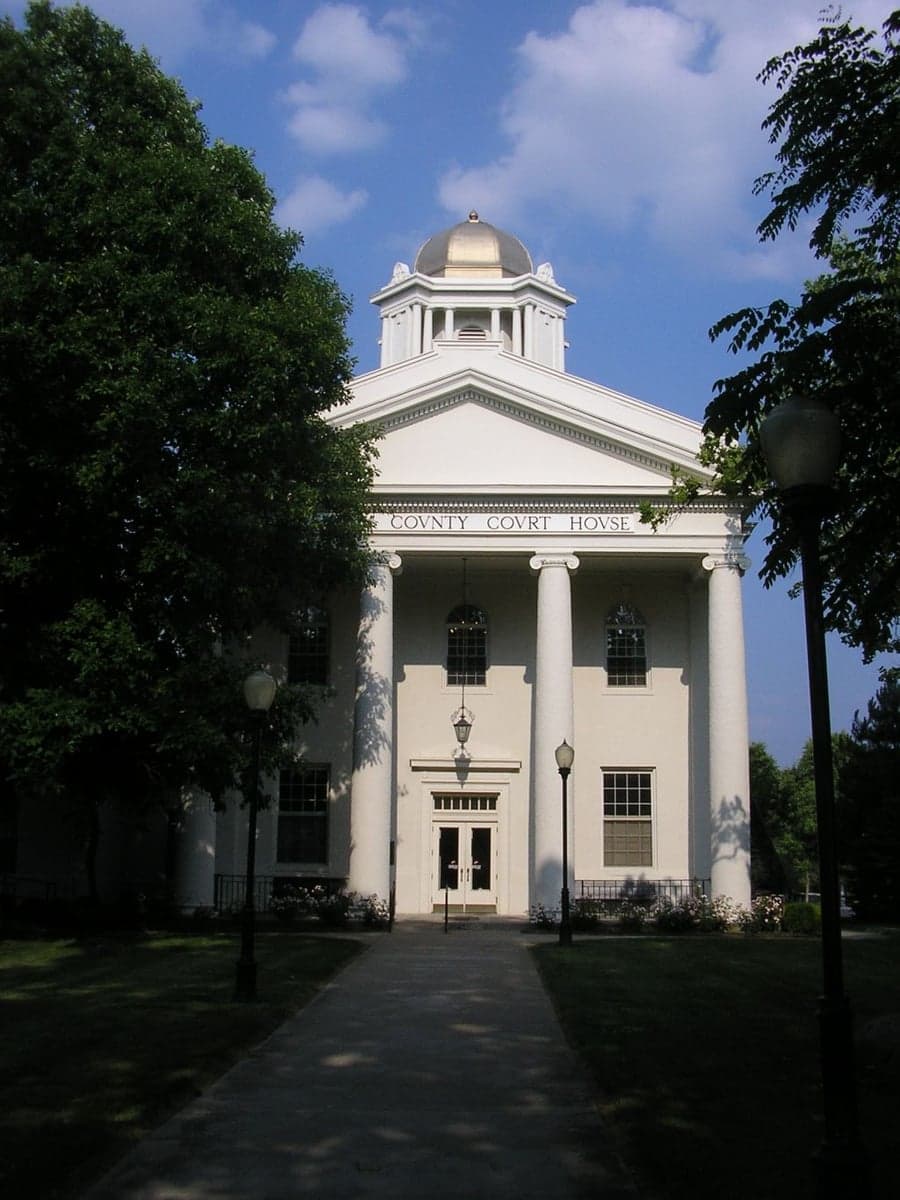
Photo: Wikipedia
Demographics of Kenton County
Affluence Level in Kenton County
A middle-class area roughly in line with national averages across income, home values, education, and employment.
People of Kenton County
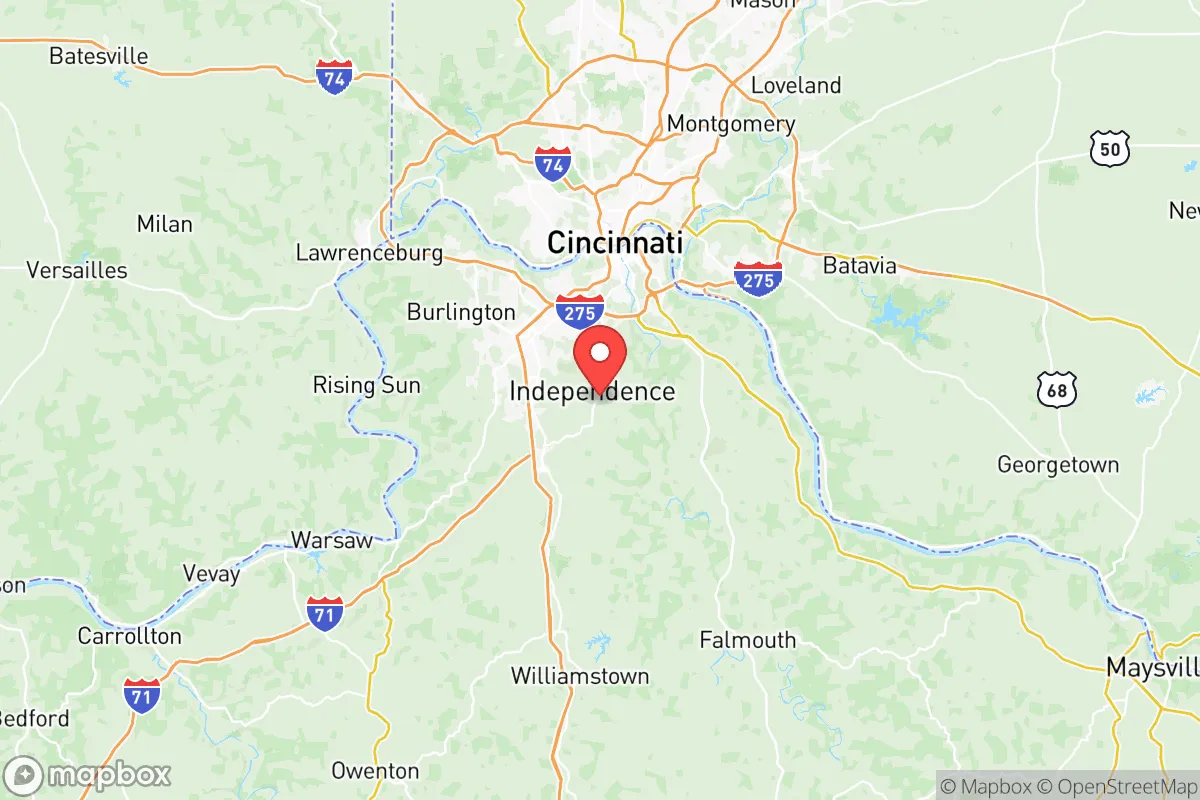
The people of Kenton County, Kentucky, today number 169,817, forming a densely populated suburban core within the Cincinnati metropolitan area. The county is predominantly white (86.0%), with a small but growing Hispanic population (4.6%) and a Black population of 4.2%, while the foreign-born share remains low at 2.6%. Its identity is shaped by a blend of historic German Catholic settlement, post-war suburban expansion, and a modern pull toward the river cities of Covington and Newport, which serve as economic and cultural anchors. The county is notably more educated than the state average, with 37.6% of adults holding a college degree, reflecting a shift toward professional and healthcare employment.
Settlement & growth (pre-1960)
Before European settlement, the area that became Kenton County was part of the hunting grounds of the Shawnee and Miami nations, who used the Ohio River as a travel corridor. The first permanent American settlers arrived in the late 1780s, mostly of Scots-Irish and English descent, moving into the region after the American Revolution under land grants from Virginia. These early pioneers established farms along the Licking River and Ohio River bottoms, with the first significant settlement at what is now Covington, founded in 1815 as a ferry crossing opposite Cincinnati.
The defining demographic wave came with German immigration between 1830 and 1880. Thousands of German Catholics and Lutherans fled economic hardship and political unrest in the German states, drawn by cheap land and industrial jobs in Cincinnati's booming river economy. They settled heavily in Covington and Newport, where they built churches, breweries, and social halls that still define the urban fabric. By 1860, German-born residents made up over 30% of Covington's population. A smaller wave of Irish immigrants arrived in the same period, working on the railroads and in the riverfront warehouses, settling in the Latonia neighborhood of Covington and along the Licking River in Newport.
Industrialization after the Civil War brought additional growth. The Licking River valley saw the rise of textile mills, foundries, and a major railroad yard in Latonia, which attracted a mix of German, Irish, and native-born workers. The town of Elsmere incorporated in 1896 as a streetcar suburb for Cincinnati commuters, while Independence remained a rural farming hamlet. The 1920s saw a small influx of Italian and Polish families into Covington's west side, but the county remained overwhelmingly white and native-born through the Great Depression. The post-World War II boom transformed the county: the 1950s and 1960s saw rapid suburbanization as white families left Cincinnati's urban core for new subdivisions in Fort Mitchell, Fort Wright, and Edgewood. The construction of Interstate 75 and the Brent Spence Bridge accelerated this outward movement, and the county's population grew from 104,254 in 1950 to 129,440 in 1960.
Modern era (post-1965)
The 1965 Hart-Cellar Act had a muted effect on Kenton County compared to coastal regions. The foreign-born population remains low at 2.6%, and the county did not experience the large-scale immigration waves seen in cities like Chicago or Houston. The most notable post-1965 immigrant group has been Hispanic, primarily of Mexican and Central American origin, who began arriving in the 1990s for construction, landscaping, and restaurant work. This community concentrates in Covington's Latonia neighborhood and in Elsmere, where a small but visible Hispanic commercial corridor has developed along Dixie Highway. The Hispanic share of the county's population has risen from under 1% in 1990 to 4.6% today.
East and Southeast Asian communities (1.0% of the population) are a more recent presence, arriving primarily since 2000 as professionals in healthcare and engineering. They are scattered rather than concentrated, with small clusters in Fort Mitchell and Edgewood near the St. Elizabeth Healthcare system. The Indian subcontinent population (0.2%) is even smaller, mostly professionals in information technology and medicine, living in the same suburban areas. The Black population (4.2%) has grown modestly from a historic low base; in 1970, the county was 96% white. Black residents today are concentrated in Covington's west side and in Newport, with some movement into Erlanger and Elsmere.
Domestic migration has been the larger force reshaping the county since 1965. The 1970s and 1980s saw continued white flight from Cincinnati into Kenton County's suburbs, with Independence and Taylor Mill growing rapidly as bedroom communities. The 1990s and 2000s brought a reverse trend: young professionals and empty-nesters began moving back into Covington and Newport, renovating historic housing stock and driving a revival of the riverfront. This urban renaissance has been fueled by the growth of St. Elizabeth Healthcare as the county's largest employer, along with the expansion of the Cincinnati/Northern Kentucky International Airport in adjacent Boone County. The county's population has grown steadily but slowly, from 151,464 in 2000 to 169,817 in 2024, reflecting a mature suburban region with limited land for new development.
The future
The demographic trajectory of Kenton County points toward gradual diversification rather than rapid change. The Hispanic population is the fastest-growing group, projected to reach 6-7% by 2035, driven by both immigration and higher birth rates. This growth is likely to remain concentrated in Covington and Elsmere, where existing enclaves provide social networks and affordable housing. The East and Southeast Asian and Indian populations will grow slowly, tied to professional recruitment by St. Elizabeth Healthcare and local engineering firms, but they are unlikely to form large ethnic enclaves given their small numbers and high educational attainment.
The county is not homogenizing; instead, it is becoming more internally differentiated. The river cities of Covington and Newport are becoming younger, more educated, and more politically liberal, while the outer suburbs of Independence, Taylor Mill, and Fort Mitchell remain predominantly white, family-oriented, and conservative. This urban-suburban divide is likely to widen as the riverfront continues to attract creative-class migrants from Cincinnati and beyond. The county's overall white share will decline slowly, from 86.0% today to perhaps 80-82% by 2040, as the non-Hispanic white population ages and has fewer children.
In-migration from other states is modest but steady, with newcomers drawn by lower housing costs relative to Cincinnati and the region's strong healthcare and logistics sectors. These domestic migrants are predominantly white and college-educated, reinforcing the county's existing cultural character rather than transforming it. The foreign-born population will remain below 5% for the foreseeable future, making Kenton County one of the least immigrant-heavy counties in the Cincinnati metro.
For someone moving in now, Kenton County offers a stable, predominantly white, and increasingly educated population with a strong German Catholic heritage and a growing urban core. The county is becoming more diverse at a measured pace, with the most visible change being the expansion of the Hispanic community in specific neighborhoods. The cultural identity remains rooted in its historic settlement patterns, and newcomers—whether from Cincinnati, the Rust Belt, or abroad—are likely to be absorbed into that existing framework rather than reshaping it. The county is not a melting pot but a layered community where each wave has left its mark on distinct neighborhoods, from the German churches of Covington to the suburban cul-de-sacs of Independence.

* Values derived from national, state, county, city and local statistics and may differ in a specific area. Last updated: 2026-06-05T09:24:34.000Z
Narrative content on this page is AI-generated and may contain mistakes. Verify any details that matter before acting on them.
ReloMaps may earn a commission from affiliate links at no extra cost to you.

