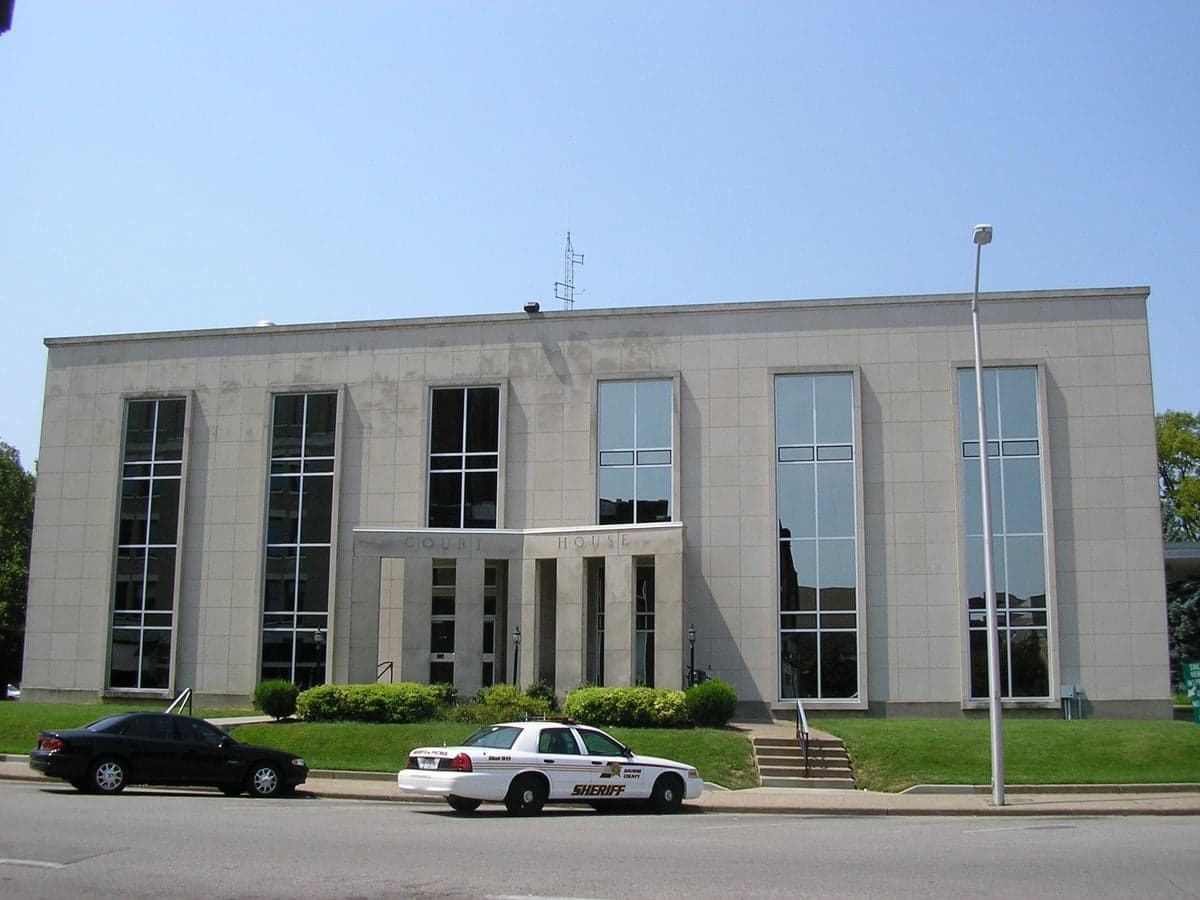
Photo: Wikipedia
Demographics of Daviess County
Affluence Level in Daviess County
A below-average socioeconomic profile. Incomes, home values, and educational attainment trail the U.S., with higher poverty and unemployment.
People of Daviess County
The people of Daviess County, Kentucky, today number 103,195, forming a community that is predominantly white (85.5%) with a notably small foreign-born population of just 2.5%. The county's identity is rooted in a blend of early American settlers, a significant Catholic German Catholic heritage centered in the city of Owensboro, and a modest but growing Hispanic (4.0%) and Black (4.3%) presence. This is a region where a strong sense of local history, family ties, and a slower pace of life define the character, distinct from the faster-growing metros of Louisville or Lexington.
Settlement & growth (pre-1960)
Before European settlement, the area that is now Daviess County was part of the hunting grounds of the Osage and Shawnee nations, who used the region's abundant game and the Ohio River for travel. The first permanent American settlers arrived in the late 18th century, shortly after the Revolutionary War, primarily of Scots-Irish and English descent. These pioneers were drawn by the promise of fertile bottomland along the Ohio River and its tributaries, and they established small farming communities. The county was officially formed in 1815, named for Major Joseph Hamilton Daveiss, a commander killed at the Battle of Tippecanoe.
The most transformative wave of settlement came in the mid-19th century, beginning around the 1840s. A large number of German Catholic immigrants, fleeing economic hardship and political unrest in their homeland, were drawn to the area by the promise of affordable farmland and the opportunity to work in the region's growing industries. They established a strong presence in and around the county seat of Owensboro, as well as in the smaller communities of Whitesville and St. Joseph. These German settlers were instrumental in building the area's Catholic institutions, including numerous churches and schools, and they brought with them a tradition of winemaking and brewing that became a local hallmark. By the late 19th and early 20th centuries, the county's economy was anchored by tobacco farming, coal mining, and the burgeoning bourbon and whiskey distilling industry, with Owensboro emerging as a major river port and manufacturing hub. This period solidified the county's cultural identity as a place of hard work, religious faith, and community cohesion, with the German Catholic influence remaining a distinctive marker even today.
Modern era (post-1965)
The post-1965 era, following the Hart-Cellar Act, brought only modest demographic change to Daviess County compared to the rest of the nation. The county did not experience the large-scale immigration waves seen in major metropolitan areas. Instead, its population growth has been driven primarily by domestic migration and natural increase. The most significant domestic trend has been a slow but steady movement of people from more rural parts of western Kentucky into Owensboro, seeking employment in healthcare, education, and manufacturing. The county's foreign-born population remains very low at 2.5%, a figure that has not shifted dramatically in recent decades.
The most notable demographic shift since 1965 has been the gradual increase in the Hispanic population, which now stands at 4.0%. This growth is largely tied to employment in the county's agricultural sector, particularly in tobacco and grain farming, as well as in the construction and service industries. These families have concentrated primarily in and around Owensboro, where a small but established Hispanic community has formed, with local businesses and churches serving as cultural anchors. The Black population, at 4.3%, has a longer history in the county, with roots in the post-Civil War era and the Great Migration, and today is largely concentrated in Owensboro's older neighborhoods. The East/Southeast Asian community (1.8%) and the Indian subcontinent community (0.3%) are small but present, often connected to professional roles in the county's healthcare system, particularly at Owensboro Health Regional Hospital. Suburbanization has been a key trend, with new residential developments spreading outward from Owensboro into unincorporated areas and smaller towns like Utica and Philpot, creating a pattern of growth that is more dispersed than concentrated.
The future
Looking ahead, Daviess County's population is projected to remain relatively stable, with slow growth driven by natural increase and modest domestic in-migration. The county is not expected to become dramatically more diverse in the near future, though the Hispanic population is likely to continue its gradual increase, potentially reaching 5-6% over the next decade. The white population, while still the overwhelming majority, will likely see a slight proportional decline as other groups grow. New residents are expected to continue settling in the suburban and exurban fringes of Owensboro, as well as in established communities like Maceo and Sorgho, where new housing developments are being built. The county's cultural identity, deeply rooted in its German Catholic heritage and its history as a river and manufacturing town, is likely to persist, even as it slowly becomes more inclusive of its growing Hispanic and other minority communities. The challenge for the county will be to attract and retain younger families and workers to sustain its economy and community life.
For someone moving in now, Daviess County offers a stable, family-oriented community with a strong sense of place and a slower pace of life. It is a place where the past is still very much present, and where the future is likely to be an evolution of that heritage rather than a radical departure. The county is becoming a slightly more diverse, suburbanized version of its historic self, offering a blend of small-town values and access to the amenities of a regional hub in Owensboro.

* Values derived from national, state, county, city and local statistics and may differ in a specific area. Last updated: 2026-08-09T13:37:07.000Z
Narrative content on this page is AI-generated and may contain mistakes. Verify any details that matter before acting on them.
ReloMaps may earn a commission from affiliate links at no extra cost to you.

