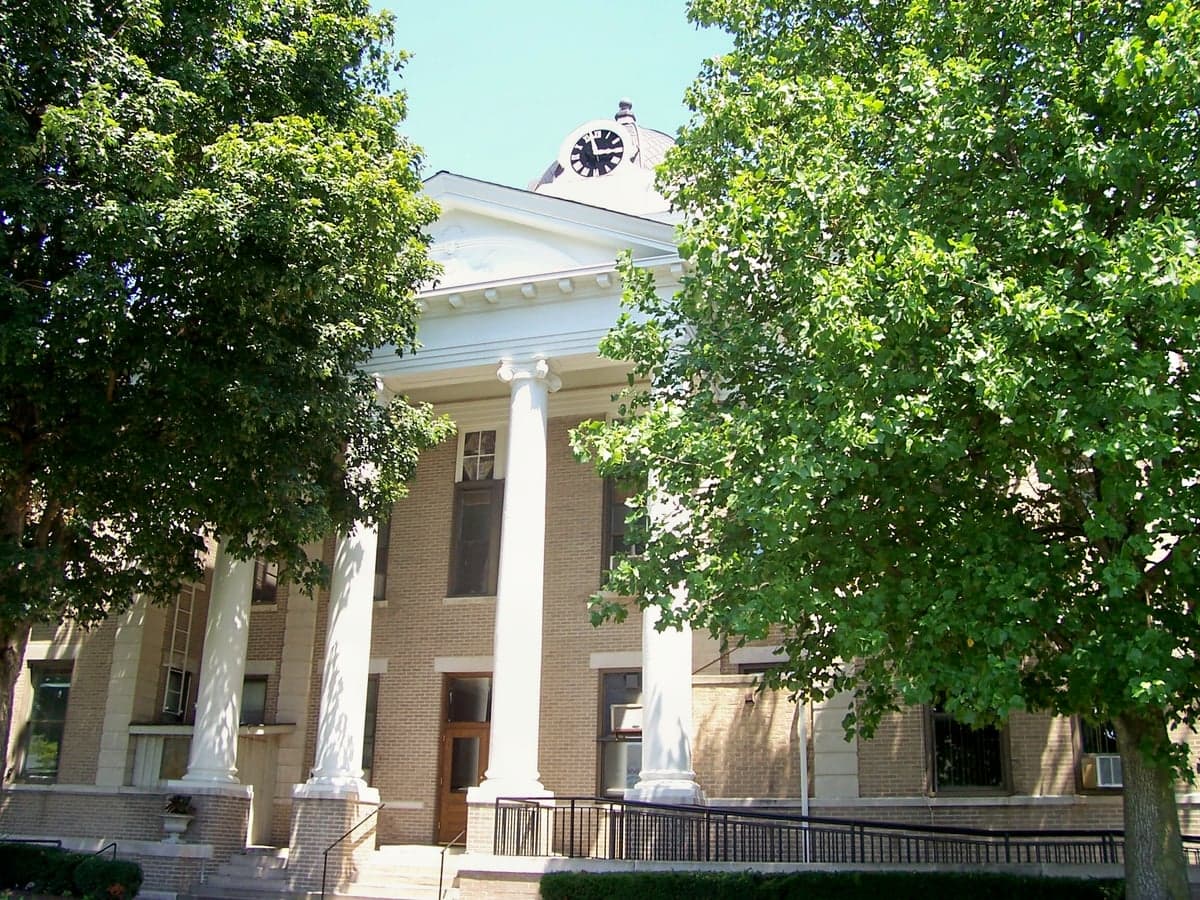
Photo: Wikipedia
Political ClimatePolitical Climate in Calloway County
Showing district-level results — no local-only data available.
Local Political AnalysisPolitical Analysis of Calloway County
Calloway County is a reliably Republican stronghold, with a Cook PVI of R+23 that makes it significantly more conservative than Kentucky as a whole (R+15). This isn't a recent shift; the county has voted Republican in every presidential election since 2000, and the margin has only widened. In 2024, Donald Trump carried the county by roughly 40 points, reflecting a deep-seated cultural and political alignment that shows no signs of softening. The real story, though, isn't just the red tint—it's the subtle variation within the county, where a few pockets of blue and a handful of swing precincts tell a more nuanced tale.
How it compares
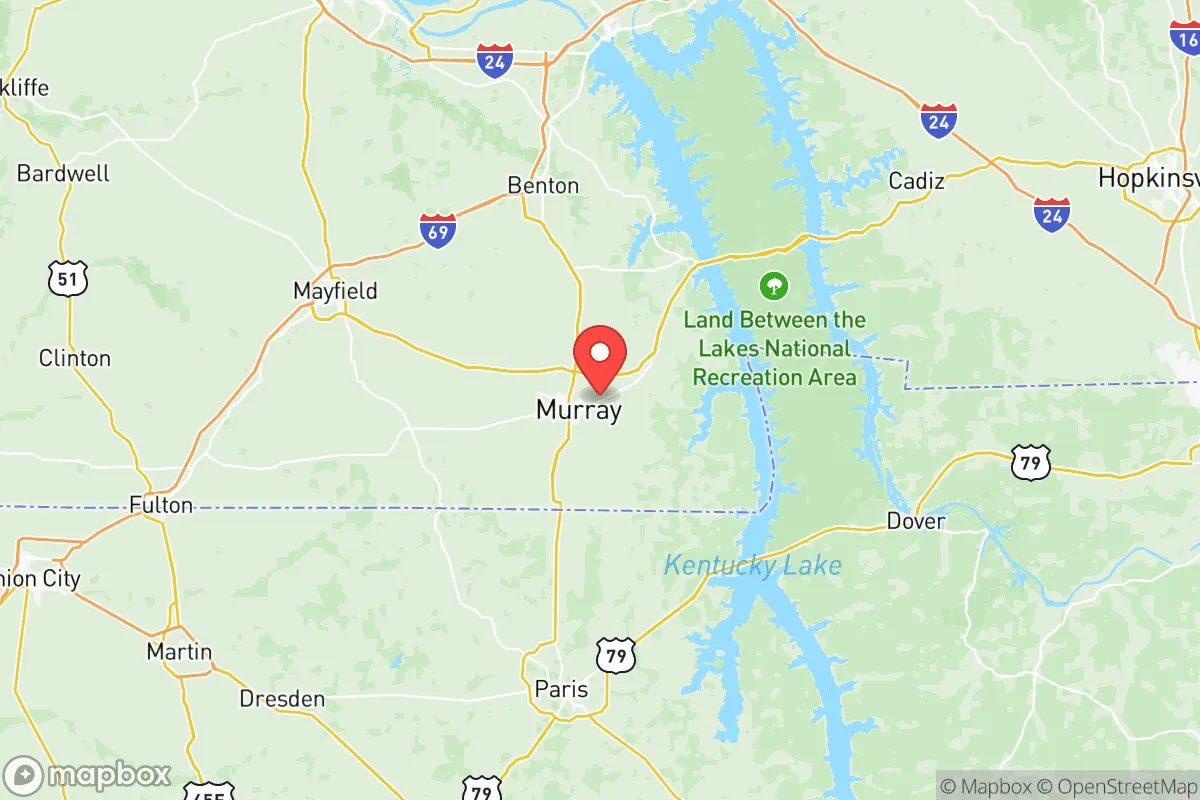
Compared to Kentucky's statewide R+15, Calloway County's R+23 is a full eight points more conservative. That gap isn't uniform across the county. The city of Murray, home to Murray State University, is the clear blue dot. Precincts around campus and downtown Murray regularly vote Democratic, sometimes by 10-15 points, driven by faculty, students, and younger professionals. In contrast, Hazel and Farmington are deep red, often delivering 75-80% of their votes to Republican candidates. The swing precincts are in the unincorporated areas around Almo and Kirksey, where local economic concerns—like soybean prices and healthcare access—can tip a precinct from red to purple in a close race. Statewide, Kentucky's R+15 is pulled left by Louisville and Lexington; Calloway County lacks any comparable urban counterweight, so its conservatism is more consistent and less contested.
What this means for residents
For conservative residents, the political climate means their values are reflected in local governance—the county commission, school board, and sheriff's office are all reliably Republican. Tax policy is generally low-regulation, and Second Amendment rights are broadly supported. For liberal residents, the reality is more isolating. While Murray provides a small liberal bubble, countywide elections are rarely competitive, and progressive candidates often struggle to gain traction outside the city limits. That said, the university's presence ensures a baseline of diversity and tolerance; you won't see overt hostility, but you will feel outnumbered. Practical effects include limited public transit funding (rural priorities dominate) and a school system that emphasizes traditional curricula. Both sides can agree that local politics are less polarized than national—neighbors might disagree on presidential candidates but still cooperate on a new fire station or road paving.
Culturally, Calloway County stands apart from Kentucky's more moderate regions. There's a strong Baptist and Methodist church presence that shapes community life, from Sunday closures to charity drives. The county's proximity to Land Between the Lakes fosters an outdoor, self-reliant ethos that aligns with its conservative lean. Unlike the more competitive suburbs of Louisville or the Appalachian coalfields, Calloway County's politics are stable and predictable—a place where the national culture war feels distant, even as local elections quietly reinforce the status quo. For anyone moving here, the takeaway is simple: if you're conservative, you'll feel at home; if you're liberal, you'll find your people in Murray, but you'll be swimming against a strong current everywhere else.

State Political ClimatePolitical Climate in Kentucky
State Political AnalysisPolitical Environment in the State
Kentucky is a deeply red state with a Cook PVI of R+15, meaning it votes about 15 points more Republican than the national average in presidential elections. The state hasn't backed a Democrat for president since Bill Clinton in 1996, and that margin has only widened: Donald Trump won the state by 26 points in 2024, up from 15 points in 2016. But this isn't a simple story of uniform conservatism — the state's politics are a tug-of-war between its historically Democratic, union-heavy urban cores and its increasingly Republican rural and suburban expanses, with a libertarian streak that runs through both sides.
Urban vs. rural divide
The political map of Kentucky is a study in contrasts. Louisville (Jefferson County) and Lexington (Fayette County) are the state's blue anchors, consistently voting Democratic by double digits. Louisville's 2024 vote was about 60-40 Democratic, driven by its diverse population, major universities, and a strong union presence in manufacturing and logistics. Lexington, home to the University of Kentucky, leans similarly. But outside these two metros, the state is overwhelmingly red. Bowling Green, home to Western Kentucky University and a growing industrial base, has trended right — it voted for Trump by about 20 points in 2024. Northern Kentucky (Covington, Newport, Florence) is a fascinating microcosm: once a Democratic stronghold tied to Cincinnati's labor unions, it has flipped hard red over the past decade, with suburban counties like Boone and Kenton now reliably Republican. The eastern coalfields (Pikeville, Hazard, Prestonsburg) were historically Democratic but have shifted dramatically — they now vote Republican by 40-50 points, driven by cultural conservatism and resentment of federal environmental regulations. Western Kentucky (Paducah, Murray, Hopkinsville) is solidly red, with the exception of Murray State University's college town influence, which creates a small blue pocket. The only other notable blue dot is Frankfort, the state capital, where state workers and a small liberal arts college tilt the vote slightly Democratic.
Policy environment
Kentucky's policy environment is a mix of low-tax conservatism and lingering Appalachian populism. The state has a flat income tax that is being phased down from 5% to 4% by 2026, with a goal of elimination. Sales tax is 6%, and property taxes are among the lowest in the nation. The state is a right-to-work state, passed in 2017, which weakened union power — a major shift in a state with a strong labor history. Education policy is a flashpoint: the state has a robust school choice movement, with charter schools legalized in 2017 (though few have opened) and a new education savings account (ESA) program passed in 2024 for low-income families. Healthcare is dominated by the expansion of Medicaid under the Affordable Care Act, which former Governor Matt Bevin (R) tried to roll back but failed; the state remains expanded, covering about 1.5 million people. Election laws are moderately restrictive: Kentucky requires a photo ID to vote, has no-excuse absentee voting only for certain groups, and has a 28-day early voting period. The state has not adopted universal mail-in voting.
Recent policy direction
The last five years have seen a sharp rightward shift on cultural and liberty issues. Gun and self-defense law: Kentucky is a constitutional carry state (permitless carry for adults 21+), passed in 2019. Stand-your-ground laws were strengthened in 2020, and there is no state-level red flag law. Parental and education rights: The state passed a "Parents' Bill of Rights" in 2023, requiring schools to notify parents of curriculum changes and allowing them to opt children out of certain materials. A 2024 law bans transgender girls from female sports in K-12 and prohibits gender-affirming care for minors. Speech and privacy: Kentucky has no broad surveillance law, but local police use license plate readers and body cameras widely. The state passed a law in 2023 restricting TikTok on government devices. Medical and bodily autonomy: Abortion is banned at all stages of pregnancy with no exceptions for rape or incest, only for medical emergencies — a near-total ban passed in 2019 (trigger law) that took effect after Dobbs. Medical marijuana was legalized in 2023 for qualifying conditions, but dispensaries won't open until 2025. Property rights: The state has strong property rights protections, including a 2018 law limiting eminent domain for private development. Taxation: The income tax phase-down is the biggest story — the state is on a path to zero income tax, which will shift the burden to sales and property taxes. Voting and ballot access: A 2024 law tightened voter ID requirements and limited third-party ballot collection, which critics say suppresses rural and minority turnout.
Civil unrest & political movements
Kentucky has seen its share of political flashpoints. The 2020 Breonna Taylor protests in Louisville were among the largest in the nation, with months of demonstrations, property damage, and a heavy police response. That event galvanized a local activist movement, but also hardened suburban opposition to defund-the-police rhetoric. The state has a strong Second Amendment sanctuary movement — over 50 counties have passed resolutions declaring themselves sanctuaries from federal gun laws. Immigration politics are less heated than in border states, but a 2024 law requires local law enforcement to cooperate with ICE detainers, and there are no sanctuary cities. Election integrity controversies flared after 2020, with the state GOP pushing for stricter voter rolls and audits; a 2022 audit found no widespread fraud. Secession or nullification rhetoric is minimal — Kentucky is not a hotbed of such movements, though some rural counties have floated "county secession" from Louisville over COVID-19 mandates. The most visible political movement is the school choice push, which has strong grassroots support from conservative Christian groups and libertarian-leaning parents.
Projection
Over the next 5-10 years, Kentucky will likely get redder, but not uniformly. In-migration is a factor: the state is seeing modest growth from retirees and remote workers from the Midwest and Northeast, drawn by low housing costs and low taxes. These newcomers tend to be conservative but not as culturally hardline as native Kentuckians — they may push for more moderate positions on education and healthcare. The Louisville and Lexington suburbs are slowly diversifying, but the rural exodus continues, concentrating Democratic votes in the cities and making the rest of the state even redder. The income tax phase-down will likely be completed, making Kentucky a no-income-tax state by the early 2030s, which will attract more business but strain funding for schools and roads. The coal country decline will continue, with economic diversification efforts (e.g., battery manufacturing in Bowling Green, data centers in Northern Kentucky) slowly shifting the economic base. The abortion ban is unlikely to be reversed at the state level, but medical marijuana and potential recreational legalization (a bill is expected in 2025) could broaden the state's appeal to libertarian-leaning conservatives. The biggest wildcard is education: if the ESA program expands, it could reshape the political landscape by drawing more families into the school choice camp, further entrenching conservative dominance.
For a new resident, the bottom line is this: if you're a conservative, you'll find a state that largely aligns with your values on taxes, guns, and cultural issues, with a government that is actively moving in your direction. If you're a liberal, you'll find two blue cities where you can live comfortably, but state-level politics will feel hostile — your vote will have little impact on statewide races, and you'll need to accept that your rights on abortion and transgender issues are severely restricted. The state is stable, safe, and affordable, but the political temperature is rising, especially around education and local control. Pick your county carefully — the difference between living in Louisville's Highlands and rural Pike County is as wide as the difference between two different states.
* Values derived from national, state, county, city and local statistics and may differ in a specific area. Last updated: 2026-08-24T13:15:29.000Z
Narrative content on this page is AI-generated and may contain mistakes. Verify any details that matter before acting on them.
ReloMaps may earn a commission from affiliate links at no extra cost to you.

