
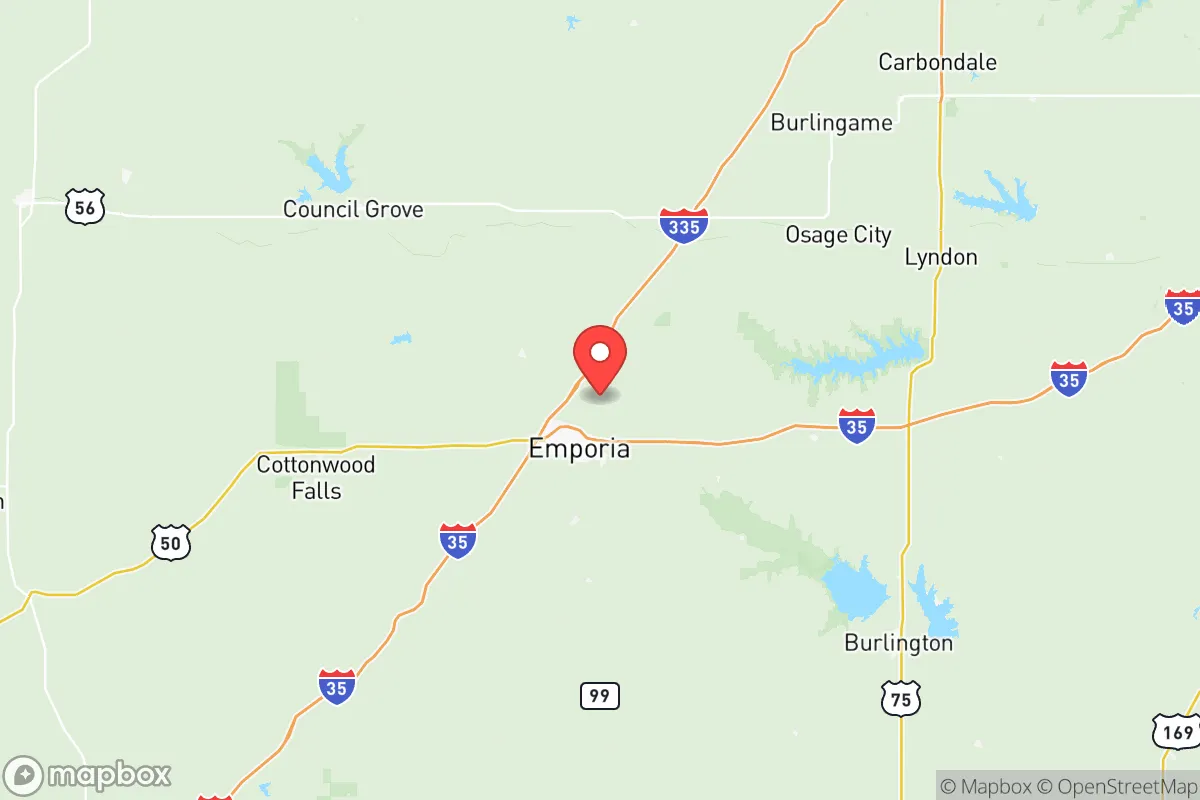
Photo: Wikipedia
Personal Sovereignty in Lyon County
Viable for self-reliance. Generally workable, though some barriers may limit total independence.
What does Personal Sovereignty tell us?
Personal Sovereignty measures your capacity for self-reliance and independence with minimal government friction. Higher scores mean fewer barriers between you and the way you want to live... but it assumes you have the space you need and good neighbors.
What does this tell us?
Personal Sovereignty measures your capacity for self-reliance and independence with minimal government friction. Higher scores mean fewer barriers between you and the way you want to live... but it assumes you have the space you need and good neighbors.
State Policy
Energy independence: Self-sufficient (80% of energy produced in-state)
Personal Liberty
Homesteading

Personal Liberty Analysis
Lyon County, Kansas offers a notably high degree of personal sovereignty compared to much of the country, particularly for those seeking to minimize government overreach in daily life. The county’s regulatory environment, tax structure, and cultural norms create a landscape where self-reliance is not just tolerated but expected. For individuals and families evaluating relocation from high-control states, the autonomy found here—from firearm ownership to off-grid living—represents a tangible departure from the encroaching mandates seen in places like Johnson County or the Kansas City metro.
Tax burden and regulatory posture: How Lyon County compares to surrounding areas
Lyon County’s tax burden is among the more favorable in Kansas for those prioritizing financial sovereignty. The county’s mill levy for 2025 sits at approximately 48 mills, which is moderate for rural Kansas but significantly lower than the 70+ mills found in Douglas County (Lawrence) or the 60+ mills in Shawnee County (Topeka). Property taxes on a $150,000 home in Emporia, the county seat, run roughly $2,400 annually—about half what a comparable property would cost in Johnson County. Sales tax in Emporia is 8.5% (state + county + city), but unincorporated areas like Neosho Rapids or Reading see lower combined rates due to no city tax. The regulatory posture is equally lean: Lyon County has no county-wide zoning in unincorporated areas, meaning property owners in places like Allen or Olpe can build structures, park RVs, or keep livestock without the permitting headaches common in incorporated towns. Emporia itself has zoning, but it’s applied with a light hand—no overly restrictive setback rules or HOA-style mandates. For a prepper or homesteader, this regulatory vacuum is a strategic asset.
Self-defense and gun law specifics: What you can and cannot do in Lyon County
Kansas is a constitutional carry state, and Lyon County fully embraces that framework. No permit is required to carry a concealed firearm for anyone 21 or older who can legally possess a firearm. Open carry is also lawful without a permit. The county sheriff’s office in Emporia is known for a pro-Second Amendment stance; there are no local ordinances restricting magazine capacity, firearm types, or storage requirements. Stand-your-ground law applies statewide, meaning no duty to retreat in any place you are lawfully present. For those concerned about defensive use, Lyon County’s courts have historically been sympathetic to self-defense claims—prosecutions for justified shootings are rare. The only notable restriction is that carrying in K-12 schools remains prohibited without a school security license, though churches and private property owners can set their own rules. Gun ranges are accessible: the Lyon County State Fishing Lake has a public range, and private clubs near Hartford offer longer-distance shooting. Compared to states like California or New York, this is a sanctuary for firearm freedom.
Self-reliance and homesteading viability: Lot sizes, zoning, and off-grid feasibility
Lyon County is a strong candidate for off-grid and homesteading lifestyles, particularly outside Emporia’s city limits. In unincorporated areas, there are no county building codes for single-family dwellings, no mandatory inspections, and no requirement to connect to municipal water or sewer. Wells and septic systems are permitted through the Kansas Department of Health and Environment, but the process is straightforward and inexpensive—typically under $500 for a permit. Lot sizes vary: agricultural parcels in the Bushong area can be 5 to 40 acres, while smaller tracts near Americus offer 1- to 3-acre homesteads. Solar panels and wind turbines are unregulated at the county level, though Emporia’s city code requires a permit for grid-tied systems. Rainwater collection is legal without restriction. For those seeking total grid independence, properties in the Lebo or Reading areas are ideal—no HOAs, no zoning overlays, and neighbors who keep to themselves. The only practical limitation is water availability: the Flint Hills region has variable groundwater, so a well test before purchase is wise. But for a prepper wanting to build a bunker, raise chickens, and live off the land, Lyon County offers few bureaucratic obstacles.
Personal liberties: Parental rights, medical autonomy, speech, and property
Parental rights in Lyon County are robust, reflecting Kansas’s broader legal framework. The state has a Parental Bill of Rights (K.S.A. 38-2201 et seq.) that affirms parents’ authority over their children’s education, healthcare, and religious upbringing. School boards in Emporia and rural districts like North Lyon County (Americus) have resisted federal overreach on curriculum mandates, and mask or vaccine mandates were never enforced in the county’s schools during the COVID era. Medical autonomy is similarly strong: Kansas has no state-level vaccine passport system, and Lyon County’s health department does not mandate any adult vaccinations. The state’s emergency powers law was reformed in 2021 to limit governors’ ability to shut down businesses or impose lockdowns without legislative approval—a direct response to 2020 overreach. Free speech is protected under the Kansas Constitution, which has its own free speech clause that courts have interpreted broadly. Property rights are reinforced by the state’s Private Property Protection Act, which requires compensation for any regulatory taking. In practice, this means Lyon County officials are hesitant to impose land-use restrictions that could trigger legal challenges. For a conservative concerned with government creep, this is a rare pocket of resistance.
Overall, Lyon County ranks among the top 10% of Kansas counties for personal sovereignty, especially when compared to the regulatory density of the I-35 corridor or the Kansas City suburbs. The combination of low taxes, minimal zoning, constitutional carry, and strong parental rights creates an environment where individuals can live largely unbothered by state or county overreach. For a prepper or survivalist weighing relocation, the trade-off is clear: you sacrifice some urban amenities and job diversity (Emporia’s economy is anchored by Tyson Foods and Emporia State University), but you gain a level of autonomy that is increasingly rare in the United States. If the trend toward centralized control continues, Lyon County’s hands-off posture will only become more valuable.

* Values derived from national, state, county, city and local statistics and may differ in a specific area. Last updated: 2026-05-23T10:40:30.000Z
Narrative content on this page is AI-generated and may contain mistakes. Verify any details that matter before acting on them.
ReloMaps may earn a commission from affiliate links at no extra cost to you.

