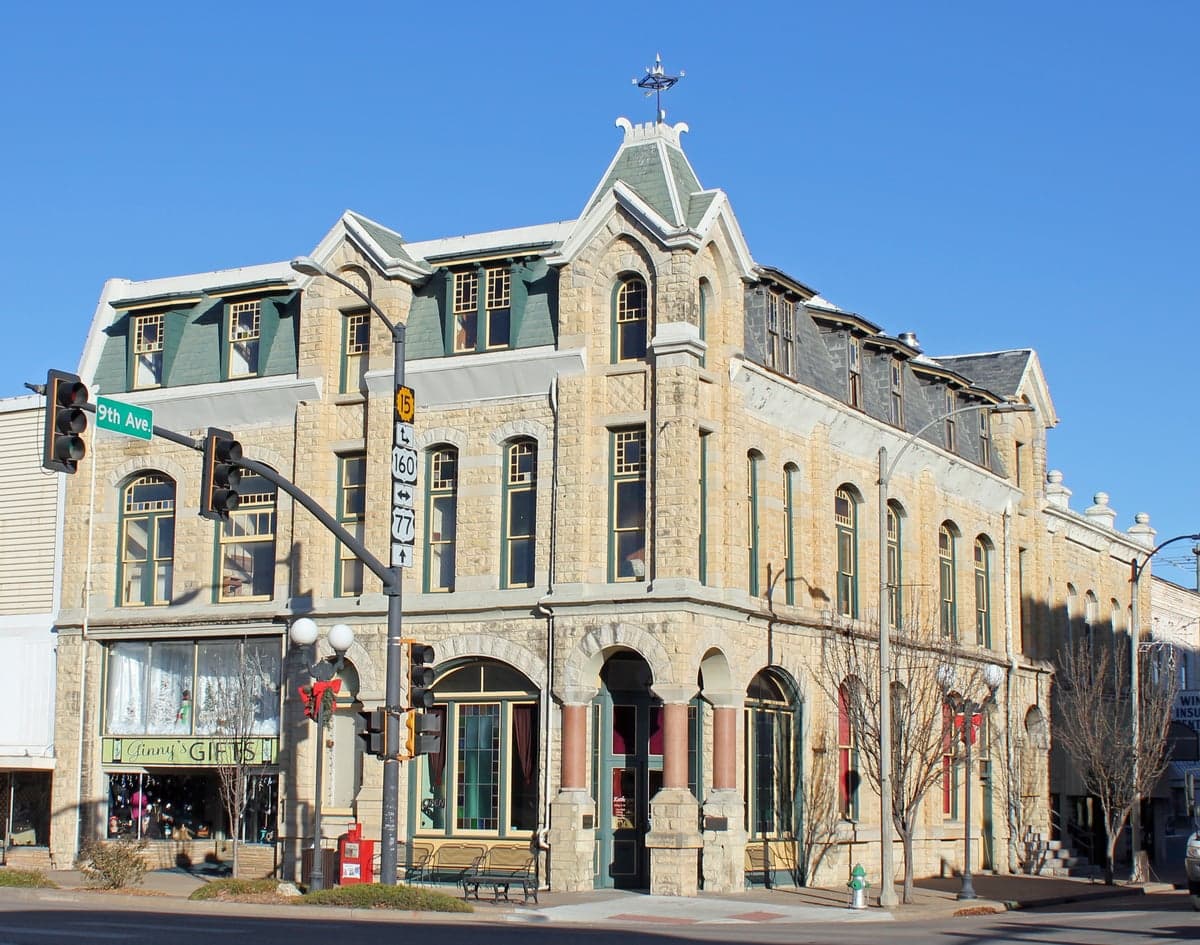
Photo: Wikipedia
Political ClimatePolitical Climate in Cowley County
Showing district-level results — no local-only data available.
Local Political AnalysisPolitical Analysis of Cowley County
Cowley County has long been a solidly conservative stronghold, with a Cook PVI of R+12 that puts it three points to the right of Kansas as a whole. That R+12 rating isn't just a number—it reflects a deep-rooted, no-nonsense political culture that values personal liberty, limited government, and a healthy skepticism of federal overreach. While the state of Kansas has drifted slightly more moderate in recent years, Cowley County has held the line, and if you look at the voting patterns in places like Arkansas City and Winfield, you'll see a clear preference for candidates who prioritize local control and constitutional rights over top-down mandates.
How it compares
Compared to Kansas's statewide R+9, Cowley County's R+12 means it's reliably redder, but not in a monolithic way. The county's two main towns tell different stories. Arkansas City leans heavily Republican, with precincts routinely delivering 65-70% of the vote for GOP candidates—this is where you'll find the strongest support for Second Amendment rights and school choice. Winfield, home to Southwestern College, has a few precincts that swing closer to purple, especially near the campus, where younger voters and faculty occasionally push results toward the center. The rural precincts outside both towns—places like Dexter, Udall, and Burden—are deep red, with turnout driven by agricultural concerns and a fierce independence from state-level bureaucracy. The swing precincts are really in Winfield's Ward 2 and Ward 3, where a mix of retirees and college-affiliated residents can tip a local race by a few points, but even there, the overall county trend hasn't budged much since 2020.
What this means for residents
For folks living here, the political climate means less government intrusion in daily life compared to more progressive parts of Kansas. You won't see the same push for vaccine mandates or strict business closures that you might in Johnson County or Lawrence. Property taxes remain a hot-button issue, but the county commission has generally resisted the kind of spending increases that would require heavy-handed revenue grabs. The local school boards in Arkansas City and Winfield have stayed focused on core academics and parental rights, rather than diving into controversial social curricula. That said, there's a growing concern among longtime residents about state-level trends—like the expansion of Medicaid or any move toward red flag gun laws—that could eventually trickle down. The county's conservative majority has been a bulwark against that so far, but it takes constant vigilance at the ballot box.
Culturally, Cowley County still feels like old-school Kansas: church potlucks, Friday night football, and a general distrust of politicians who promise to fix everything from Topeka or D.C. The biggest policy distinction from the rest of the state is the county's strong support for agricultural land use protections and a hands-off approach to zoning in unincorporated areas. If you value the freedom to live your life without a government checklist, this is still one of the better places in Kansas to do it. But the pressure is mounting—as more people move in from blue states, the local political culture could shift. For now, though, Cowley County remains a place where your rights come first, and the government knows its place.

State Political ClimatePolitical Climate in Kansas
State Political AnalysisPolitical Environment in the State
Kansas is a solidly Republican state with a Cook PVI of R+9, but don’t let that number fool you into thinking it’s a monolith. Over the past 20 years, the state has swung hard right on cultural and fiscal issues, then moderated slightly, and is now in a tug-of-war between a deeply conservative rural base and a growing, more progressive urban corridor. The dominant coalition remains the traditional GOP, but internal fights between the mainstream chamber-of-commerce wing and the more populist, liberty-minded faction have defined the last decade. If you’re looking for a place where conservative values still hold the levers of power, Kansas is a strong bet—but you’ll want to know exactly where you’re planting your flag.
Urban vs. rural divide
The political map of Kansas is a textbook study in contrast. The eastern third of the state, anchored by Johnson County (suburban Kansas City), is the state’s population center and its most politically competitive region. Johnson County has been trending left for a decade—it voted for Biden in 2020 by a narrow margin and has sent moderate Republicans and even Democrats to the state legislature. Lawrence, home to the University of Kansas, is a deep-blue island, reliably voting 70%+ Democratic in statewide races. Kansas City, Kansas (Wyandotte County) is similarly Democratic, driven by a large minority population and union-heavy industrial base. Meanwhile, Wichita (Sedgwick County) is a bellwether—it leans Republican but has a sizable moderate wing, and its suburbs like Derby and Andover are reliably red. The rest of the state—the vast rural expanse from Dodge City in the west to Manhattan in the Flint Hills—votes 70-80% Republican. Sedgwick County outside Wichita and Shawnee County (Topeka) are purple-ish, but the rural counties overwhelmingly decide statewide races. The divide isn’t just geographic; it’s cultural. Rural Kansans see the state as a last bastion of traditional values, while urbanites increasingly push for progressive policies on education and social issues.
Policy environment
Kansas’s policy environment is a mixed bag for conservatives, but the trend is positive. The state has a flat income tax rate of 5.7% (down from a top rate of 6.45% a decade ago), and the sales tax is 6.5% statewide, with local add-ons. Property taxes are moderate but a perennial complaint. The big story was the 2012-2017 “Kansas Experiment” under Governor Sam Brownback, which slashed income taxes and promised economic growth. It didn’t pan out as hoped—revenues cratered, and the legislature reversed many cuts in 2017. But the lesson learned was that tax cuts without spending restraint don’t work. Today, the state is fiscally conservative but not radical. On education, Kansas has a mixed record: school choice is limited compared to states like Florida, but there are charter schools in Wichita and Kansas City, and homeschooling is lightly regulated. The state has a constitutional carry law (permitless concealed carry since 2015) and strong Second Amendment protections. On healthcare, Kansas refused Medicaid expansion under the ACA, a win for fiscal conservatives, but rural hospital closures remain a concern. Election laws are solid: voter ID is required, and the state has clean voter rolls. There’s no state-level abortion ban (the Kansas Supreme Court found a right to abortion in the state constitution in 2019, and voters rejected a constitutional amendment to overturn it in 2022), which is a sore point for many conservatives. Overall, the policy environment is center-right, with room for improvement on school choice and tax reform.
Trajectory & freedom
Kansas has been on a rollercoaster regarding personal freedom, but the long-term trend is toward more liberty, especially on gun rights and parental rights. The 2015 permitless carry law was a landmark win. In 2021, the legislature passed the Parental Bill of Rights, which affirms parents’ authority over their children’s education and medical decisions—a direct response to COVID-era school closures and mask mandates. On medical freedom, Kansas was one of the first states to ban COVID-19 vaccine mandates for state employees and contractors (2021). Property rights are strong; there’s no state-level rent control, and zoning is largely local. However, the 2019 Kansas Supreme Court decision on abortion was a major setback for the pro-life movement, and the 2022 “Value Them Both” amendment’s failure showed that even in a red state, abortion rights have significant support, especially in the suburbs. On the downside, the state has seen creeping government overreach in the form of local mask mandates and business closures during the pandemic, though those have been repealed. The legislature is currently considering a “Second Amendment Preservation Act” to nullify federal gun laws, which would be a major expansion of state-level sovereignty. Overall, Kansas is moving in the right direction on most freedom metrics, but the abortion issue remains a flashpoint.
Civil unrest & political movements
Kansas is not a hotbed of civil unrest, but there have been notable flashpoints. The 2020 George Floyd protests in Kansas City, Kansas and Lawrence saw some property damage and clashes with police, but nothing on the scale of Portland or Seattle. The most visible political movement in recent years has been the “No More Red” campaign by the Kansas GOP’s populist wing, which successfully primaried several moderate Republicans in 2022 and 2024, pushing the party further right. On the left, the Kansas Abortion Access Fund and Planned Parenthood have been highly active, especially after the 2022 vote. Immigration politics are relatively quiet—Kansas has no sanctuary cities, and the state passed a law in 2011 requiring proof of citizenship to register to vote. There’s been no serious secession or nullification rhetoric, though some rural counties have discussed “county sovereignty” resolutions in response to state-level mandates. Election integrity is a live issue: the 2020 and 2022 elections saw no major scandals, but the legislature has tightened rules on mail-in ballots and drop boxes. A new resident would notice that political signs are common in rural areas, but in Johnson County, you’ll see a mix of both parties. The overall vibe is civil but polarized.
Projection
Over the next 5-10 years, Kansas will likely become more conservative in the legislature but more divided in statewide races. The key demographic trend is the continued growth of Johnson County, which is attracting young professionals from both coasts. If that trend accelerates, Johnson County could flip permanently blue, making statewide elections competitive. However, the rural counties are not shrinking as fast as in some other Plains states, thanks to a stable agricultural economy and immigration from blue states. The state’s in-migration is modest but positive, with many newcomers from California and Colorado seeking lower taxes and conservative values. Expect the legislature to pass more school choice measures, a possible flat tax reduction, and a renewed push for a constitutional amendment on abortion. The biggest wildcard is the Kansas Supreme Court—if it continues to strike down conservative laws, there will be a push for judicial reform. For a new resident, the bottom line is this: Kansas will remain a solidly red state for the next decade, but the suburbs will become the battleground. If you’re moving to Wichita or Manhattan, you’ll find a reliably conservative environment. If you’re in Overland Park or Lenexa, you’ll be in a purple area that’s trending left. Plan accordingly.
For a conservative individual or family, Kansas offers a strong foundation: low taxes, solid gun rights, parental control in education, and a legislature that generally respects personal liberty. The main trade-offs are the abortion landscape (which is more liberal than the state’s overall lean) and the growing political influence of Johnson County. If you want a place where your values are the norm, pick a rural or small-city location. If you want a more diverse, suburban environment, be prepared for some political friction. Either way, Kansas is a state where your vote still matters—and where the fight for freedom is far from over.
* Values derived from national, state, county, city and local statistics and may differ in a specific area. Last updated: 2026-05-12T02:01:15.000Z
Narrative content on this page is AI-generated and may contain mistakes. Verify any details that matter before acting on them.
ReloMaps may earn a commission from affiliate links at no extra cost to you.

