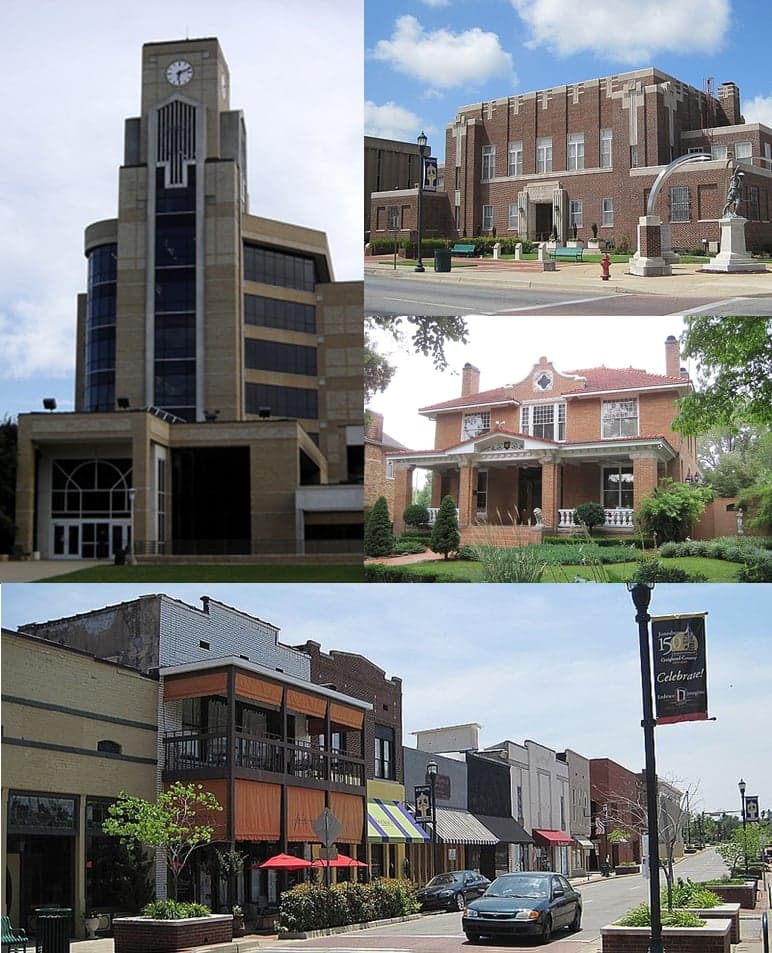
Photo: Wikipedia
Political ClimatePolitical Climate in Jonesboro, AR
District shown is the primary district for this city’s centroid. Cities may span multiple districts.
Local Political AnalysisPolitical Analysis of Jonesboro, AR
Jonesboro, Arkansas, is about as reliably conservative as it gets, with a Cook PVI of R+23 that puts it deep in the red column. The city and surrounding Craighead County have voted Republican in every presidential election since 2000, and that trend has only solidified over the last decade. You won’t find much hand-wringing over the national political mood here—most folks are focused on local issues like keeping taxes low, protecting Second Amendment rights, and making sure the government stays out of their day-to-day lives. The trajectory is steady: Jonesboro is getting more conservative as it grows, not less, which is a relief to those of us who’ve watched other parts of the state drift leftward.
How it compares
Drive an hour west to Fayetteville, and you’re in a completely different world—Washington County leans blue, with a Cook PVI of D+5, and you’ll see more yard signs for progressive candidates and more talk about “equity” initiatives. That’s not Jonesboro. Even compared to Little Rock, which is a purple-ish city with a strong Democratic base, Jonesboro feels like a fortress of common sense. The surrounding towns like Paragould and Blytheville are also conservative, but Jonesboro is the economic and cultural anchor of northeast Arkansas, and it sets the tone. The contrast is stark: while some cities are embracing government overreach on everything from zoning to mask mandates, Jonesboro has largely resisted those trends, and the local leadership seems to understand that personal freedom isn’t a bargaining chip.
What this means for residents
For people living here, the political climate translates into a pretty straightforward daily life. You’re not going to see the city council pushing for new gun control ordinances or trying to impose progressive social policies on local businesses. Property taxes are low, the cost of living is manageable, and there’s a general sense that the government’s job is to keep the roads paved and the schools funded—not to micromanage how you raise your kids or run your small business. That said, there are some warning signs worth keeping an eye on. As Jonesboro grows—it’s one of the fastest-growing cities in Arkansas—there’s always a risk that new residents from more liberal areas bring their politics with them. So far, the city has held the line, but it’s something to watch, especially in local school board and city council races. A shift toward progressive ideology here would be a real gut punch, because it would mean more regulations, higher taxes, and less freedom.
Culturally, Jonesboro is still very much a place where church attendance is high, hunting and fishing are weekend staples, and the phrase “government overreach” gets people riled up at the dinner table. There’s no city-wide plastic bag ban, no talk of defunding the police, and no serious push for rent control—and that’s exactly how most residents want it. The biggest policy distinction you’ll notice is how the city handles growth: it’s pro-business, pro-development, and generally skeptical of any new regulations that might slow things down. If you’re looking for a place where you can live your life without a bunch of bureaucratic nonsense, Jonesboro is still that place. But don’t take it for granted—keep showing up to those city council meetings and voting in every local election, because the moment you stop paying attention is the moment the progressives start making inroads.

State Political ClimatePolitical Climate in Arkansas
State Political AnalysisPolitical Environment in the State
Arkansas has been a reliably red state for decades, but the nature of that conservatism has shifted significantly. The state leans Republican by about 30 points in presidential elections, with Donald Trump winning 62% of the vote in 2024. However, the dominant coalition is no longer the old-school, moderate Democratic machine that ran things through the 1990s. Over the last 10-20 years, the state has moved from a "yellow dog" Democratic tradition—where conservative rural voters backed local Dems—to a solidly Republican stronghold, driven by the realignment of white working-class voters and the collapse of the old party structure. The shift accelerated after 2010, when the GOP took full control of the legislature and governorship, and it has only hardened since.
Urban vs. rural divide
The political map of Arkansas is starkly divided between its few urban centers and the vast rural expanse. Little Rock (Pulaski County) is the state's blue island, voting for Biden in 2020 and Harris in 2024 by comfortable margins, driven by a mix of Black voters, university faculty, and younger professionals. Fayetteville and Bentonville in Northwest Arkansas are more nuanced—Washington County has trended purple, with Fayetteville itself leaning left due to the University of Arkansas, while Bentonville remains reliably red thanks to the Walmart corporate culture and a heavily conservative exurban population. The rest of the state is deeply Republican. Jonesboro in the northeast, Fort Smith in the west, and Texarkana in the southwest all vote GOP by 30-40 points. The rural delta counties—like Lee and Phillips—are the only other Democratic holdouts, but they're shrinking fast. The real story is the suburbs: places like Conway and Cabot have become reliably red, while Rogers and Springdale have seen a surge of conservative-leaning transplants from California and Illinois.
Policy environment
Arkansas's policy environment is aggressively conservative, but with a pragmatic, low-tax bent. The state has a flat income tax of 4.4% (down from 7% a decade ago), and the legislature is pushing toward elimination. Sales tax is high—over 9% in some cities—but there's no property tax on vehicles or business inventory. The regulatory posture is light: no state-level minimum wage above the federal $7.25, and right-to-work laws are firmly in place. Education policy is a flashpoint: the state passed the LEARNS Act in 2023, which created universal school vouchers, banned "critical race theory" in classrooms, and restricted transgender athletes. Healthcare is a mixed bag—Arkansas expanded Medicaid under the private option, but the state has also passed some of the strictest abortion laws in the nation, including a near-total ban with no exceptions for rape or incest. Election laws are tight: voter ID is required, early voting is limited to 14 days, and absentee ballots require a notarized signature or two witnesses. The state also passed a 2021 law restricting ballot drop boxes and limiting mail-in voting.
Trajectory & freedom
On the freedom front, Arkansas is moving in a decidedly libertarian-conservative direction, but with some worrying caveats. The good news: constitutional carry (permitless carry of handguns) became law in 2021, and the state has a strong castle doctrine and stand-your-ground law. Parental rights were strengthened by the LEARNS Act, which gives parents more control over school choice and curriculum transparency. The state also passed a law in 2023 banning COVID-19 vaccine mandates by private employers, a clear win for medical autonomy. Property rights are solid—Arkansas is a "right to farm" state, and there's no state-level zoning authority that can override local control. The bad news: the state's medical marijuana program, passed by ballot initiative in 2016, has been hamstrung by a conservative legislature that refuses to expand qualifying conditions or allow home cultivation. And while the state has no income tax on retirement income, the sales tax burden is regressive and hits low-income families hardest. The biggest red flag for liberty-minded folks is the state's emergency powers—during COVID, Governor Asa Hutchinson kept a state of emergency active for over two years, which gave him unilateral authority to suspend laws. That power has since been reined in by the legislature, but it's a reminder that executive overreach can happen anywhere.
Civil unrest & political movements
Arkansas has seen relatively little civil unrest compared to larger states, but there have been notable flashpoints. The 2020 Black Lives Matter protests in Little Rock turned violent on a few occasions, with property damage and clashes with police, but they were small compared to Portland or Seattle. The state's immigration politics are tense but not explosive—Arkansas has a small but growing Hispanic population (especially in Northwest Arkansas), and the legislature passed a 2023 law requiring local law enforcement to cooperate with ICE. There's no sanctuary city movement to speak of; even Little Rock's Democratic mayor has avoided that label. Election integrity is a live issue: the 2020 and 2022 cycles saw Republican activists pushing for audits and tighter rules, and the state's GOP secretary of state has been a vocal proponent of "clean voter rolls." The most visible political movement is the MAGA-aligned grassroots that has taken over county GOP committees in places like Saline County and Faulkner County, pushing for more aggressive action on abortion, guns, and school choice. On the left, the Arkansas Public Policy Panel and Indivisible groups organize around voting rights and Medicaid expansion, but they have little legislative success.
Projection
Over the next 5-10 years, Arkansas will likely become more conservative, not less. The in-migration from blue states—particularly to Northwest Arkansas—is bringing in a mix of fiscally conservative tech workers and culturally conservative retirees, both of which reinforce the GOP majority. The state's population is growing slowly (about 1% per year), but the growth is concentrated in the reddest areas. The rural delta will continue to shrink and lose political clout, while the suburbs of Little Rock and the I-49 corridor will dominate. The biggest wildcard is the Hispanic population, which is growing fast in Springdale and Rogers—if those voters shift left, it could create a competitive district in Northwest Arkansas, but that's a decade away at best. The legislature will likely continue to push for income tax elimination, further school choice expansion, and tighter election laws. The biggest risk for conservatives is complacency—the state is so red that primary fights often matter more than general elections, and that can lead to infighting and policy overreach.
Bottom line for a new resident: If you're moving to Arkansas, you're coming to a state that is deeply conservative and getting more so. You'll find low taxes, strong gun rights, and a government that generally stays out of your personal life—as long as you're not trying to expand Medicaid or teach critical race theory. The trade-offs are a weak social safety net, high sales taxes, and a political culture that can feel insular and suspicious of outsiders. If you're a conservative looking for a place where your values are the norm and the government is your ally, Arkansas is a solid bet. Just don't expect much diversity of thought in the statehouse, and be prepared for a legislature that is more interested in cultural battles than infrastructure or economic development. It's a good place to raise a family if you value freedom, but it's not a place for people who want the government to solve their problems.
* Values derived from national, state, county, city and local statistics and may differ in a specific area. Last updated: 2026-04-30T01:04:32.000Z
Narrative content on this page is AI-generated and may contain mistakes. Verify any details that matter before acting on them.
ReloMaps may earn a commission from affiliate links at no extra cost to you.

