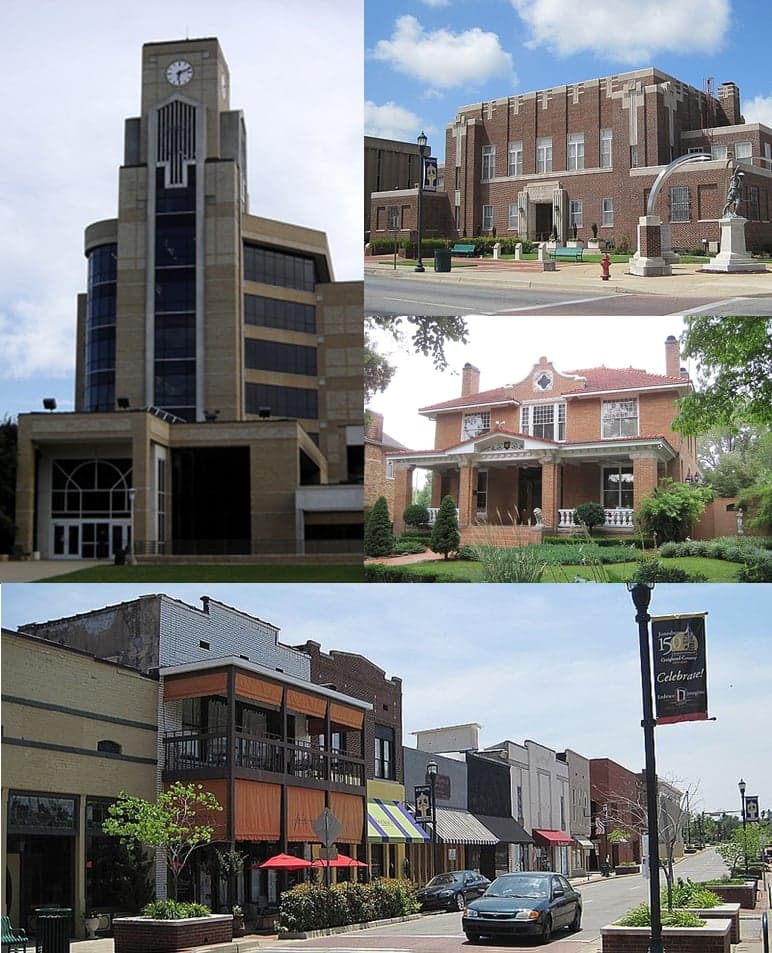
Photo: Wikipedia
Demographics of Jonesboro, AR
Affluence Level in Jonesboro, AR
A below-average socioeconomic profile. Incomes, home values, and educational attainment trail the U.S., with higher poverty and unemployment.
People of Jonesboro, AR
The people of Jonesboro, Arkansas, today number 79,187, forming a majority-white (64.3%) city with a substantial Black minority (22.6%) and a growing Hispanic community (7.4%). The city’s identity is shaped by its role as the regional economic hub of northeast Arkansas—a place where a relatively low foreign-born share (3.0%) and a college-educated rate of 29.8% reflect a population rooted in domestic migration and local university growth. Distinct neighborhoods still echo the settlement patterns of the past, from historic railroad corridors to modern subdivisions.
How the city was settled and grew
Jonesboro was founded in 1859 as a railroad town on the Cairo & Fulton line, drawing its first wave of settlers—mostly white yeoman farmers and merchants from Tennessee, Kentucky, and the Upper South—who cleared the swampy Crowley’s Ridge timberland for cotton. The post-Civil War era brought a second wave: freed Black families who established the South Main and Union Street neighborhoods, building churches, schools, and small businesses along the rail corridor. By the early 1900s, the city’s population was roughly 70% white and 30% Black, with the Black community concentrated in the Booker T. Washington area (named for the school built there in 1916). The Great Depression and subsequent mechanization of cotton farming pushed many Black families northward in the Great Migration, reducing the Black share to about 15% by 1950. Meanwhile, white in-migration from surrounding rural counties—drawn by the expanding retail and manufacturing base—filled new subdivisions like Hillcrest and West Washington, which remain predominantly white today.
Modern era (post-1965)
The 1965 Hart-Cellar Act had a muted effect on Jonesboro; the city’s foreign-born population remains low at 3.0%, and most post-1965 growth came from domestic migration. The 1970s and 1980s saw a significant return of Black families to the city, reversing the Great Migration trend, as manufacturing plants (e.g., Emerson Electric, Hytrol Conveyor) and Arkansas State University expanded. The Parker Road and Stadium Boulevard corridors became hubs for new Black middle-class subdivisions, while the historic South Main area saw disinvestment. Hispanic growth began in the 1990s, driven by poultry processing and construction jobs; the East Highland district emerged as a gateway neighborhood for Mexican and Central American families, with Spanish-language groceries and churches appearing by 2000. The Asian population (East/Southeast Asian, 1.2%) is small but concentrated near the university, with a handful of Vietnamese and Filipino families in the University Heights area. The Indian subcontinent population (0.4%) is even smaller, mostly professionals at A-State or the medical sector, with no distinct ethnic enclave.
The future
Jonesboro’s population is projected to reach 90,000–95,000 by 2040, driven by continued domestic in-migration from the Memphis and Little Rock metros and natural increase among the Hispanic community. The city is not homogenizing; rather, it is tribalizing into distinct enclaves. The white population is aging in place in Hillcrest and West Washington, while younger white families are moving to new subdivisions in the Harrisburg Road corridor. The Black population is growing modestly, with a slight outward shift from Parker Road to newer developments near Red Wolf Boulevard. The Hispanic share is rising fastest—projected to reach 12–14% by 2040—and is consolidating in East Highland and spreading into the Southwest Drive area. The East/Southeast Asian and Indian communities are likely to remain small and assimilated, tied to university and medical employment. The foreign-born share may rise to 5–6%, but Jonesboro will remain a predominantly native-born, domestic-migration city.
For a conservative-leaning mover, Jonesboro is becoming a more diverse but still majority-white regional hub where neighborhoods remain largely defined by race and income. The city offers a stable, family-oriented environment with low crime in the western subdivisions, but the eastern and southern corridors are seeing the most demographic change. New arrivals should expect a place where community identity is strongly tied to neighborhood and church, and where the pace of change is gradual rather than disruptive.

* Values derived from national, state, county, city and local statistics and may differ in a specific area. Last updated: 2026-04-30T01:04:32.000Z
Narrative content on this page is AI-generated and may contain mistakes. Verify any details that matter before acting on them.
ReloMaps may earn a commission from affiliate links at no extra cost to you.

