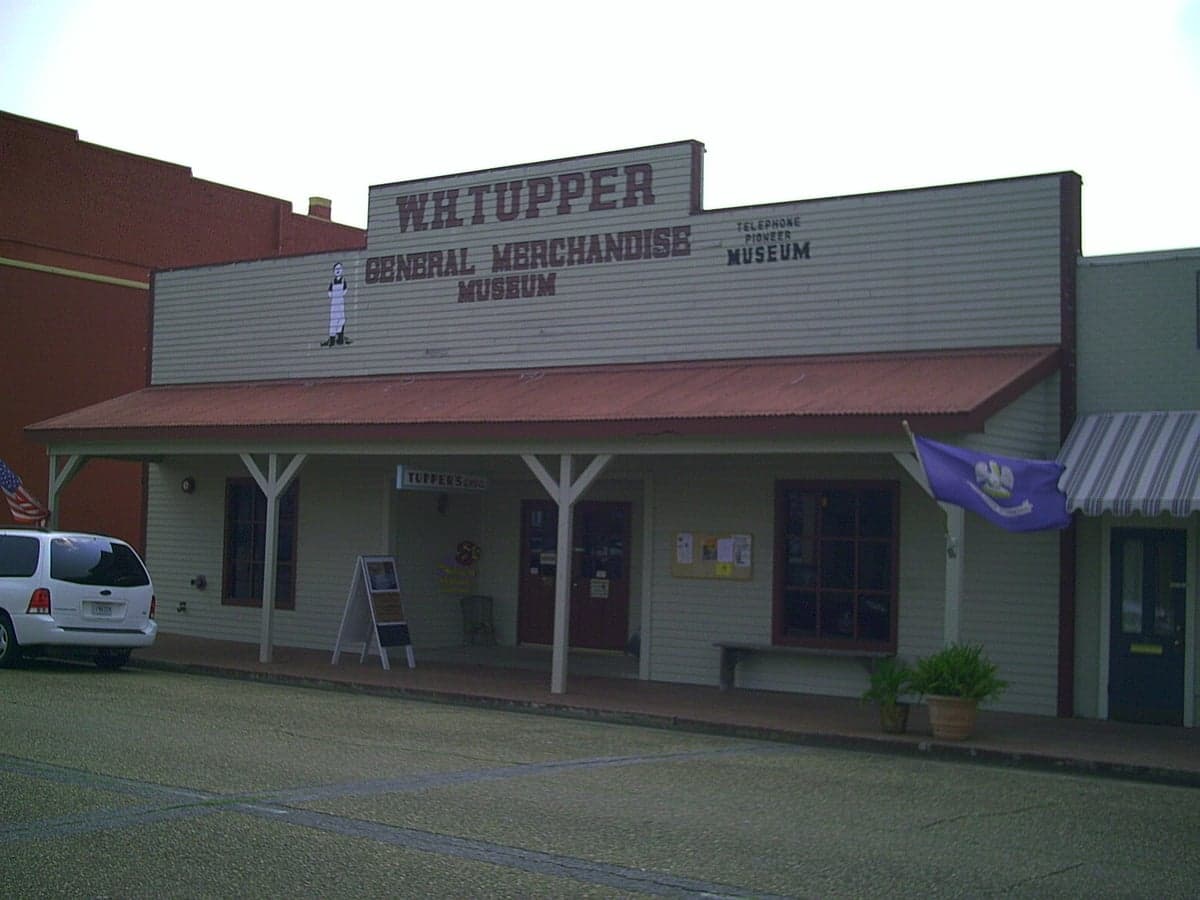
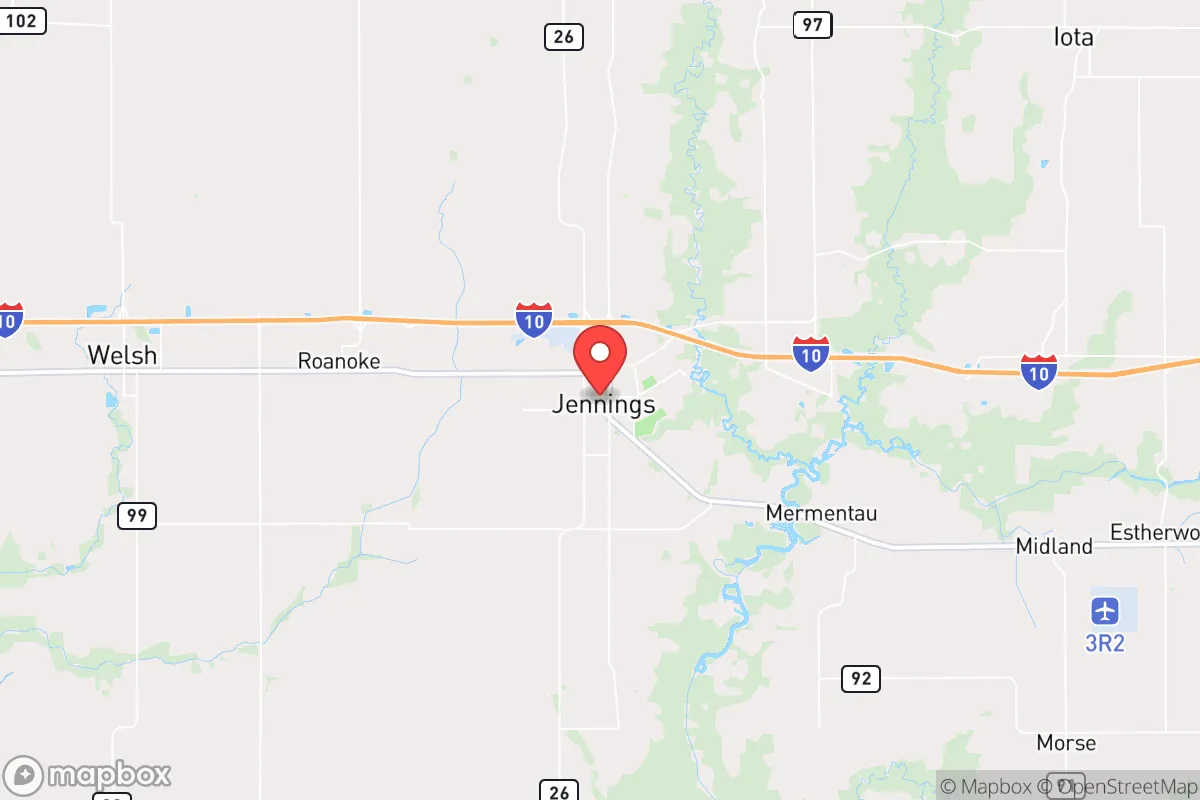
Photo: Wikipedia
Demographics of Jennings, LA
Affluence Level in Jennings, LA
A below-average socioeconomic profile. Incomes, home values, and educational attainment trail the U.S., with higher poverty and unemployment.
People of Jennings, LA
The people of Jennings, Louisiana, today form a small, predominantly native-born community of 9,679 residents, characterized by a strong White majority (65.0%) and a significant Black population (22.4%), with very limited ethnic diversity—only 0.4% of residents are foreign-born. The city’s identity is rooted in its role as the parish seat of Jefferson Davis Parish, with a population that is notably less educated than the national average (14.6% college-educated) and heavily tied to local agriculture, oil, and manufacturing. Distinctive markers include a deep sense of local history, a conservative social fabric, and a population density of roughly 1,200 people per square mile, giving it a small-town feel where neighborhoods like South Jennings and North Jennings retain distinct historical character.
How the city was settled and grew
Jennings was founded in 1884 as a railroad town on the Southern Pacific line, drawing its first wave of settlers primarily from other parts of Louisiana and the Deep South. The discovery of oil in the Jennings Oil Field in 1901 triggered a boom, attracting workers from Texas and Oklahoma, many of whom settled in the Oil City neighborhood near the field’s edge. The original plat of the city centered on the railroad depot, with early commercial development along what is now Main Street. By the 1920s, the population had grown to around 5,000, with a mix of White farmers, Black laborers who worked the rice and cotton fields, and a small number of Cajun families from the surrounding Acadiana region. The Historic District around Cary Avenue and the Southwest Addition were built during this era, housing the merchant class and oil executives, while Black workers concentrated in the East Side neighborhood near the railroad tracks. The city’s growth plateaued after World War II, as the oil industry matured and agriculture mechanized, leaving Jennings as a stable, slow-growing parish seat.
Modern era (post-1965)
After the 1965 Hart-Cellar Act, Jennings saw virtually no new immigration—its foreign-born share remains at 0.4%—meaning the city’s demographic story is one of domestic stability rather than ethnic transformation. The White population has gradually declined from an estimated 75% in 1970 to 65.0% today, while the Black share has risen from roughly 18% to 22.4%, driven by natural increase and some in-migration from rural Jefferson Davis Parish. The Hispanic share, at 4.4%, is a recent development, largely consisting of Mexican-origin families who moved in during the 2000s to work in poultry processing and agriculture; they have concentrated in the West Jennings area near the industrial parks. The East/Southeast Asian population (0.5%) is minimal, with a handful of Vietnamese families who arrived after the 1970s, settling near the South Jennings commercial corridor. Suburbanization has been limited, as the city lacks a major metropolitan commuter base; newer subdivisions like Oakdale Estates (built in the 1990s) have attracted middle-class White and Black families seeking larger lots, but the overall population has remained flat, hovering around 10,000 since 1980.
The future
Jennings’ population is likely to continue its slow decline or stagnation, with projections suggesting a drop to 9,200–9,400 by 2040 as younger residents leave for larger cities like Lafayette or Lake Charles. The city is not homogenizing into a single identity but rather tribalizing into distinct enclaves: the East Side remains predominantly Black, North Jennings is overwhelmingly White and older, and West Jennings is becoming a small Hispanic hub. The immigrant communities are not growing—the 0.4% foreign-born share is among the lowest in Louisiana—and the small Hispanic population is assimilating linguistically but remains residentially clustered. The college-educated share (14.6%) is unlikely to rise significantly without new industry, as the local economy remains anchored in low-skill sectors. The next decade will likely see an aging White population, a stable Black community, and a slight Hispanic increase, but no major demographic disruption.
For someone moving to Jennings now, the city offers a deeply rooted, conservative community with clear neighborhood identities and minimal ethnic change. The population is stable but aging, and new residents should expect a place where local history and family ties matter more than rapid growth or diversity. The best bet for a newcomer is to focus on the South Jennings or Oakdale Estates areas, which offer the most integrated and newer housing stock, while understanding that the city’s future is one of preservation, not transformation.

* Values derived from national, state, county, city and local statistics and may differ in a specific area. Last updated: 2026-05-01T10:58:51.000Z
Narrative content on this page is AI-generated and may contain mistakes. Verify any details that matter before acting on them.
ReloMaps may earn a commission from affiliate links at no extra cost to you.

