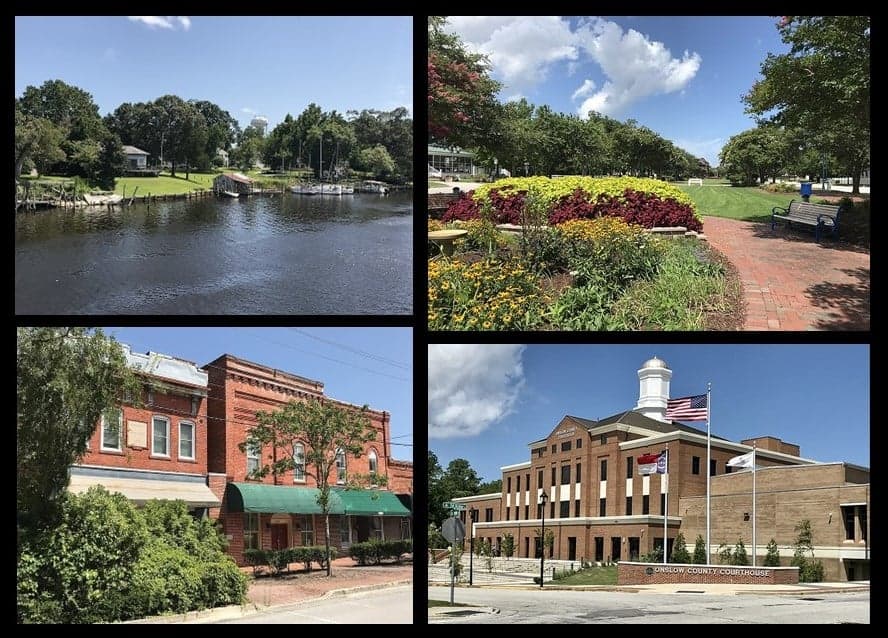
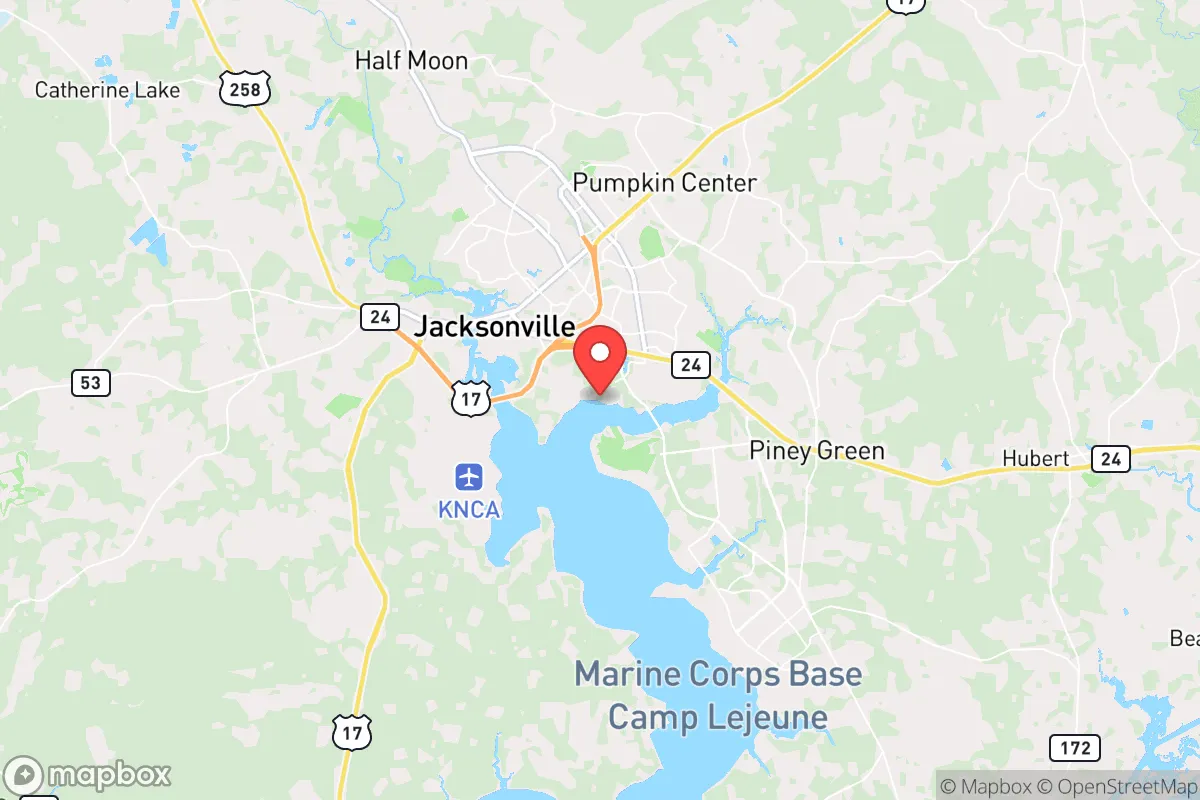
Photo: Wikipedia
Demographics of Jacksonville, NC
Affluence Level in Jacksonville, NC
A middle-class area roughly in line with national averages across income, home values, education, and employment.
People of Jacksonville, NC
The people of Jacksonville, North Carolina, today form a young, transient, and military-centric community of 73,507, shaped overwhelmingly by the presence of Marine Corps Base Camp Lejeune. The city’s character is defined by a high turnover rate, a notable Hispanic minority of 18.8%, and a Black population of 15.6%, with a foreign-born share of just 2.4% that is well below the national average. Distinctive markers include a pronounced patriotism, a service-industry economy built around the base, and a demographic profile that is more racially diverse than the surrounding Onslow County but less ethnically varied than the national average.
How the city was settled and grew
Jacksonville was not a colonial-era settlement. It was incorporated in 1842 as a small trading post for the region’s naval stores and timber industries, drawing a sparse population of white farmers and merchants from the surrounding coastal plain. The city remained a quiet county seat of fewer than 1,000 residents until the U.S. Navy selected the area for a major amphibious training base in 1941. The construction of Camp Lejeune and nearby Marine Corps Air Station New River triggered the city’s first real population wave: tens of thousands of military personnel and civilian contractors poured in during World War II and the Korean War. The historic downtown district along Marine Boulevard was built out during this era to serve the base, with boarding houses, diners, and retail shops catering to Marines and their families. The Piney Green area, just west of the base, became an early concentration of military housing and the families of enlisted personnel. By 1960, the population had surged past 13,000, overwhelmingly white and native-born, with a small Black community concentrated in the Georgetown neighborhood east of the railroad tracks.
Modern era (post-1965)
The post-1965 era in Jacksonville was defined not by immigration from abroad but by domestic in-migration tied to the military. The Hart-Cellar Act had little direct effect here; the foreign-born share remains just 2.4%, and the city’s growth came from the expansion of Camp Lejeune during the Vietnam War and the post-9/11 buildup. The most significant demographic shift has been the growth of the Hispanic population, which rose from negligible levels in 1990 to 18.8% today, driven largely by military families of Puerto Rican and Mexican heritage and by civilian service workers drawn to the construction and hospitality sectors. These families have concentrated in the Western Boulevard corridor and the Brynn Marr area, where newer apartment complexes and townhomes offer affordable rentals. The Black population, at 15.6%, is largely composed of military families and their descendants, with a historic anchor in the Georgetown neighborhood and newer clusters in the Northwoods subdivision. East and Southeast Asian communities (2.3%) are almost entirely military-affiliated, with Filipino and Korean families concentrated in base-adjacent housing near the Camp Lejeune main gate. The Indian-subcontinent population (0.4%) is small and scattered, with no distinct ethnic enclave. The white population, at 55.5%, is the most dispersed but remains dominant in the older downtown and Piney Green neighborhoods.
The future
Jacksonville’s population trajectory is tied almost entirely to the size and composition of Camp Lejeune. The city is not tribalizing into distinct ethnic enclaves in the way a traditional immigrant gateway might; instead, it is homogenizing around a military-service culture that blurs ethnic lines within the base community. The Hispanic share is likely to continue growing slowly, as military recruitment and civilian labor demand draw more families from Puerto Rico and the mainland Hispanic population. The foreign-born share is expected to remain low, as the city lacks the industrial base or refugee resettlement programs that drive immigration in other North Carolina cities. The college-educated share, at 25.0%, is below the state average and reflects the large number of young enlisted personnel who do not hold four-year degrees; this is unlikely to change significantly unless the base shifts toward more technical roles. The most likely scenario over the next 10–20 years is a stable population of 70,000–80,000, with gradual diversification through military recruitment and a slow increase in the Hispanic share to perhaps 22–25%.
For someone moving in now, Jacksonville is a place where the military defines nearly every aspect of daily life, from the job market to the social calendar to the demographic mix. The population is young, transient, and racially diverse in a way that reflects the modern U.S. military, but it remains overwhelmingly native-born and English-dominant. New residents should expect a community that is patriotic, service-oriented, and accustomed to high turnover, with neighborhoods that are more defined by proximity to the base than by ethnic or cultural boundaries.

* Values derived from national, state, county, city and local statistics and may differ in a specific area. Last updated: 2026-05-03T20:24:53.000Z
Narrative content on this page is AI-generated and may contain mistakes. Verify any details that matter before acting on them.
ReloMaps may earn a commission from affiliate links at no extra cost to you.

