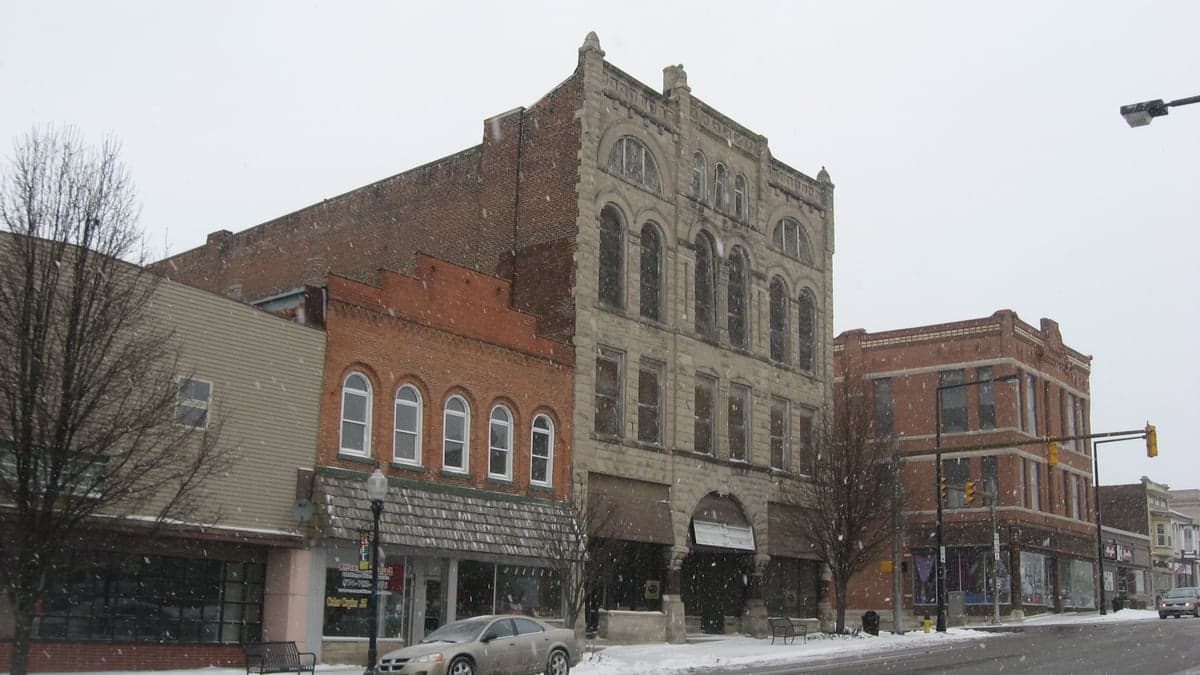
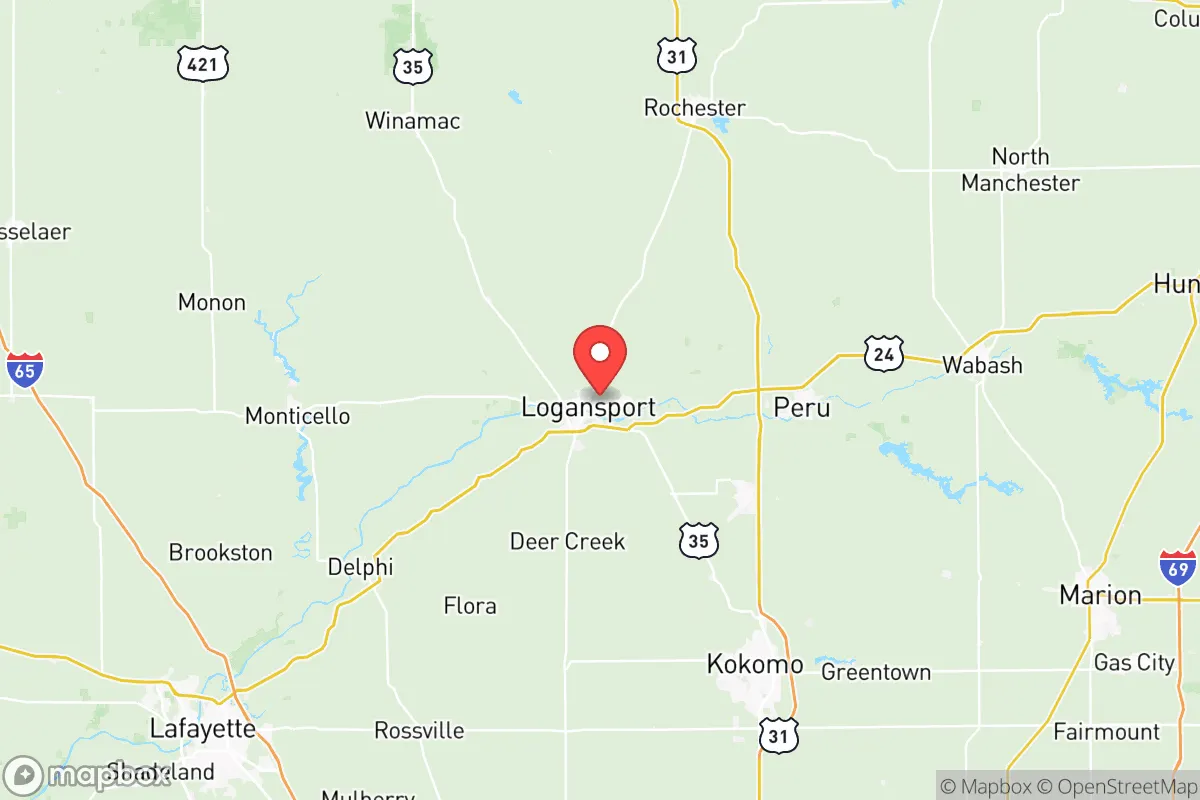
Photo: Wikipedia
Demographics of Cass County
Affluence Level in Cass County
A below-average socioeconomic profile. Incomes, home values, and educational attainment trail the U.S., with higher poverty and unemployment.
People of Cass County
The people of Cass County, Indiana, today number 37,703 and are characterized by a predominantly white population (74.7%) with a significant and growing Hispanic minority (18.1%), a small but established Black community (1.3%), and a modest East/Southeast Asian presence (1.4%). The county’s identity is rooted in its agricultural and industrial heritage, with a population density of roughly 70 people per square mile, concentrated in the county seat of Logansport and the smaller towns of Walton, Galveston, and Royal Center. Distinctive markers include a strong sense of local tradition, a lower-than-average college attainment rate (15.6%), and a foreign-born population (6.1%) that is largely Hispanic, reflecting recent economic migration tied to manufacturing and agriculture.
Settlement & growth (pre-1960)
Before American settlement, the area now known as Cass County was inhabited by the Miami and Potawatomi nations, who controlled the land along the Wabash and Eel rivers. French fur traders and missionaries passed through as early as the 1600s, but no permanent European settlements were established until after the War of 1812. The 1826 Treaty of Mississinewas forced the Miami to cede much of their territory, opening the region to American pioneers.
The first major wave of settlers were Anglo-American farmers from Kentucky, Ohio, and the Mid-Atlantic states, arriving in the 1830s and 1840s. They founded the county seat of Logansport in 1828, named after a Shawnee leader, and quickly established it as a river port and trading hub. The completion of the Wabash and Erie Canal in the 1840s brought a second wave: Irish immigrants who dug the canal and later settled in Logansport’s working-class neighborhoods, particularly along the riverfront. German immigrants followed in the 1850s and 1860s, drawn by cheap farmland and the promise of religious freedom. They established farming communities in Galveston and Walton, where German Lutheran churches and place names remain visible today.
The railroad boom of the 1870s and 1880s brought a third wave: Eastern European immigrants, including Poles and Slovaks, who worked in the rail yards and foundries of Logansport. These groups concentrated in the city’s east side, near the railroad corridors, and established Catholic parishes that still serve the community. The early 20th century saw a small influx of Black families moving north during the Great Migration, settling primarily in Logansport’s south side and working in domestic service, factories, and the railroad. By 1950, Cass County’s population had reached roughly 38,000, a figure it would hold relatively steady for decades, as the decline of the canal and rail industries slowed new immigration.
Modern era (post-1965)
The 1965 Hart-Cellar Act did not immediately transform Cass County, but its long-term effects are visible in the county’s growing Hispanic population. Beginning in the 1980s and accelerating through the 2000s, Mexican and Central American immigrants arrived to work in the county’s manufacturing plants, meatpacking facilities, and agricultural fields. The largest concentration settled in Logansport, particularly in the city’s west and south sides, where Spanish-language businesses, churches, and community organizations have taken root. Smaller Hispanic communities have also formed in Royal Center and Walton, driven by employment at local food-processing plants and farms.
Domestic migration during this period has been modest. Cass County has not experienced the rapid suburbanization seen in Indiana’s larger metro areas, though some residents have moved outward from Logansport to unincorporated areas and smaller towns like Onward and Twelve Mile in search of lower taxes and more land. The county’s Black population has remained stable but small, concentrated in Logansport’s historic south-side neighborhoods. The East/Southeast Asian community (1.4%) is a recent addition, with a small number of Vietnamese and Filipino families settling in Logansport, often working in healthcare and manufacturing. The Indian-subcontinent population (0.1%) is negligible, consisting of a handful of professionals employed at local hospitals and businesses.
Racially, the county has become more diverse since 1990, when the population was roughly 95% white. The Hispanic share has grown from under 2% in 1990 to 18.1% today, driven by both immigration and higher birth rates. This shift has created some cultural friction, but also new economic vitality, particularly in Logansport’s retail and service sectors. The foreign-born share (6.1%) is higher than many neighboring rural counties, reflecting the pull of manufacturing jobs that do not require a college degree.
The future
Cass County is projected to become more diverse over the next 10-20 years, driven primarily by continued Hispanic population growth. The white population is expected to decline slowly due to aging and out-migration of younger residents, while the Hispanic share could reach 25-30% by 2040. The East/Southeast Asian and Black populations are likely to remain small but stable, with modest growth if healthcare and manufacturing sectors expand. New immigrant communities are concentrating in Logansport, where existing ethnic infrastructure and affordable housing provide a foothold, while the county’s smaller towns are likely to remain predominantly white and older.
Culturally, Cass County is becoming a place where a traditional, rural, white majority is gradually sharing space with a younger, more diverse Hispanic population. This is most visible in Logansport’s schools, where Spanish is now commonly heard, and in the annual Fiesta celebration that draws thousands. The county’s political identity, historically conservative, may shift slightly as Hispanic voters become a larger share of the electorate, though turnout among this group remains lower than the white population. The county’s low college attainment rate (15.6%) suggests that economic opportunities for newcomers will continue to center on manufacturing, agriculture, and logistics rather than knowledge-economy jobs.
For someone moving in now, Cass County offers a low-cost, family-oriented environment with a growing cultural diversity that is still anchored in its Midwestern roots. The population is becoming younger and more Hispanic in Logansport, while the outlying towns remain stable and traditional. The key dynamic to watch is whether the county can retain its younger residents and attract new families, or whether population decline in the white majority will offset Hispanic growth, leading to a slowly shrinking but more diverse county overall.

* Values derived from national, state, county, city and local statistics and may differ in a specific area. Last updated: 2026-11-15T20:36:11.000Z
Narrative content on this page is AI-generated and may contain mistakes. Verify any details that matter before acting on them.
ReloMaps may earn a commission from affiliate links at no extra cost to you.

