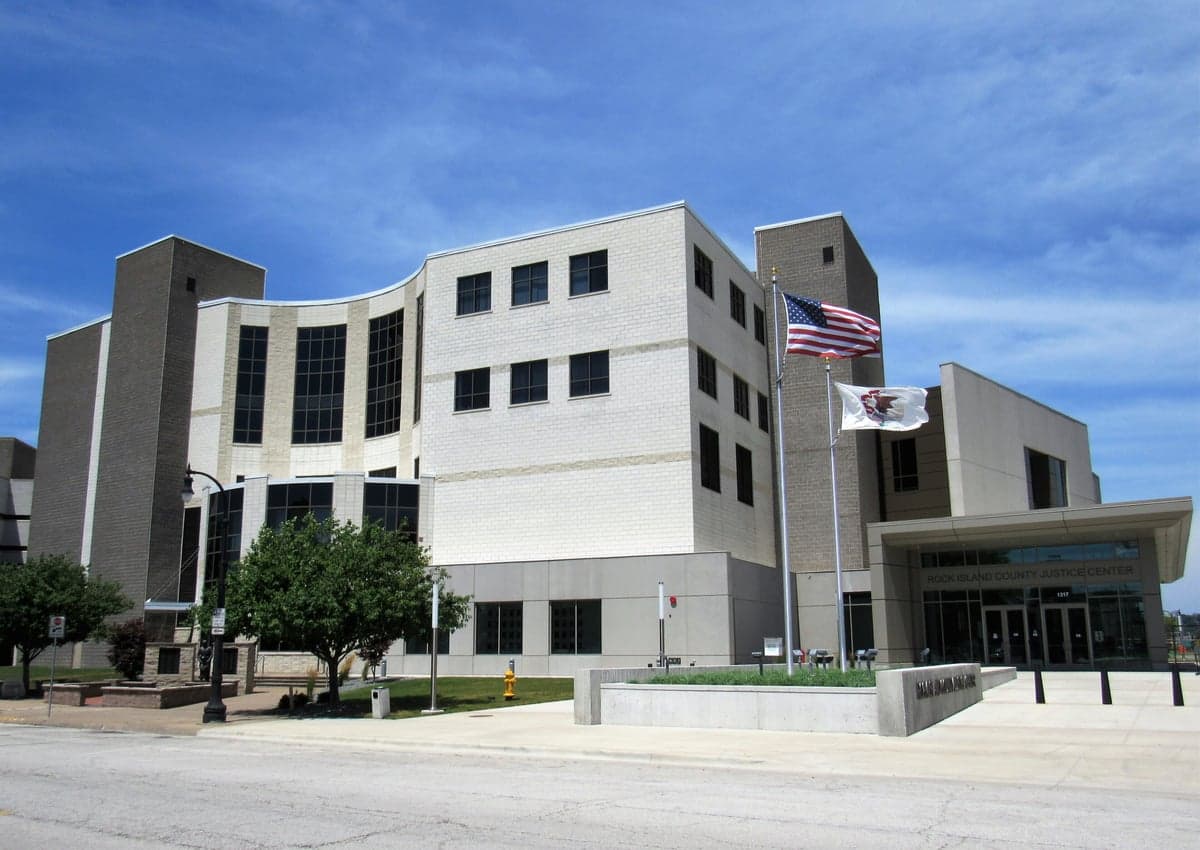
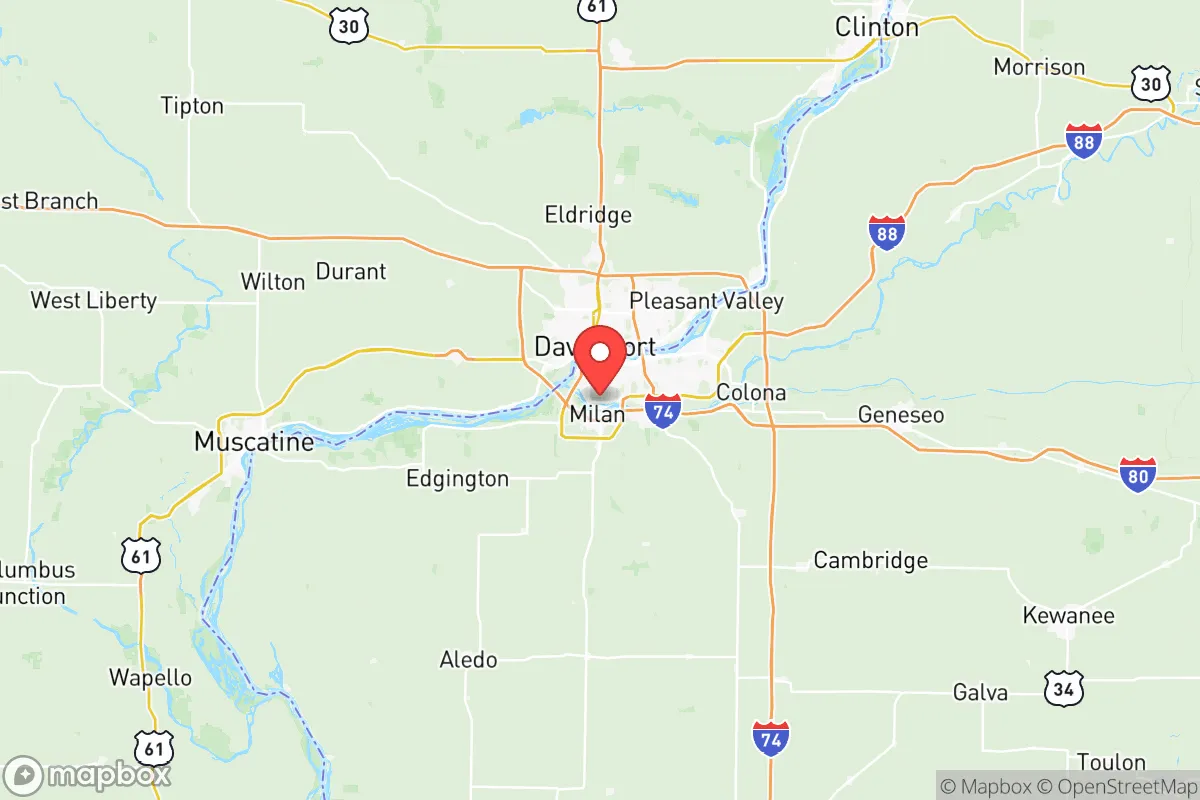
Photo: Wikipedia
Political ClimatePolitical Climate in Rock Island County
Showing district-level results — no local-only data available.
Local Political AnalysisPolitical Analysis of Rock Island County
Rock Island County has been a reliable Democratic stronghold for decades, but its edge has been steadily eroding. The county’s Cook PVI of D+3 is notably softer than Illinois’ statewide D+7 rating, meaning it’s less blue than the state as a whole. In presidential elections, the margin has shrunk from double-digit Democratic wins in the 1990s and 2000s to single-digit ones in 2016 and 2020, and the county flipped to Donald Trump in 2016 before narrowly returning to Joe Biden in 2020. The trend line points toward a competitive toss-up within the next two cycles, especially as downstate Illinois continues to drift rightward.
How it compares
Rock Island County’s D+3 PVI puts it in a different political universe than the Chicago-centric D+7 of Illinois. The county is part of the Quad Cities metro area, which straddles the Iowa border, and its politics reflect a mix of union-heavy industrial towns and rural conservative precincts. Moline and East Moline lean blue, driven by manufacturing workers and a sizable Latino population in East Moline’s 61244 ZIP code. Rock Island city itself is the bluest part of the county, with precincts near Augustana College and the downtown core routinely delivering 65-70% Democratic margins. But drive 15 minutes south to Hampton or Port Byron, and you’ll find precincts that vote 60-65% Republican. The swing precincts are in the suburban townships around Milan and Coal Valley, where ticket-splitting is common and local races often decide the countywide balance. In 2024, the county’s Democratic sheriff and state’s attorney both won by comfortable margins even as the presidential race was a nail-biter, showing that local incumbency still matters more than national branding here.
What this means for residents
For liberal residents, the county remains a comfortable place to live politically. The Democratic majority on the county board and the city councils of Rock Island, Moline, and East Moline means progressive priorities like public transit funding, affordable housing initiatives, and environmental remediation of the Rock River waterfront get consistent support. Conservative residents aren’t shut out, though. The county’s Republican minority is concentrated in the rural townships and has real influence on land-use decisions, agricultural policy, and school board elections in districts like Riverdale and Sherrard. The practical effect of the D+3 lean is that neither side can govern by fiat. County board votes on the budget and zoning often require bipartisan coalitions, and the county’s status as a “blue island in a red sea” of surrounding rural counties means local Democrats are more moderate than their Cook County counterparts. You won’t see defund-the-police movements here; the county’s Democratic sheriff runs on a tough-on-crime platform and wins rural precincts that vote Republican for president.
Culturally, Rock Island County is distinct from the rest of Illinois in a few key ways. The Quad Cities’ location on the Mississippi River gives it a Midwestern identity that feels more Iowa than Chicago. The county has a strong tradition of labor union activism, especially at the John Deere plants in Moline and East Moline, which keeps economic populism alive in both parties. There’s also a noticeable libertarian streak in the rural areas, where residents resent state mandates from Springfield on everything from gun laws to school funding. The county’s Democratic Party is more socially conservative than the national party, particularly on gun rights and agricultural regulation. For newcomers, the political climate is best described as pragmatic. People here vote for the person, not the party, and the county’s slow drift rightward is more about population loss in the blue cities than a wholesale conversion of Democratic voters. If you’re moving from Chicago or the coasts, you’ll find the political conversations less heated and more focused on local issues like bridge repairs and riverfront development than national culture wars.

State Political ClimatePolitical Climate in Illinois
State Political AnalysisPolitical Environment in the State
Illinois is a solidly Democratic state with a Cook PVI of D+7, meaning it votes about seven points more Democratic than the national average in presidential elections. That blue lean is driven overwhelmingly by Chicago and its inner suburbs, while the rest of the state — from the collar counties to the Mississippi River — has shifted hard to the right over the past two decades. The result is a state that feels like two different countries politically, and the gap is widening every cycle.
Urban vs. rural divide
The political map of Illinois is a study in extremes. Cook County, home to Chicago, casts roughly 40% of the state's votes and delivers margins of 70-80% for Democrats. That alone is enough to carry statewide races. The collar counties — DuPage, Lake, Kane, Will, and McHenry — were once reliably Republican but have trended blue in presidential years, especially in the inner suburbs like Naperville and Arlington Heights. Meanwhile, downstate Illinois is now deeply red. Counties like Effingham, Williamson, and Jefferson routinely vote 70-80% Republican. The divide is so stark that some downstate counties have passed symbolic resolutions to explore secession from Illinois, though none have gone anywhere. The political reality is that a conservative moving to Illinois will feel at home in places like Quincy, Edwardsville, or the farm country around Decatur, while a liberal will find their people in Chicago, Evanston, or Oak Park.
Policy environment
Illinois has a progressive tax structure that is actually regressive in practice — the state uses a flat income tax of 4.95%, but property taxes are among the highest in the nation, averaging over 2% of home value statewide. Cook County and the collar counties are especially punishing, with rates often exceeding 2.5%. Sales tax can hit 10.25% in Chicago. The regulatory posture is heavily pro-labor and pro-union, with a $15 minimum wage and strong collective bargaining protections. Education policy is dominated by the Chicago Teachers Union, and the state has a school funding formula that sends disproportionate state aid to Chicago Public Schools. Healthcare is broadly liberal: Illinois expanded Medicaid under the ACA and has strong abortion protections codified into law. Election laws are among the most accessible in the country, with automatic voter registration, no-excuse mail voting, and same-day registration. For a conservative, the tax burden and union-friendly labor laws are the biggest practical headaches.
Recent policy direction
Illinois has moved decisively left on most fronts in the last five years. In 2023, the state banned assault weapons and high-capacity magazines, a law that is currently being challenged in federal court but remains in effect. Gun owners must also have a Firearm Owners Identification (FOID) card, a uniquely Illinois requirement. On education, the state eliminated cash bail in 2023 through the SAFE-T Act, which also mandated body cameras for all police by 2025. Parental rights in education have been a flashpoint: Illinois requires schools to teach LGBTQ-inclusive history and does not require parental notification if a student changes their name or pronouns. On medical freedom, Illinois has some of the strongest abortion protections in the Midwest, with no waiting periods and no parental consent requirement for minors. Property rights are constrained by high property taxes and strong tenant protections, including a statewide rent control ban preemption that was repealed in 2023, allowing Chicago to impose rent control. Voting access is extremely easy, with mail ballots sent automatically to anyone who has voted in recent elections. For a conservative relocator, the gun ban and education policies are the most likely dealbreakers.
Civil unrest & political movements
Illinois has seen its share of political turbulence. The 2020 George Floyd protests in Chicago were large and occasionally violent, with looting on Michigan Avenue and clashes with police. The city has a long history of organized activism on both sides: the left is anchored by groups like the Chicago Teachers Union and Black Lives Matter Chicago, while the right has a presence in downstate counties with active Republican organizations and Second Amendment advocacy groups like the Illinois State Rifle Association. Immigration politics are a major fault line. Chicago is a sanctuary city, and Cook County generally refuses to cooperate with ICE detainers. Downstate counties like Effingham and Edgar have passed resolutions declaring themselves "sanctuary counties for the unborn" or opposing state gun laws. Election integrity controversies have been relatively muted compared to swing states, though some downstate Republicans have raised concerns about mail voting and the state's automatic voter registration system. A new resident will notice the political tension most in the state legislature, where Chicago and downstate representatives often clash openly.
Projection
Over the next 5-10 years, Illinois is likely to become even more polarized. Chicago's population is slowly declining, but the city's political power is not — the state's legislative map is drawn to protect Democratic majorities, and the collar counties are trending bluer. Downstate will continue to lose population and political influence, which will likely fuel more secession talk and deeper cultural resentment. In-migration patterns are not helping the state: Illinois loses residents to Florida, Texas, and Indiana every year, and those leaving tend to be more conservative and middle-class. The people moving in are disproportionately younger, more diverse, and more liberal, concentrated in Chicago and its suburbs. A conservative moving to Illinois today should expect the state to be more Democratic and more progressive in a decade, with higher taxes, tighter gun laws, and stronger union influence. A liberal moving in will find a state that largely aligns with their values, though the fiscal challenges — massive pension debt and chronic budget deficits — will remain a long-term drag.
For a new resident, the bottom line is this: Illinois is a state where your political experience depends almost entirely on where you live. If you're conservative and choose a downstate town like Edwardsville or Quincy, you'll find a community that shares your values, but you'll be fighting the state government on taxes, guns, and education policy every step of the way. If you're liberal and settle in Chicago or Evanston, you'll be in a political bubble that matches your views, but you'll pay some of the highest taxes in the country for the privilege. The state's trajectory is clear — it's getting bluer and more expensive — so choose your location carefully and go in with eyes open.
* Values derived from national, state, county, city and local statistics and may differ in a specific area. Last updated: 2026-08-08T13:18:46.000Z
Narrative content on this page is AI-generated and may contain mistakes. Verify any details that matter before acting on them.
ReloMaps may earn a commission from affiliate links at no extra cost to you.

